
Stocks Race to End of Historic Quarter

The AI trade is driving stocks toward the end of a historic quarter.
The S&P 500 has risen 15 percent since the end of March and is on pace for its biggest quarterly gain since the pandemic. Technology stocks are up 44 percent, their best showing since at least 1999, according to TradeStation data.
The trend stayed alive last week after Morgan Stanley boosted its price target on Western Digital (WDC) by 33 percent, citing increased demand for hard drives and data storage. Micron Technology (MU) and Seagate Technology (STX) -- other key players in the data-center boom -- also kept rising. Intel (INTC) rose after President Trump said the chipmaker will partner with Apple (AAPL) on domestic semiconductor production.
Stocks also shrugged off a hawkish message from the Federal Reserve to "deliver price stability." Policymakers now expect to hike interest rates at least once this year instead of cutting. They also significantly raised inflation forecasts. While that might sound negative, longer-term borrowing costs fell: The "yield curve" (difference between two- and 10-year Treasury yields) narrowed to the lowest level since March 2025. That may suggest the Fed is regaining credibility under its new chairman, Kevin Warsh.
Oil prices helped the disinflationary trend last week by dropping to a three-month low. The International Energy Agency sees more downside, with production swelling by 8 million barrels per day as demand shrinks by 1 million barrels. Could that push the petroleum market from a dramatic deficit to a global glut? Energy stocks responded with their biggest weekly decline since the tariff-induced selloff in March-April 2025. The selloff occurred despite oil inventories dropping more than expected to multiyear lows.
Biggest Gainers in S&P 500 Since March | |
|---|---|
| SanDisk (SNDK) | +244% |
| Micron Technology (MU) | +236% |
| Marvell Technology (MRVL) | +214% |
| Intel (INTC) | +204% |
| Western Digital (WDC) | +176% |
| Source: TradeStation data | |
Biotech Breakout
Biotechnology stocks broke out to new highs, mostly powered by Moderna (MRNA). The vaccine maker had its best week since 2022 after a U.S. FDA panel backed its inoculation for seasonal flu. Natural-gas turbine maker GE Vernova (GEV) also rebounded from a steep pullback, reminding investors that the AI boom is also driving major investments in power infrastructure.
Robinhood Markets (HOOD) jumped after announcing job cuts and growth in AI-powered trading.
Airlines rallied and are back near levels from the start of the coronavirus pandemic. Industrials broke out to a new high last week. That sector includes power-tech stocks like GEV, data-center plays like Vertiv (VRT) and airlines.
Zooming out to bigger quarterly returns, chips dominated the gains within technology. Cybersecurity companies gained, while most other software companies struggled. The Russell 2000 small-cap index also had its best quarterly performance since the coronavirus vaccine was announced in the last three months of 2020.
Energy and precious metals fared the worst this quarter.
Options began trading in Space Exploration Technologies (SPCX). It averaged 1.7 million contracts in its first three sessions, which would rank third in the Nasdaq-100 and S&P 500.
Biggest Decliners in the S&P 500 Since March | |
|---|---|
| Charter Communications (CHTR) | -42% |
| Intuit (INTU) | -38% |
| Accenture (ACN) | -35% |
| Zoetis (ZTS) | -33% |
| Tractor Supply (TSCO) | -33% |
| Source: TradeStation data | |
Strong Consumer
Last week featured strong consumer-related data. Retail sales for May rose more than expected. While higher gasoline prices contributed to the jump, the "control group" that excludes energy increased almost twice the forecast amount. Growth excluding autos also rose much more than expected. Higher spending was reported in categories like e-commerce, miscellaneous retailers and furniture stores. Food outlays were flat -- consistent with recent price moderation in staples. That suggests consumers are spending more freely on discretionary items, which opposes the narrative of Americans being squeezed by inflation.
On a year-over-year basis, retail sales grew the most since December 2022. (Annual headline inflation was then running at 7.1 percent, versus 4.2 percent now.)
Pending home sales were also quadruple the estimated amount, beating forecasts for the fourth straight month. That may reflect growing momentum in the housing market, even if construction is lagging.
Most of the other economic headlines last week were relatively unimportant.
Charting the Market
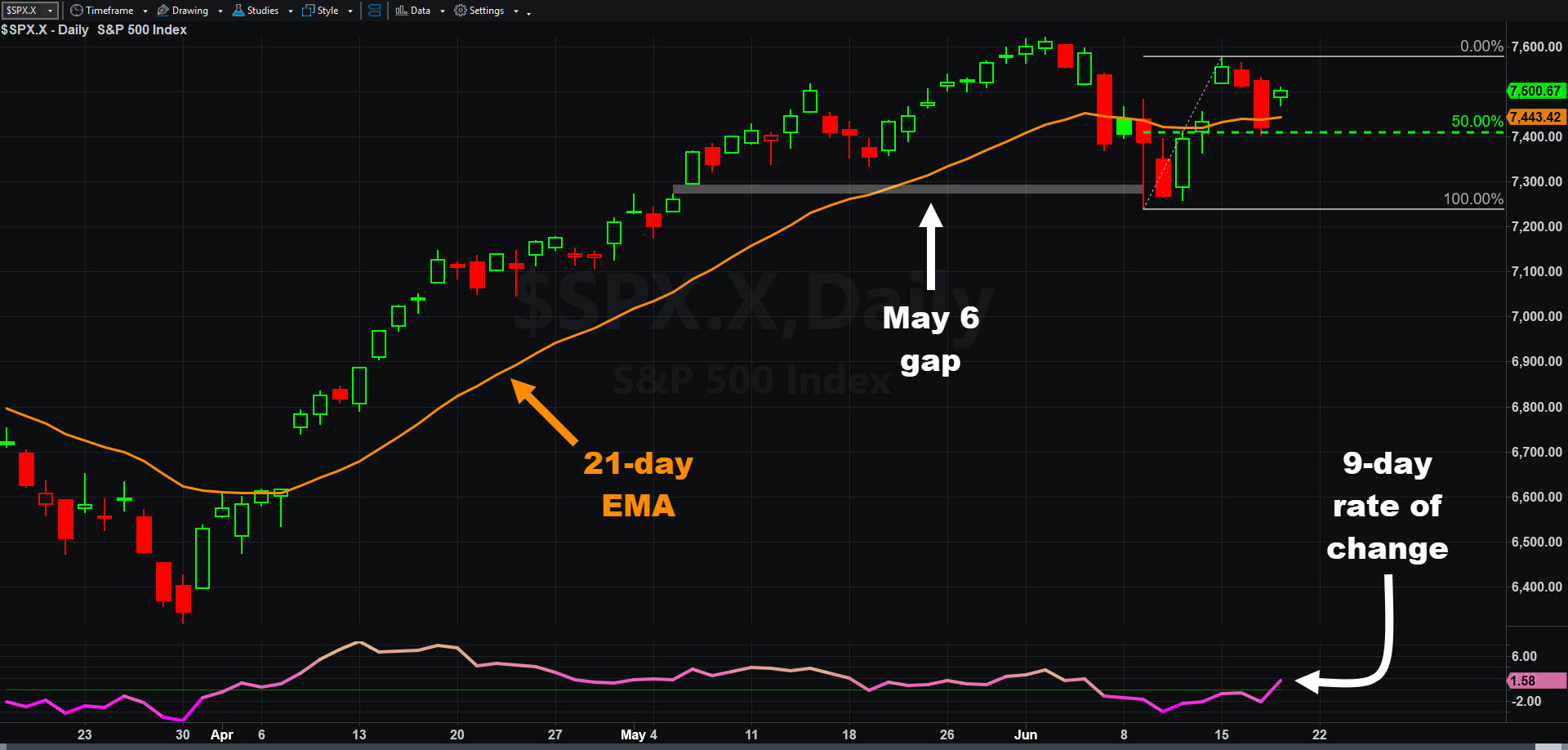
The S&P 500 rose 0.9 percent in the holiday-shortened week between Friday, June 12, and Thursday, June 18. The index's bounce may have shown further signs of stabilization after finding support at May 6's bullish price gap the previous week.
The index started by jumping, followed by a pullback. It then held the 7,400 level and a 50 percent retracement of its move from the low of the month. That may reflect buying interest at higher levels.
Prices also held the 21-day exponential moving average and the 9-day rate of range turned positive again. Those signals may be consistent with short-term bullishness returning.
Given the strong quarterly momentum cited above, could traders also look for strength through the end of June?
The Week Ahead
This week is relatively quiet, with only a few noteworthy events scheduled.
Carnival (CCL) announces quarterly results tomorrow morning. AI-chip maker Cerebras Systems (CBRS) issues its first set of numbers as a public company in the afternoon. FedEx (FDX) reports, as well.
Wednesday brings crude-oil inventories in the morning. Qualcomm (QCOM), which has been pivoting to AI, holds its investor day. The postmarket features MU earnings and the Fed's stress test results, which could impact banking stocks.
The main economic event is on Thursday morning: The personal consumption expenditures (PCE) inflation report. Personal spending and income and jobless claims are also due.
Revised consumer sentiment is on Friday morning.