
SpaceX Launches Options After Dominating Stock Flow

Space Exploration Technologies has become one of the most active stocks in just two days, and now the options are launching.
Elon Musk's spaceflight company traded 522 million shares on Friday, June 12. It had the highest volume for any non-penny stock in the session and surpassed the five busiest members of the S&P 500 combined. It led again on Monday, with turnover exceeding 245 million shares.
SPCX also achieved the top ranking at TradeStation, pushing ahead of heavyweights on our platform like Tesla (TSLA) and Nvidia (NVDA).
The next big event is today, when options begin trading. Given the broad activity already in the stock, could it soon become one of the most active underliers in the options market? Here are the top symbols now, according to TradeStation data:
| Symbol | Average Options Volume | Implied Volatility |
|---|---|---|
| SPDR S&P 500 ETF (SPY) | 15.9 million | 16% |
| Invesco QQQ Trust (QQQ) | 10.1 million | 26% |
| Nvidia (NVDA) | 3.2 million | 38% |
| Tesla (TSLA) | 3.1 million | 49% |
| iShares Russell 2000 (IWM) | 2.7 million | 25% |
| Source: TradeStation data |
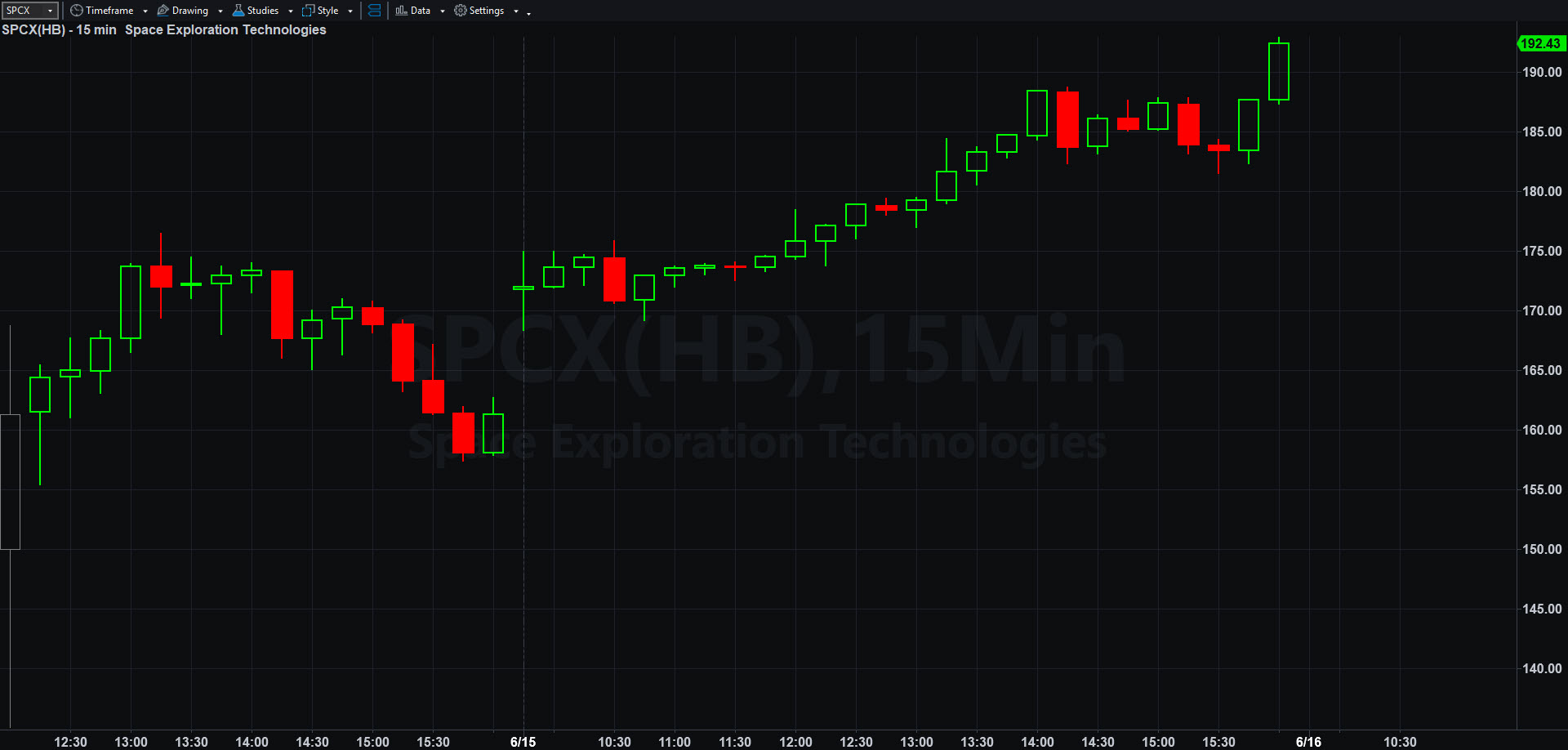
SPCX went public last week for $135 and moved up to close at $160.95. It jumped another 20 percent to end Monday's session at $192.50. The rally boosted its market capitalization from the initial value of $1.78 trillion to $2.1 trillion. That would rank sixth in the S&P 500, surpassing Tesla (TSLA) -- Elon Musk's other major company. (SPCX isn't eligible to join the S&P 500 for at least a year.)
Calls and Puts
Options are derivatives tied to the underlying price of securities like SPCX shares. Call options fix the level where stock can be purchased, while puts fix the selling price. Calls typically gain value to the upside and puts can appreciate when shares fall. However, SPCX options may be more complicated because they're likely to have high implied volatility, which means they price in substantial price moves.
If that's the case, call buyers could lose money even if the stock rises. Put buyers could also lose money even if SPCX falls. (Learn more about time decay here.)
Traders may consider adjusting to high implied volatility with strategies like:
- Vertical spreads: Buying a call or put near the money and selling another further from the money. Calls can make money to the upside and puts can profit to the downside. This trade looks for a directional move.
- Credit spreads: Selling a call or put near the money and buying another further from the money. It generates a credit, which becomes profit if the stock stays below or above certain levels.
- Covered calls: Buying shares and selling calls at the same time. It generates a credit, which lowers the cost basis and limits upside.
Key Dates for SpaceX Traders
SPCX may be especially volatile because of its newness as a public company and because only about 5 percent of its total shares are available for trading. That makes it harder for dealers to hedge positions, which could also result in wider bid/ask spreads. Some buyers could also be looking for the stock to join the Nasdaq-100 shortly after the long Independence Day weekend.
There are some other potentially important dates:
- June 27: Fidelity lets IPO buyers (pre-trading) exit positions in brokerage accounts.
- July 6: SPCX could be added to the Nasdaq-100 index (tracked by QQQ). While not confirmed, this change is potentially consistent with indexing rules.
- July 12: Other brokerages allow IPO buyers to sell shares.
In conclusion, SPCX is already setting records. It's become the busiest major stock after going public in the largest-ever IPO. Today could add to the heavy activity with the launch of options trading.
Hypothetical examples are for educational purposes only.
Options trading is not suitable for all investors. Your TradeStation Securities' account application to trade options will be considered and approved or disapproved based on all relevant factors, including your trading experience. See www.TradeStation.com/DisclosureOptions. Visit www.TradeStation.com/Pricing for full details on the costs and fees associated with options.
Margin trading involves risks, and it is important that you fully understand those risks before trading on margin. The Margin Disclosure Statement outlines many of those risks, including that you can lose more funds than you deposit in your margin account; your brokerage firm can force the sale of securities in your account; your brokerage firm can sell your securities without contacting you; and you are not entitled to an extension of time on a margin call. Review the Margin Disclosure Statement at www.TradeStation.com/DisclosureMargin.
Exchange Traded Funds (“ETFs”) are subject to management fees and other expenses. Before making investment decisions, investors should carefully read information found in the prospectus or summary prospectus, if available, including investment objectives, risks, charges, and expenses. Click here to find the prospectus.