Nasdaq Stabilizes as Earnings Validate AI
Stocks might be stabilizing as megacap earnings validate the AI story.
The S&P 500 rose 1 percent between Friday, July 24, and Friday, July 31, while the Nasdaq-100 climbed 0.5 percent. Both indexes broke two-week losing streaks and rebounded following key reversals on Wednesday. Could the recent uptrend resume? (See "Charting the Market" below for more.)
Earnings from Microsoft (MSFT) and Amazon.com (AMZN) were key events. MSFT's profit and sales beat estimates as Azure grew more than expected. The number of Copilot users also rose 50 percent sequentially, confirming its potential as an in-house revenue driver. It may also lay the groundwork for future agentic revenue, with customers paying per-task fees for work completed by AI.
The Redmond, Washington-based company jumped 16 percent on Thursday, adding a record $450 billion of market cap (according to Seeking Alpha). It was the stock's biggest one-day gain since 2008, driving its best week since 1999.
AMZN also beat on the top and bottom lines. Gross margins and operating margins were the highest in at least two years as datacenter investments paid off. The profit growth followed the spread of custom chips like Trainium and system upgrades like Project Rainier. The company's e-commerce business also benefited from 26 percent growth in high-margin advertising revenue. AMZN had its biggest one-day gain since 2012 and its best week in 11 years (up 17 percent).
Biggest Gainers in the S&P 500 Last Week | |
|---|---|
| Cognizant Technology Solutions (CTSH) | +22% |
| Microsoft (MSFT) | +22% |
| Garmin (GRMN) | +21% |
| Workday (WDAY) | +18% |
| Charter Communications (CHTR) | +18% |
| Source: TradeStation data | |
MSFT held future capex plans stable and AMZN raised its budget from $200 billion to $220 billion. Something else happened: Alphabet (GOOGL), which previously cratered on negative free cash flow, recovered its losses and had its second-biggest weekly gain in the last two years. That may suggest fears about heavy capex are easing.
Hardware and Software
Last week also saw bounces and strong earnings in hardware and software companies. The hardware companies seemed to confirm that AI demand remains intact. The software news suggested that older companies left out of the AI boom could now be stabilizing. Both trends could be positive for technology and the Nasdaq in general.
Hardware news:
Monolithic Power (MPWR): The maker of power-control chips reported strong earnings, revenue and guidance as enterprise data, GPUs, XPUs and CPUs ramp.
- Arm (ARM): The CPU maker's earnings, revenue and guidance beat estimates. Management cited demand from traditional Neoverse cloud computing and was optimistic about its coming AGI agentic product.
- Teradyne (TER): The maker of equipment for making chips and robots announced strong earnings, revenue and guidance. AI and datacenter demand were drivers.
- Bloom Energy (BE): The provider of fuel cells for datacenters beat earnings and revenue guidance.
- Celestica (CLS): The electronics-manufacturing contractor beat estimates and issued strong guidance amid orders from customers like GOOGL and OpenAI.

Software also climbed last week. While MSFT was the biggest name, some smaller companies that fell sharply in late 2025and early 2026 bounced. Cognizant Technology Solutions (CTSH), which raised guidance, led the move. Others on the list included Workday (WDAY), PTC (PTC), Oracle (ORCL), Accenture (ACN) and ServiceNow (NOW).
Second-quarter earnings are on pace to increase by 47.4 percent, according to FactSet. That would be the fastest pace since the rebound from coronavirus in the second quarter of 2021. Analysts are also hiking their estimates for the current quarter, according to the research firm.
Biggest Decliners in the S&P 500 Last Week | |
|---|---|
| Lennox (LII) | -23% |
| C.H. Robinson Worldwide (CHRW) | -21% |
| Vertiv (VRT) | -17% |
| SanDisk (SNDK) | -15% |
| NXP Semiconductors (NXPI) | -15% |
| Source: TradeStation data | |
Rates and the Fed
Last week's other big story was the Federal Reserve leaving interest rates unchanged. Bond yields spiked on the news as some investors doubted Chairman Kevin Warsh's commitment to fighting inflation.
Speaking of inflation, the personal consumption expenditures (PCE) price index for June matched estimates. Personal income and spending missed slightly, but jobless claims were lower than expected for the sixth straight week.
Overall, economic data hasn't played a big role on market direction recently. The Hormuz crisis and oil are the main concerns because of their impact on inflation.
Consumer discretionaries were the top sector last week thanks to AMZN's surge. Software makers, Chinese technology stocks, retailers and airlines were also strong. Utilities, chipmakers, housing and metals fared the worst.
Charting the Market
While the market barely moved last week, there were potential signals of improving price action.
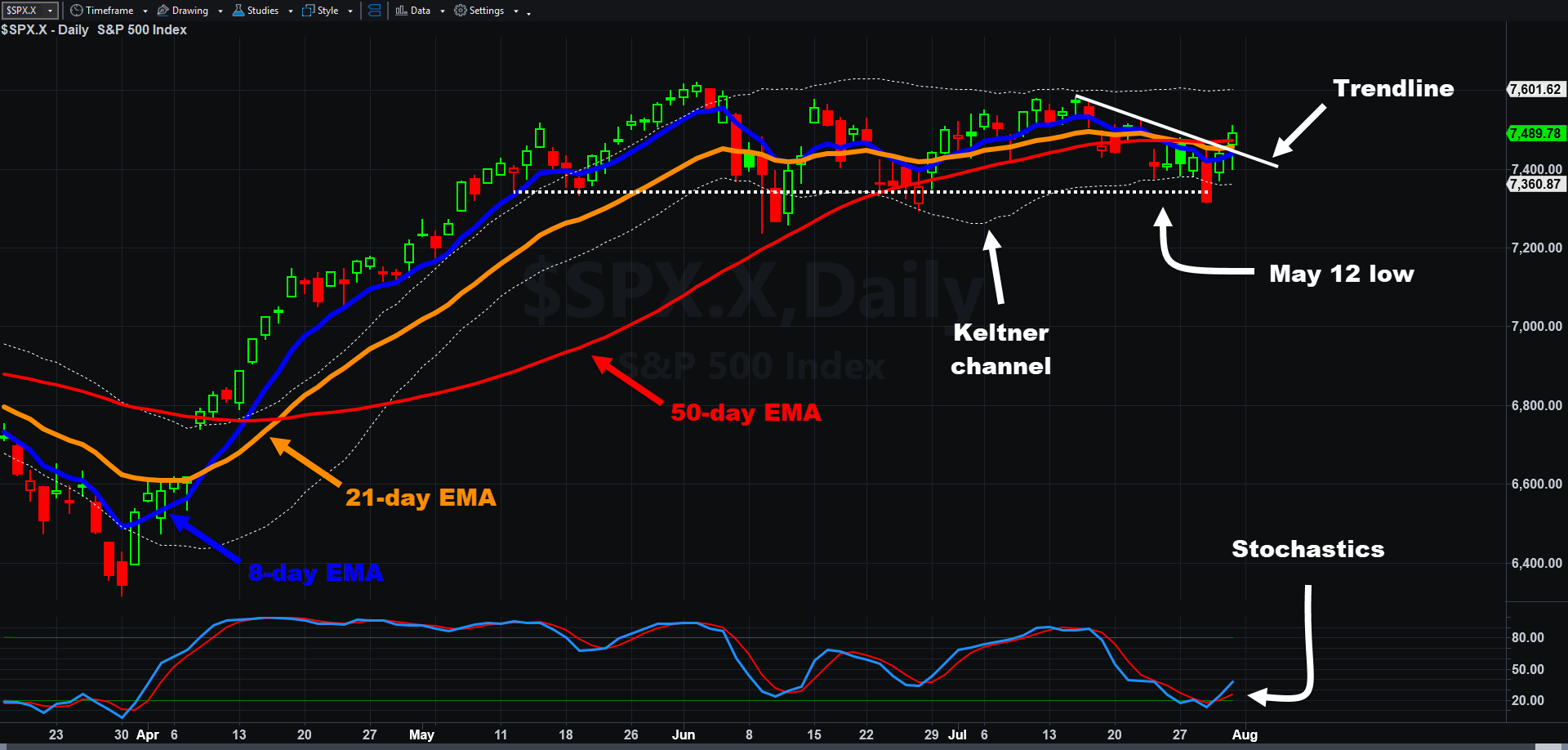
First, the S&P 500 rebounded after testing a support level at the May 12 low of 7,340. (The Nasdaq-100 similarly snapped back from below its May 1 low.) Those "false breakdowns" are potentially bullish reversal patterns.
Another result for the S&P 500 was a higher weekly low versus late June.
Second, prices moved back above their 8-day and 21-day exponential moving averages, and their 50-day moving average.
Third, stochastics rebounded from an oversold condition. The index also held the bottom of its Keltner channel.
Next, Friday's close broke a falling trendline since mid-July.
Finally, the number of Nasdaq-100 companies above their 20-day moving averages rose from 33 to 55. That increase of 22 stocks was the biggest positive change since mid-April when stocks were recovering from the Iran war pullback, according to TradeStation data.
Longer-term borrowing costs, like the yields on the 10- and 30-year Treasuries, may present a risk to equities.
The Week Ahead
This week brings even more earnings, although mostly from less prominent companies. There's also big monthly economic news, such as non-farm payrolls.
The Institute for Supply Management's manufacturing index is due tomorrow morning. Palantir Technologies (PLTR) reports in the postmarket.
Tuesday brings job openings, plus results from Advanced Micro Devices (AMD), Amgen (AMGN) and Arista Networks (ANET). Space Exploration Technologies (SPCX) reports earnings for the first time as a public company.
ADP's private-sector payrolls report is on Wednesday morning, along with ISM's service-sector index and crude-oil inventories. Eli Lilly (LLY), Walt Disney (DIS), Shopify (SHOP) and Uber Technologies (UBER) issue results in the morning. SanDisk (SNDK), Western Digital (WDC) and AppLovin (APP) are due in the postmarket. Fed governor Lisa Cook also delivers a speech.
Thursday features initial jobless claims and earnings from ConocoPhillips (COP) and Airbnb (ABNB).
The monthly non-farm payrolls report is due Friday morning.
.jpg&w=3840&q=75)