Traders Dump Chips with Rate Hike Expected

Traders are dumping semiconductors as they rotate to software and brace for a potential interest-rate hike.
The S&P 500 rose 0.5 percent between Friday, August 21, and Friday, August 28. The Philadelphia Semiconductor Index declined 2.3 percent despite Nvidia (NVDA) and Marvell Technology (MRVL) reporting better-than-expected quarterly results. Other groups associated with data centers, like fiber optics and power technology, also fell.
"The Fed's predominant focus right now should be on prices," Federal Reserve Chairman Kevin Warsh said in his first annual Jackson Hole, Wyoming, speech. "We have work to do."
The central banker also said moderate inflation readings in recent months don't confirm that "underlying trends have meaningfully improved." He also bantered about "hikes" in the nearby wilderness.
The market gradually reacted over the course of the address, which Warsh described as a "trail map." Before the speech, CME's FedWatch tool showed only a 35 percent chance of policymakers raising interest rates at their next meeting on September 16. After the speech, those odds had risen to 59 percent. The U.S. dollar and Treasury yields also jumped, while gold and silver reversed sharply lower.
Biggest Decliners in the S&P 500 Last Week | |
|---|---|
| PayPal (PYPL) | -13% |
| Generac (GNRC) | -11% |
| Hormel (HRL) | -9.7% |
| Casey's General Stores (CASY) | -9.6% |
| Marvell Technology (MRVL) | -8.6% |
| Source: TradeStation data | |
Inflation and Rates
Other headlines may further bolster odds of higher inflation and/or interest rates:
- Futures on corn (@C), soybeans (@S) and wheat (@W) ended the week at their highest levels in more than a year, partially because of fighting between Ukraine and Russia.
- Diesel prices are also near record highs as inventories hit a record low for the season. (Stockpiles normally rise 5-10 percent between mid-May and mid-August. This year they are up just 0.5 percent, according to Claude's analysis of Energy Department data.) What happens in October, when distillate fuel demand increases with the fall harvest, winter heating and holiday freight?
- Jobless claims were lower than expected.
- PCE inflation (headline) was higher than expected.
- Personal income and spending were higher than expected.
- July durable goods were higher than expected.

Software Surges
While chipmakers struggled, software companies had another strong week. Salesforce (CRM) led the charge with its biggest gain in six years after earnings and revenue beat estimates. Agentforce's annual recurring revenue (ARR) more than tripled year-over-year. Marc Benioff's cloud-computing company also announced a partnership with AI giant Anthropic called Claudeforce.
CrowdStrike (CRWD) hit a new record high after AI-powered threats increased demand for cybersecurity. CRWD is also benefiting from a billing model called Falcon Flex to increase customer usage of its products. Smaller security provider Okta (OKTA) jumped on strong results. ServiceNow (NOW) followed the rallies in CRM and CRWD.
Software is in the midst of its biggest two-month outperformance relative to chips since at least 2001. That's a sharp change from early 2026, when chips led by the most over the same interval.
Communications had the biggest gain of any sector last week. Meta Platforms (META) led the gains after reaching an $18 billion settlement over children's use of social media. Technology and financials also climbed.
Health care gave back some of its recent gains and was the weakest sector overall. PayPal (PYPL) had the biggest decline in the S&P 500 after Bloomberg reported the collapse of a potential takeover.
Biggest Gainers in the S&P 500 Last Week | |
|---|---|
| Salesforce (CRM) | +22% |
| CrowdStrike (CRWD) | +14% |
| ServiceNow (NOW) | +13% |
| Veeva Systems (VEEV) | +12% |
| Synopsys (SNPS) | +11% |
| Source: TradeStation data | |
Cyclicals Slide
Metals fell as the dollar rose and energy gave back some of its recent gains.
Non-technology companies that have benefited from capital spending also fell, especially industrials like Generac (GNRC), Comfort Systems USA (FIX), United Rentals (URI) and GE Vernova (GEV). Combined with the weakness in chips and IT hardware, this may reflect uncertainty about the data-center construction boom.
The small cap-focused Russell 2000 dropped and became the first of the four major indexes to cross below its 50-day moving average.
Digging inside the technology sector may show other signs of cyclical weakness. TradeStation data shows that most stocks under the 100-day moving averages sell or produce IT hardware. The list includes fiber optics, analog chips and semiconductor-manufacturing equipment. Interestingly, many of these stocks remained above their 100-day MAs in March when the Iran war rattled markets.
In contrast, most companies above their 100-day moving averages are software companies like CRM, NOW and CRWD. These "secular" growth stocks tend to be less sensitive to the economy.
The reversal compared with March reflects a shift away from cyclical hardware stocks. That may be important if the Fed hikes rates, which often weighs on economically sensitive companies.
Charting the Market
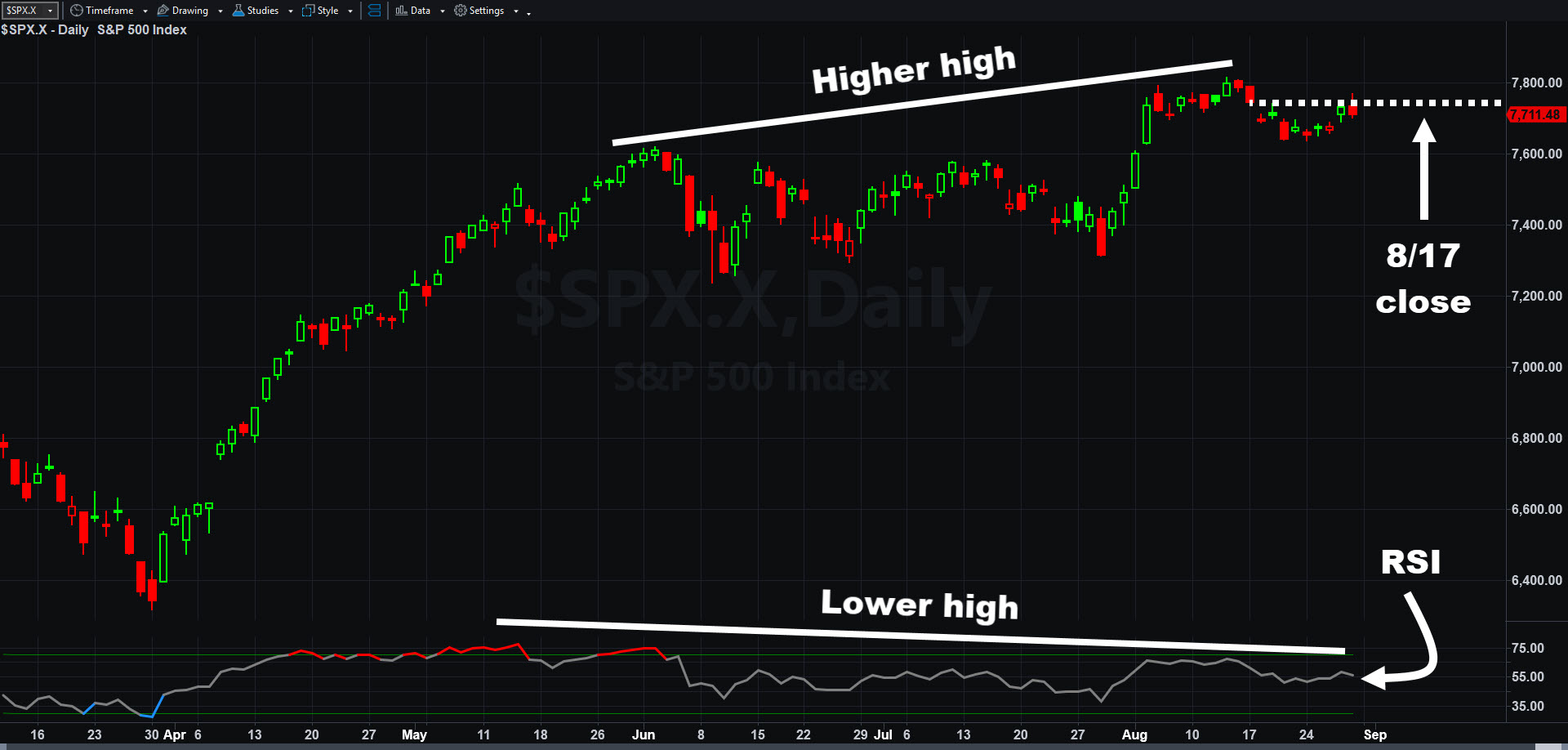
The S&P 500 may be showing signs of fatigue as the market enters September, which has been the weakest month this decade. (It's seen an average drop of 2.9 percent since 2020, with declines in four of the six years.)
Wilder's Relative Strength Index (RSI) made a lower high in August compared with May -- despite the broader market making a new high. RSI also failed to exceed 70 -- unlike the earlier period. Such "bearish divergence" may be viewed as a potential reversal pattern. Momentum indicators like moving average convergence/divergence (MACD) could paint a similar picture.
Second, Treasury yields have been rising.
Similar patterns emerged in early 2022 when technology stocks rolled over and the Fed hiked rates.
Third, the S&P 500 index stalled at a bearish gap from August 18. Is that zone becoming resistance?
The Week Ahead
This week brings important monthly economic data and earnings from a few technology companies.
Nothing important is scheduled for today.
Tomorrow's items include the Institute for Supply Management's manufacturing index and the government's job openings report (JOLTs). Dell Technologies (DELL) and Palo Alto Networks (PANW) announce quarterly results.
ADP's private-sector payrolls and crude-oil inventories are due on Wednesday morning. Broadcom (AVGO), Hewlett-Packard Enterprise (HPE), Snowflake (SNOW) and NetApp (NTAP) report in the afternoon.
Thursday features initial jobless claims and ISM's service-sector index. Ciena (CIEN) reports earnings and Tesla (TSLA) holds a Cybercab event in Austin.
Nonfarm payrolls are on Friday morning. It's followed by a long weekend because of Labor Day on September 7.
.jpg&w=3840&q=75)