Apple Leads Rotation Away from Chips

The second half of 2026 began with aggressive selling in AI data-center stocks like semiconductors and IT hardware names, but Apple surged.
The S&P 500 rose 1.8 percent in the holiday-shortened period between Friday, June 26, and Thursday, July 2. It was the biggest weekly gain since early May.
Changes beneath the surface were dramatic: Memory-chip makers Micron Technology (MU) and SanDisk (SNDK), the index's top performers this year, led the selling. Both had their biggest weekly drops since early March. Key supplier Teradyne (TER) also fell, along with fiber-optic firms like Coherent (COHR) and Ciena (CIEN).
Selling extended to adjacent companies like Lumentum (LITE), Marvell Technology (MRVL), Caterpillar (CAT) and Generac (GNRC). Deutsche Bank estimated that technology funds had a record outflow of $9.3 billion last week, while famed short seller Michael Burry took bearish positions against MU and CAT.
All those facts suggest capital is moving away from stocks associated with the buildout of AI data centers. Given the historic gains in April and May, investors may be wary of the shift continuing. That could be especially true in the near term with a new quarter underway.
Biggest Gainers in the S&P 500 Last Week | |
|---|---|
| Axon Enterprise (AXON) | +28% |
| Moderna (MRNA) | +19% |
| Palantir Technologies (PLTR) | +14% |
| Palo Alto Networks (PANW) | +14% |
| Genuine Parts (GPC) | +14% |
| Source: TradeStation data | |
Apple Leads the Dow
AAPL, which is famously underexposed to AI, led the Dow Jones Industrial Average to a new record high. Some of the move followed reports that the iPhone maker is planning new foldable models and considering Chinese suppliers to offset high memory-chip costs. (AAPL also rose the most versus MU since 2008.)
Some of the other big gainers were laggards recovering from earlier declines. Palantir Technologies (PLTR) rebounded from a 52-week low. Meta Platforms (META) bounced after Bloomberg reported it might lease out excess AI computing power. Robinhood Markets (HOOD), S&P Global (SPGI), Visa (V) and Mastercard (MA) also climbed from basing patterns, making financials the top sector last week.
Software continued its recovery -- especially cybersecurity names like Palo Alto Networks (PANW) and CrowdStrike (CRWD). Fox (FOXA) rebounded after dropping last month. Genuine Parts (GPC) rose on a report that O'Reilly Automotive (ORLY) wanted to acquire its auto-parts business. Air Products & Chemicals (APD) had its biggest weekly gain since the pandemic after abandoning an unprofitable clean-energy project.
Healthcare Extends Breakout
Healthcare was the only sector to make a new all-time high, continuing its surge from the previous week. Moderna (MRNA) kept rising on optimism about its vaccine pipeline. Veeva Systems (VEEV) climbed 12 percent and concluded its best two-week run in over a decade. Vertex Pharmaceuticals (VRTX) climbed after the FDA expanded use of its Casgevy sickle-cell drug. AbbVie (ABBV) had similar news on a psoriasis treatment and agreed to acquire Apogee Therapeutics (APGE) for its clinical-stage zumilokibart inflammation compound.
Those trends helped push the Nasdaq Biotechnology Index further into record territory.
There was also more downside in energy as oil traffic increased through the Strait of Hormuz.
Biggest Decliners in the S&P 500 Last Week | |
|---|---|
| SanDisk (SNDK) | -17% |
| Teradyne (TER) | -16% |
| Micron Technology (MU) | -14% |
| Coherent (COHR) | -12% |
| Ciena (CIEN) | -12% |
| Source: TradeStation data | |
Jobs and Inflation
Last week featured a mix of data suggesting the economy remains mostly healthy with potential for lower inflation over time.
Nonfarm payrolls grew by only half the expected amount and ADP's private-sector hiring missed. While that sounds negative, the unemployment rate and weekly jobless claims were lower than forecast. Layoffs fell sharply and job-openings data for May surprised to the upside.
That mix of news suggests demand for workers remains intact, but a lack of candidates is slowing employment growth.
The Institute for Supply Management's manufacturing index missed estimates by a narrow margin. However, its prices paid index dropped the most since July 2022. That's potentially noteworthy because the price index was a leading indicator of inflation rising in 2020 and slowing in 2023.
Speaking of inflation, Kevin Warsh said that "prices are too high." The newly confirmed Federal Reserve chairman also suggested he won't cut interest rates until inflation moves back toward 2 percent. Beth Hammack, another voting member of the board, told CNBC that higher interest rates might be needed. However she seemed to rule out a hike at the July 29 meeting.
Some interesting notes came from FactSet last week. First, the research firm noted that earnings estimates for S&P 500 members rose 3.4 percent between March and June. It was the biggest increase during a quarter in four years. Second, the fewest companies issued bearish guidance and the most issued bullish guidance since 2021. Third, the number of technology companies issuing positive guidance was the highest since at least 2006.
Separately, the American Association of Individual Investors reported that only 31.4 percent of respondents in its weekly survey expect the stock market to rise in the next six months. It was the lowest reading since the height of the Iran crisis on March 18.
Is that combination of positive earnings trends and bearish sentiment a contrary indicator?
Charting the Market
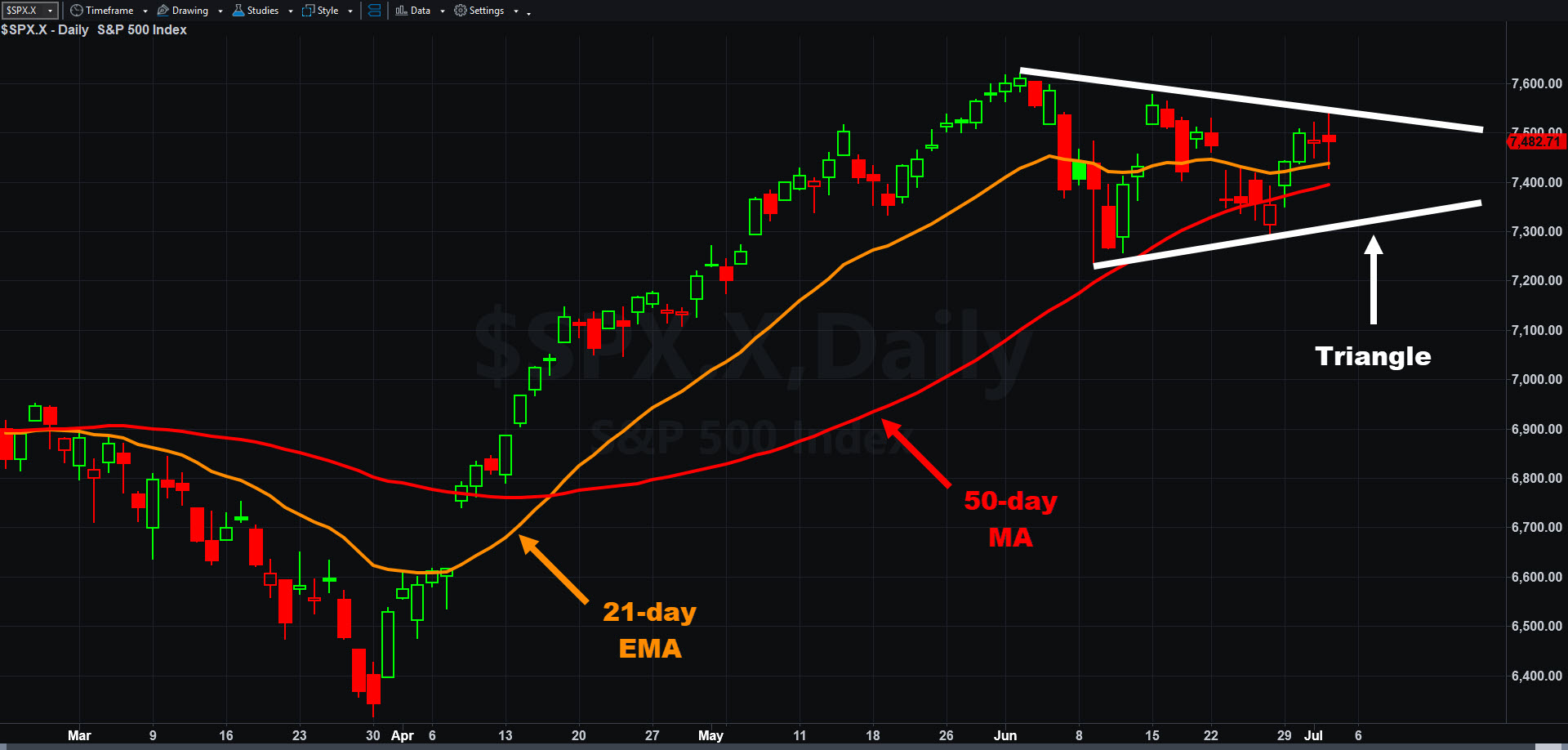
The S&P 500 consolidated in June after beginning the month by stalling at 7,600. There have been signs of improving breadth. For example, the advance/decline line hit a new record high on Thursday and 64 percent of the index's members rose last week. That's consistent with buyers rotating into new parts of the market (as noted above).
The S&P 500 has made higher lows and lower highs as it moves sideways. The resulting triangle may reflect potential for a breakout. Bollinger Bandwidth, which measures volatility, has also narrowed to its tightest readings since the first half of March.
Prices holding above the 50-day moving average and 21-day exponential moving average (EMA) could be viewed as further signs of the uptrend remaining intact.
The Week Ahead
This week's agenda is relatively quiet. (Things get more active next week as inflation data and more earnings arrive.)
ISM's service-sector report is due today and Fed Governor Christopher Waller speaks.
AI chip maker Penguin Solutions (PENG) reports earnings tomorrow afternoon.
Wednesday features crude oil inventories and minutes from the last Fed meeting at 2 p.m. ET.
Initial jobless claims are on Thursday, along with PepsiCo (PEP) earnings. New York Fed President John Williams speaks.
Delta Air Lines (DAL) announces quarterly results on Friday morning.