Stocks Get Stuck as Sellers Hammer Chips
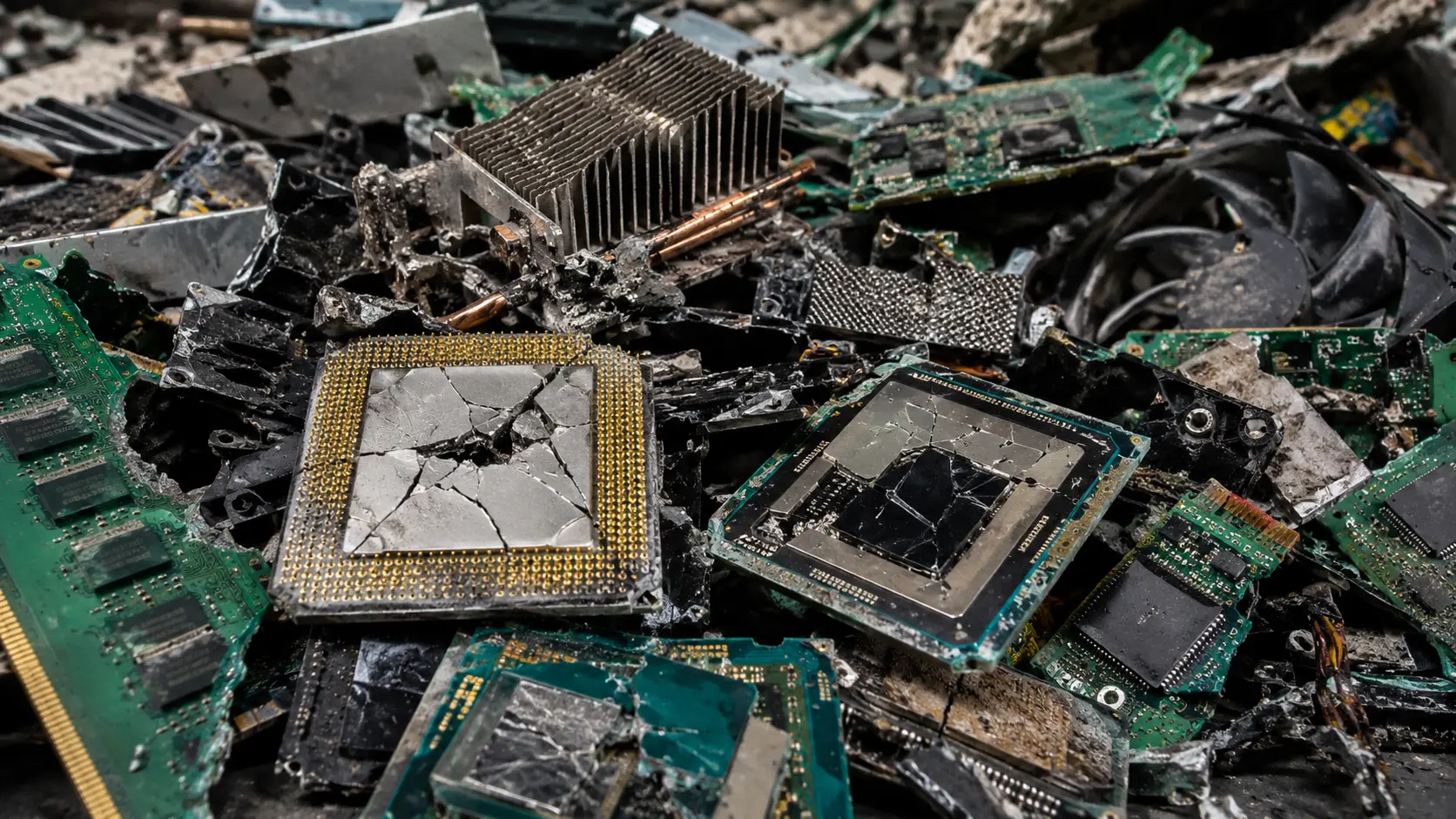
Stocks might be stuck in a range as sellers hammer AI names like chipmakers.
The S&P 500 fell 1.6 percent between Friday, July 10, and Friday, July 17. The Philadelphia Semiconductor Index, on the other hand, plunged 10 percent.
In absolute terms, it was the biggest weekly drop for chips since the Liberation Day selloff in April 2025. Relative to the S&P 500, the 8.6 percent underperformance was the worst showing since May 2009. That could be important for an industry that's led equity markets for years from its position in the heart of the AI buildout.
Political and regulatory risk could also be growing as New York limited data center construction and New Mexico limited a natural gas pipeline for Oracle (ORCL). Those forces, combined with broad profit-taking, overshadowed strong quarterly results and guidance from Taiwan Semiconductor (TSM), the world's biggest chip-manufacturing firm.
International Business Machines (IBM) had its biggest weekly drop in at least 55 years on weak guidance. The big problem? As customers invest more in AI, they're spending less on legacy IT services. Alphabet (GOOGL) slid on reports it delayed its Gemini 3.5 Pro model. There is also new competition from China -- this time from Moonshot AI's Kimi K3 model.

SpaceX (SPCX) dropped 15 percent and ended below its $135 IPO price for the first time. The company delayed a test flight of its Super Heavy booster, which could slow deployment of V3 satellites that are key for the growth of Starlink. (It may try again as early as today.)
Micron Technology (MU) fell 13 percent and lost its status as a trillion-dollar company.
Aside from chips and tech, last week saw downside in metals, airlines and biotechs. Cybersecurity firms like Palo Alto Networks (PANW) rose despite declines in the broader tech sector. PayPal (PYPL) had its biggest weekly gain since 2022 after rejecting a $53 billion takeover offer from Stripe and Advent International.
Biggest Decliners in the S&P 500 Last Week | |
|---|---|
| SanDisk (SNDK) | -29% |
| International Business Machines (IBM) | -26% |
| Marvell Technology (MRVL) | -20% |
| Corning (GLW) | -19% |
| Ciena (CIEN) | -19% |
| Source: TradeStation.com | |
Upside in Energy
Crude-oil futures rose 16 percent last week, the biggest gain since the Iran War started in March. They climbed an additional 2 percent on Sunday evening after fighting intensified over the weekend.
While energy prices fell in June on optimism about the Strait of Hormuz, some traders may see potential for a rebound because of inventories. U.S. stockpiles, including the Strategic Petroleum Reserve (SPR), have dropped to multiyear lows. Oilprice.com also reported China may increase imports after cutting purchases by more than 40 percent last month.
Meanwhile, Goldman Sachs raised its price estimate on crude by 13 percent.
Energy led the market last week and reclaimed its position as the top-performing sector this year. Real estate and consumer staples followed, suggesting investors are rotating away from tech in the third quarter. Banks, retailers and Chinese stocks also climbed.
Inflation and the Fed
The consumer price index (CPI) and producer price index (PPI) for June were both lower than expected. Last month's drop in energy prices accounted for some of the improvement. But import prices unexpectedly rose as Chinese goods had their biggest increase since 2008. Are tariffs starting to drive inflation again?
"Inflation isn't coming from only one source -- it's broad-based," Cleveland Federal Reserve President Beth Hammack said. She said businesses have asked her to raise interest rates to ease price pressures, adding that the strong economy reduces the need for low rates.
"If we do not see signs of disinflation soon, I am prepared to act," Fed Governor Lisa Cook told an audience in Washington. She also noted that the strong economy lets policymakers focus on price stability over job growth.
Biggest Gainers in the S&P 500 Last Week | |
|---|---|
| PayPal (PYPL) | +22% |
| Cintas (CTAS) | +14% |
| Valero Energy (VLO) | +10% |
| Marathon Petroleum (MPC) | +10% |
| Palo Alto Networks (PANW) | +10% |
| Source: TradeStation data | |
"I currently believe modestly higher interest rates would better balance the outlook and risks for the FOMC’s dual mandate goals," Dallas Fed President Lorie Logan said in Houston.
"I am concerned ... that inflation will remain at its elevated level or even trend higher, requiring tighter monetary policy in the near term," Fed Governor Chris Waller said on Monday.
Fed Chairman Kevin Warsh told lawmakers in Congressional testimony that the central bank has "no tolerance for persistently elevated inflation." He gave fewer explicit signals toward rate hikes, following his policy of avoiding guidance.
Jobless claims fell more than expected to their lowest level in more than two months. That highlights the tight labor market and explains why policymakers are more concerned about fighting inflation than supporting growth.
Charting the Market
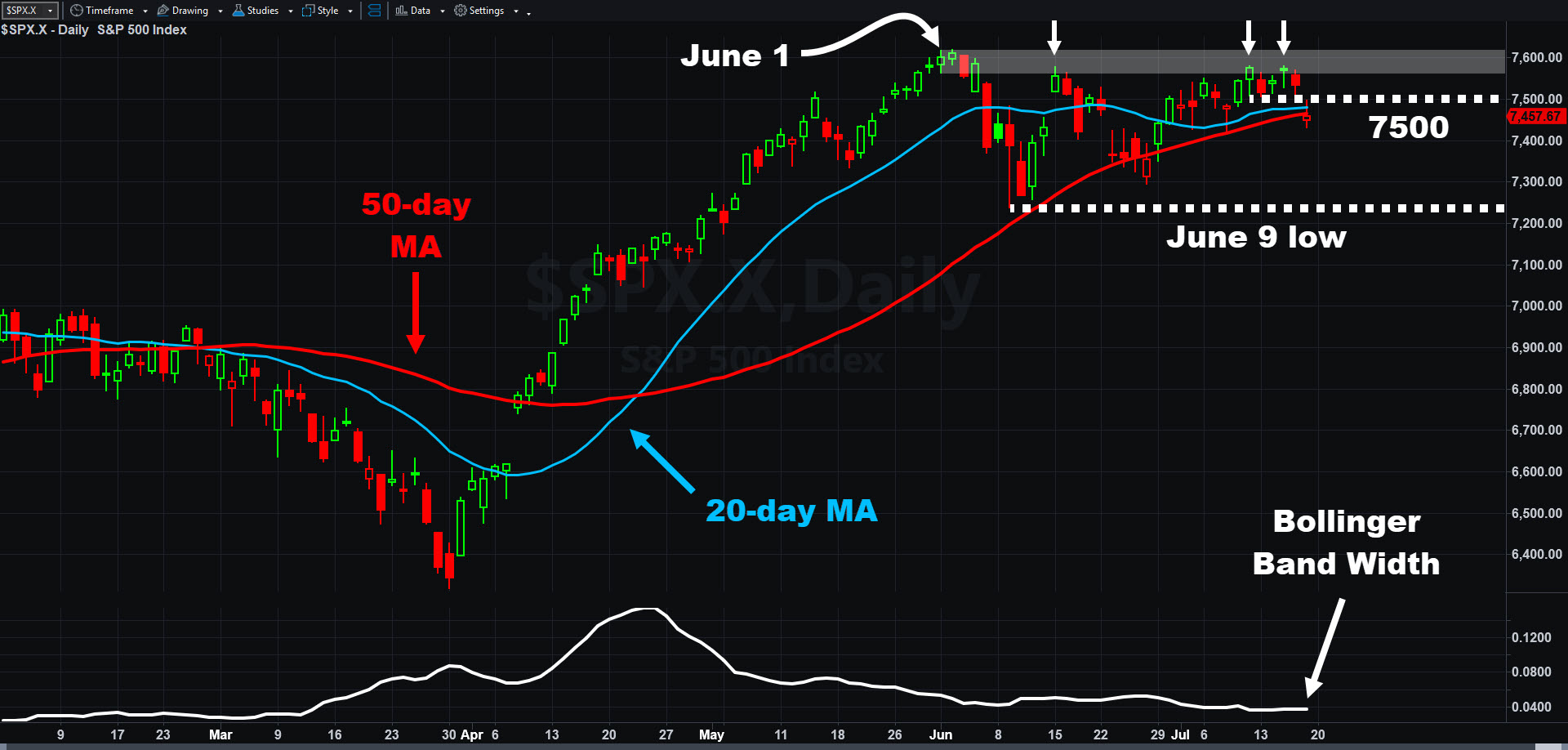
The S&P 500 stalled last week at 7,582, near the previous week's high and an intraday peak on June 15. It also matched the price range from an outside candle on June 1, immediately before the index's last record high. Such price action may confirm resistance is in place, and create potential for a longer period of sideways movement.
Friday's move was especially noteworthy because prices gapped below their range since the preceding Friday, July 10. They also returned below the big round number of 7,500.
The index closed under its 50-day moving average and the 20-day MA is also nearing a potential cross below the 50-day MA. Those signals may reflect a weakening intermediate-term trend.
Volatility could be another issue because Cboe's volatility index (VIX) snapped above 16 last week, while Bollinger Band Width has narrowed. That could suggest price swings are due to increase after a lull.
Speaking of big price moves, 29 members of the S&P 500 dropped at least 10 percent last week. Only six had double-digit gains.
There have also been growing worries about leverage stemming from a July 7 Leuthold Group report that margin debt has increased twice as fast as stock prices. That reportedly matches behavior around peaks in 2000, 2007 and 2021. Other analysts focus on rising margin debt as a percentage of GDP. These reports covering the U.S. are separate from confirmed reports of widespread margin calls in South Korea -- the home of memory chip giants Samsung Electronics and SK Hynix (SKHY).
The Week Ahead
This week brings more earnings and fewer economic events.
Today is relatively quiet.
General Motors (GM), 3M (MMM) and Charles Schwab (SCHW) issue quarterly reports tomorrow.
Wednesday features crude oil inventories, followed by these important earnings in the postmarket: Tesla (TSLA) Alphabet (GOOGL), IBM, ServiceNow (NOW) and Texas Instruments (TXN).
Initial jobless claims are on Thursday, along with results from companies like Intel (INTC) and American Airlines (AAL).
New home sales and American Express (AXP) earnings are on Friday.
.jpg&w=3840&q=75)