Is Tech Getting Bullish as the Fed Hikes?

The Federal Reserve just hiked interest rates, but the big story could be growing bullishness in technology stocks.
The S&P 500 ended last week fractionally lower after rebounding from a loss of 1.9 percent. The tech sector, however, rose for a fourth straight week -- its longest winning streak since May.
The gains started with cybersecurity companies like CrowdStrike (CRWD) and Palo Alto Networks (PANW) on Monday. They rallied after Anthropic CEO Dario Amodei warned of increased risks from autonomous agents hacking sensitive systems.
Then came a series of positive headlines and analyst calls. Citi mentioned potential upside in Meta Platforms (META), citing this week's Meta Connect conference as a near-term catalyst. Oracle (ORCL) issued strong results and guidance, adding that AI demand is still growing faster than supply. Bank of America predicted that the memory and data center markets will double by 2030.
"I expect Nvidia to sell twice as many chips as this next year as we do this year," Nvidia (NVDA) CEO Jensen Huang said on Friday.
In other words, the rally in tech was driven by both fears about AI and optimism about its growth.
Biggest Gainers in the S&P 500 Last Week | |
|---|---|
| Revvity (RVTY) | +15% |
| CrowdStrike (CRWD) | +15% |
| Generac (GNRC) | +11% |
| Coinbase (COIN) | +11% |
| Palo Alto Networks (PANW) | +9.6% |
| Source: TradeStation data | |
Reuters also reported that Intel (INTC) may help South Korea's SK Hynix (SKHY) produce memory chips in the U.S. Alphabet (GOOGL) advanced after Evercore raised its price target from $420 to $450, citing market-share gains in search.
Fed Hikes Rates
The Fed hiked interest rates by 25 basis points and suggested another increase is coming this year.
"The committee’s unanimous vote shows our resolve to achieve price stability on a timelier basis," Chairman Kevin Warsh said after the news conference. He added that "inflation is too high" and "underlying trends have [not] meaningfully improved."
Policymakers raised their estimates for price increases and lowered estimates for unemployment. That tilts their focus in a hawkish direction toward fighting inflation and away from supporting economic growth.
Developments last week highlighted those points. Trucking firm J.B. Hunt Transport Services (JBHT) had the biggest decline in the S&P 500 and its worst week since 2009 after management warned about higher costs from diesel prices and driver capacity. Bank of America (BAC) dropped after warning that higher borrowing costs hurt investment-banking revenue.
Retail sales increased at almost twice the anticipated pace and initial jobless claims fell more than expected. Those points confirm the economy remains in expansion and supported the Fed's rate hikes.
Biggest Decliners in the S&P 500 Last Week | |
|---|---|
| J.B. Hunt Transport Services (JBHT) | -13% |
| Charter Communications (CHTR) | -12% |
| Constellation Energy (CEG) | -11% |
| Corning (GLW) | -9.8% |
| Comcast (CMCSA) | -9.8% |
| Source: TradeStation data | |
Chip Breakout?
The Philadelphia Semiconductor Index rose for a third straight week and is back at a falling trendline marking its pullback since June. Other groups associated with AI data centers, like fiber optics and power equipment, climbed late in the week. Speaking of power equipment, Generac (GNRC) rallied after Amazon.com (AMZN) placed long-term orders and received warrants to purchase shares in the generator company.
Traders may eye these groups in the near term because they are associated with AI data center investment. They have also led the market over the last 1-2 years, with little sign of fundamentals weakening. Chip earnings, for example, are expected to grow 126 percent in the current quarter, according to FactSet.
Software companies, especially cybersecurity firms, were the top performers overall last week. Coinbase (COIN) jumped along with cryptocurrencies. Life-sciences company Revvity (RVTY) continued to rally on the heels of strong earnings last month.
Utilities, financials and real estate were the weakest sectors as borrowing costs increased. Oil services, metals and retailers also fell.
Large Cap Leadership
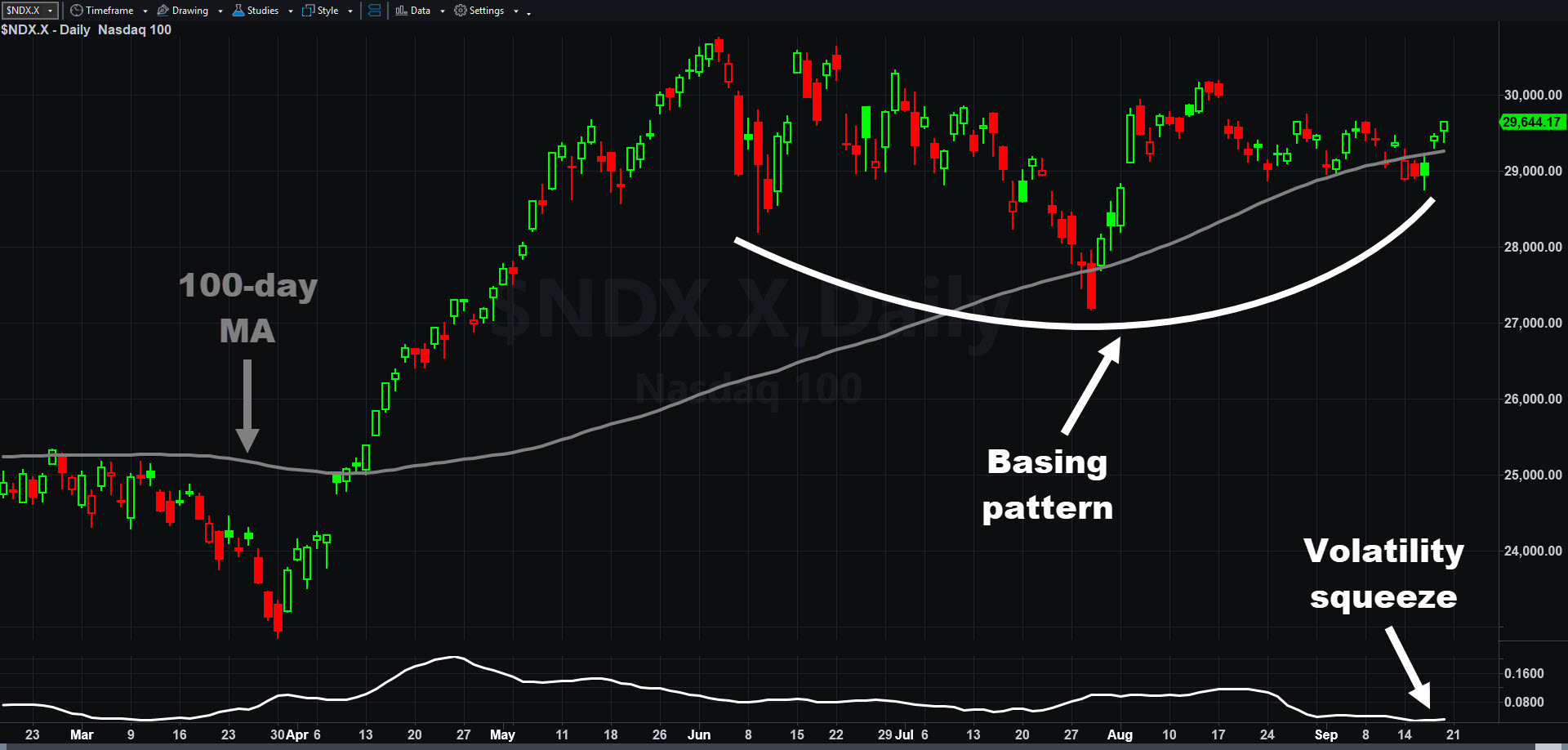
All told, barely one-quarter of the S&P 500's members rose last week. Despite the weak breadth, the biggest companies outperformed. Six of the index's 10 members worth at least $1 trillion rose, with an average gain of 1.3 percent. The Nasdaq-100 has also led the four major indexes for three straight weeks -- something that last happened in April and May.
These points -- combined with strong earnings and positive news flow -- may suggest that investors are returning to large growth stocks. It could also suggest that a phase of value and small-cap strength has ended.
A Truist report seemed to notice this trend, noting how earnings estimates have risen as stocks move sideways. The bank compared the technology sector to the time of ChatGPT's launch in late 2022.
Charting the Market
While the overall market faces risks, some investors may see opportunity tilted to the upside.
First, rising bond yields have been a concern. But they fell after the Fed hiked rates, and stocks rose. That may suggest policymakers gained credibility in their fight against inflation.
Second, data from the American Association of Individual Investors showed the most negative sentiment since May 2025. That's often viewed as a contrary indicator -- in this case showing ample cash on the sidelines.
Third, the biggest and most important companies have strong earnings and are trying to lead again.
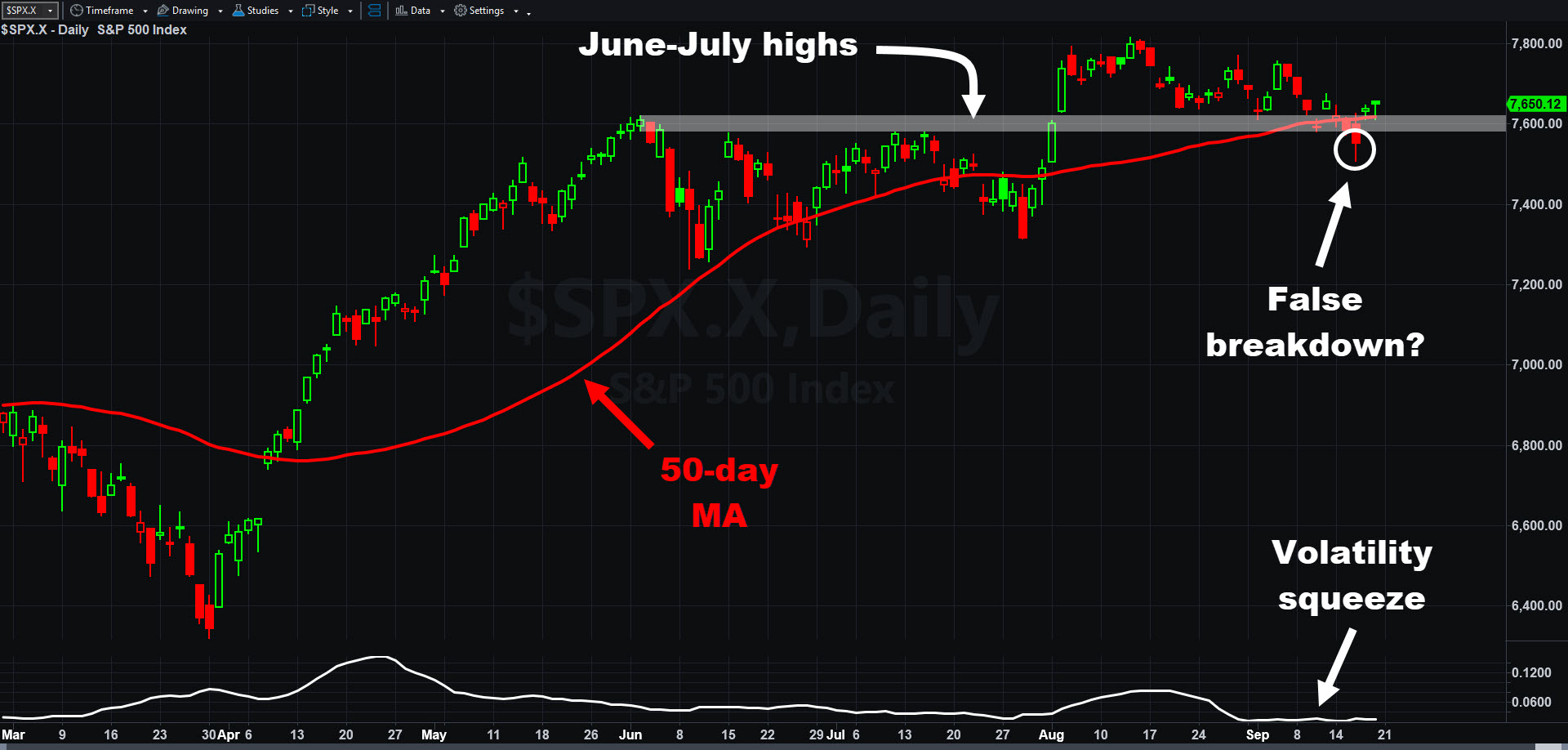
Price action in the S&P 500 was consistent with these points. The index dropped to a six-week low, briefly crossing under its June high and 50-day moving average. Its quick rebound could represent a false breakdown.
Bollinger Bandwidth has also narrowed, which may create potential for prices to expand. Cboe's volatility index, which moves inversely to stocks, was also rejected below 19 (a lower high versus June and July).
The Week Ahead
This week has a mix of events, none of which is clearly most important.
Nothing significant is scheduled for today.
Tomorrow may bring news on the Hormuz crisis because President Trump is expected to meet with leaders of countries including Saudi Arabia and the UAE.
Crude oil inventories are due Wednesday. META also begins its two-day Meta Connect conference, which is expected to feature AI and smart glasses.
Thursday features initial jobless claims and new home sales. Cleveland Fed President Beth Hammack, a hawkish Fed policymaker, also speaks. Costco (COST) reports earnings.
Durable goods orders are on Friday.
.jpg&w=3840&q=75)