Stocks Teeter as Oil and Interest Rates Surge

Stocks could be teetering as rising oil prices drive interest rates higher.
The S&P 500 fell 0.8 percent in the holiday-shortened week between Friday, September 4, and Friday, September 11. More than three-quarters of the index's members lost value.
Energy and U.S. Treasury yields were the big drivers. Crude-oil futures climbed 9.4 percent to end the week above $100 only the second time this decade. (It followed a 9.7 percent gain the previous week.) The yield on the 10-year Treasury note also broke its January 2025 peak to register its highest weekly close since July 2007. That happened despite Treasury Secretary Scott Bessent announcing a $6 billion buyback -- triple the normal amount. He also doubled the size of future repurchases.
The consumer price index (CPI) rose 0.3 percent excluding food and energy, 0.1 percentage point more than expected. Higher energy costs passed through to airfares and tariffs boosted car prices. The producer price index (PPI) also jumped as higher energy prices lifted the cost of intermediate goods, finished goods, trucking and warehousing services.
The inflationary trends could be poised to continue because diesel prices are up 12 percent to a new record so far in September.
Rate Hike this Week?
Markets reacted by looking for the Federal Reserve to raise interest rates at its meeting this Wednesday, September 16. CME's FedWatch tool shows an 87 percent probability of a rate hike, up from 59 percent a week before. Yields on six-month and two-year Treasuries, which track Fed expectations, rose by the most in more than a year.
Traders responded by selling global stocks, homebuilders and metals. The Russell 2000 small cap index also had its biggest drop since early June. Retailers and software makers declined, as well.
Biggest Decliners in the S&P 500 Last Week | |
|---|---|
| Cooper (COO) | -23% |
| Casey General Stores (CASY) | -19% |
| FactSet (FDS) | -14% |
| Amgen (AMGN) | -14% |
| Howmet Aerospace (HWM) | -11% |
| Source: TradeStation data | |
Healthcare stocks had their biggest weekly drop since the Iran war began in early March, led by Cooper (COO) and Amgen (AMGN). Contact-lens company COO issued weak guidance. Drugmaker AMGN fell after a drug-trial failure at Novartis (NVS) raised doubts about its own pipeline product. All three companies had their biggest drops in more than 16 years.
War and Global Energy
Last week also saw potentially big developments around Saudi Arabia. First, Yemen's Houthis captured the towns of Mokha and Dhubab -- plus Mayun island. That significantly increases their control of the Bab el-Mandeb Strait at the mouth of the Red Sea.
Second, the key East-West Pipeline was closed after an apparent drone attack. That removed the Saudis' main route to bypass the Strait of Hormuz. It also reduces supply to refineries on the Red Sea.
Third, an OPEC report showed Saudi oil production dropping 23 percent in August to a 36-year low of 6.2 million barrels per day.
"You're entering a really dangerous phase of this commodity rally," strategist Jeff Currie told Bloomberg on Friday. "The shortages are so extreme on both sides that the whole complex moves."
Currie's mention of "both sides" referred to crude oil and refined products, an important dynamic in the energy market. Crude oil prices rose less than many expected when the Iran war began because refineries were knocked offline and China slowed purchases. That reduced demand for crude and drove up refined products like diesel. The difference (or "crack spread") recently got so extreme that Chinese refineries are buying again to capitalize on high diesel prices. As a result, crude prices are now climbing faster than diesel.
Domestic inventories shrank less than expected last week, but the Strategic Petroleum Reserve (SPR) hit a new 44-year low.
Wall Street responded with a flurry of bullish calls:
- HSBC raised its Brent forecasts for this year and next.
- Goldman Sachs said Brent reaching $120 or higher "definitely plausible" after the recent developments in Saudi Arabia.
- Amrita Sen of Energy Aspects told CNBC that oil could move "sharply higher" because of "eye-watering" inventory drops and fighting in the Middle East.
- Commerzbank raised its year-end Brent forecast from $75 to $85.
- Bank of America raised its estimate for Brent from $76 to $83.
- EIA (part of the U.S. Energy Department) raised its Brent forecast from $82 to $90
Tech Hardware Rallies
Several technology stocks rose last week. Most were hardware companies associated with AI datacenters.
Hewlett Packard Enterprise (HPE) had its biggest weekly gain ever after raising guidance. It also benefited from strong results from key customer Oracle (ORCL).
Biggest Gainers in the S&P 500 Last Week | |
|---|---|
| Hewlett Packard Enterprise (HPE) | +19% |
| Skyworks Solutions (SWKS) | +19% |
| Ciena (CIEN) | +8.9% |
| HP (HPQ) | +8.7% |
| Coherent (COHR) | +8.3% |
| Source: TradeStation data | |
Skyworks Solutions (SWKS) rose on continued optimism about its planned merger with Qorvo (QRVO).
Fiber-optic companies Ciena (CIEN) and Coherent (COHR) gained on optimism about demand from AI datacenters. Similar beliefs boosted computer maker HP (HPQ).
Other companies making chips and hardware, like Dell Technologies (DELL), Advanced Micro Devices (AMD) and Intel (INTC) rose. Several other moves followed presentations at the Goldman Sachs Communacopia + Technology Conference and Citi Global TMT Conference.
Apple (AAPL) also gained after announcing the iPhone Duo, its first foldable handset. The $1,999 price could help AAPL raise average selling prices (ASPs) and boost margins.
Charting the Market
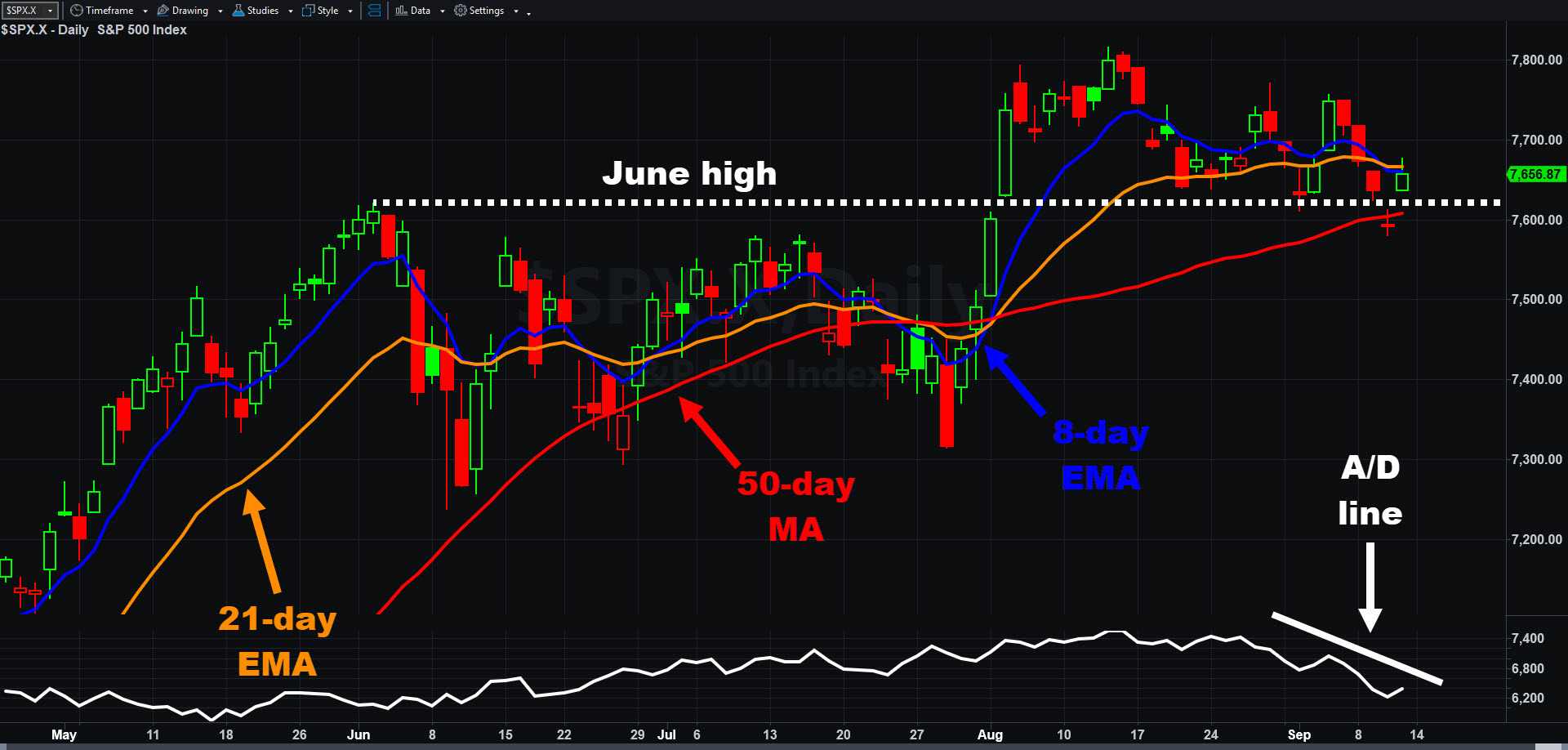
The S&P 500 has remained in a tight range with low volatility. Traders may see positives and negatives balancing, waiting for bullish or bearish scenarios to play out.
The main bullish case hinges on the index staying above its 50-day moving average and its June peaks. Both patterns may confirm its longer-term uptrend. Profits have also remained very strong by historical standards: Wall Street analysts expect S&P 500 earnings in the current quarter to increase by almost 29 percent. That follows growth of more than 25 percent in the first and second quarters, according to FactSet.
Bears might focus on weakening internals. TradeStation data shows that only eight members of the S&P 500 made a new 52-week high last week, the least since April 2025. A falling advance/decline line additionally shows weakening breadth. Another potential issue is growing weakness in economically sensitive sectors like industrials and consumer discretionaries.
Momentum may provide further warnings as oscillators like moving average convergence/divergence (MACD) and Wilder's Relative Strength Index (RSI) slide.
The Week Ahead
The Fed meeting dominates this week's agenda, but it's not the only event.
Nothing important is scheduled for today.
Salesforce's (CRM) Dreamforce conference begins tomorrow and runs through Thursday. It may bring news on AI and agentic applications.
Wednesday's premarket features retail sales, export and import prices. Crude-oil inventories follow at 10:30 a.m. ET.
The Fed's interest rate decision is at 2 p.m. ET. Chairman Kevin Warsh delivers a press conference 30 minutes later. Lennar (LEN) reports earnings after the closing bell.
Thursday morning brings initial jobless claims, housing starts and building permits.
.jpg&w=3840&q=75)