
SpaceX Faces More Catalysts After Big Moves

SpaceX blasted off in June and came back to earth in July. Will Elon Musk's volatile space stock keep moving?
Upcoming events suggest there could be plenty more catalysts for the company, officially called Space Exploration Technologies (SPCX).
The two big catalysts could be a key rocket launch and the unlocking of more shares after this year's historic IPO.
Flight 14 is the first event that could impact the shares. It will test Starship, the largest and most powerful rocket ever flown. The complete vehicle stands about 400 feet tall -- taller than the Statue of Liberty -- and produces more than twice the liftoff thrust of the Saturn V rocket that carried astronauts to the moon. It also dwarfs Falcon 9, the company's current workhorse.
The key question is whether the tower can catch Starship, potentially advancing its viability as a launch vehicle. That, in turn, could speed deployment of Starlink V3 satellites, which are 10 times more powerful than earlier systems. Success would represent a big jump from the company's current Falcon 9 rocket, which isn't large enough to launch V3 satellites.
Two big uncertainties remain with Flight 14: First, timing isn't confirmed, but it's expected for late August or early September. Second, it's not even confirmed whether SPCX will try to catch Starship (although it's been widely discussed).
Stock Unlocks
Share unlocks are the next potential catalyst. SPCX went public on June 11, initially offering about 4 percent of its outstanding shares. Another 20 percent of the stock covered by its 180-day lockup became eligible for trading on August 6. Additional tranches of 7 percent each are scheduled for release on August 20, September 9, September 24, October 9 and October 24.
Even though the dates and amounts are known, there is still uncertainty about how many shares will actually be sold. Pre-IPO investors aren't required to become sellers. Some could hold their stock in anticipation of Starship becoming a long-term success.
That could produce unexpected outcomes because Wall Street already knows about SPCX's looming supply of newly tradable shares. Active traders understand that well-known risks have a strange way of not playing out as expected because markets are forward-looking. That was the case after the first unlock two weeks ago, when the stock rallied instead of falling. Efficient markets seldom hand out free money.
Earnings and Capex
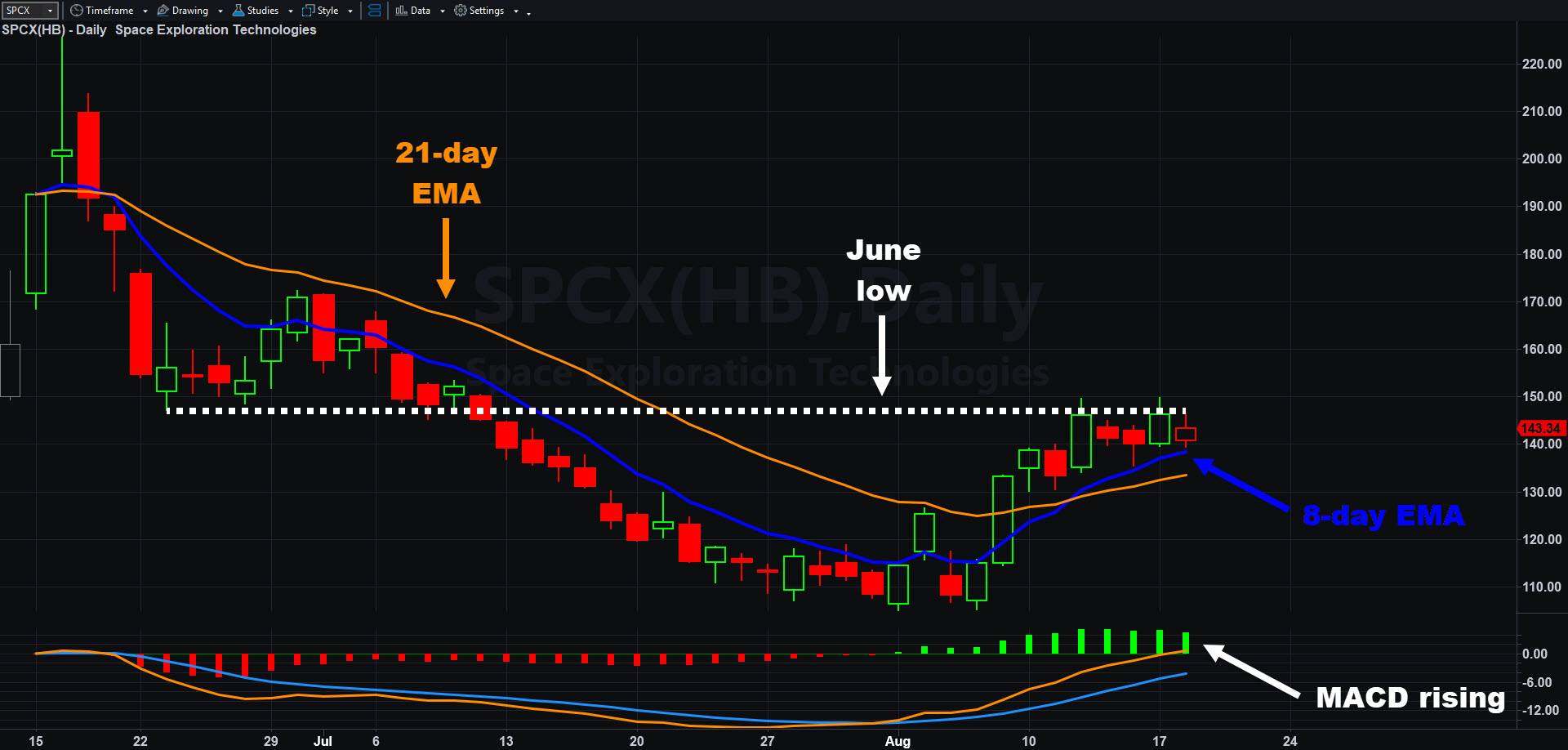
SPCX fell 2 percent to $143.34 yesterday. The IPO priced its shares for $135 each. They jumped to $225.65 the following week before stalling and losing half their value by early August. They rebounded to their June low around $150, pulling the 8-day exponential moving average above the 21-day EMA. The moving average convergence/divergence (MACD) oscillator is also rising. Those signals may reflect short-term bullishness.
Prices have spent more than a week at their June low around $150. A push above that level could be viewed as a bullish breakout, while a drop might indicate it's become resistance.
SPCX had its first quarterly report as a public company on August 4. Earnings and revenue beat estimates, mostly driven by the Starlink data service. It also increased capital spending sharply, like many large tech companies.
SpaceX Options
SPCX options started trading in mid-June and it quickly became one of the busiest underliers in the market. (Its average daily volume of 1.1 million contracts ranks fourth in the Nasdaq-100, according to TradeStation data.)
Directional traders may consider vertical spreads, which involve buying a contract near the money and selling another further from the money. Bullish positions would use calls, which fix the level where a security can be purchased. Bearish strategies would use puts, which lock in the selling price.
Say, for example, an investor thinks SPCX could rally to $170 by September 18. He or she might consider buying the September 160 calls and selling the September 170s for a net cost of $1.90. That position could make about 426 percent from the stock rising 19 percent.
Likewise a bearish position could buy the September 125 puts and sell the September 115s for a net cost of about $1.74. That could earn 475 percent from SPCX declining 20 percent.
Other traders might notice the stock's implied volatility of 95 percent ranks in the top 10 of the Nasdaq-100. They may think it's overpriced, meaning the market is overstating SPCX's potential to move. He or she might consider an iron condor strategy, which involves selling calls and puts to earn premium. For example:
- The September 155 calls could be sold and the September 165 calls could be purchased for a net credit of $2.35.
- The September 130 puts could be sold and the September 120 puts could be purchased for a net credit of $2.40.
- The trader would keep the resulting $4.75 credit. They would keep that amount as their maximum profit if SPCX is between $130 and $155 on expiration. Their maximum loss of $5.25 would occur below $120 or above $165.
Hypothetical examples are for educational purposes only.
Options trading is not suitable for all investors. Your TradeStation Securities' account application to trade options will be considered and approved or disapproved based on all relevant factors, including your trading experience. See www.TradeStation.com/DisclosureOptions. Visit www.TradeStation.com/Pricing for full details on the costs and fees associated with options.
Margin trading involves risks, and it is important that you fully understand those risks before trading on margin. The Margin Disclosure Statement outlines many of those risks, including that you can lose more funds than you deposit in your margin account; your brokerage firm can force the sale of securities in your account; your brokerage firm can sell your securities without contacting you; and you are not entitled to an extension of time on a margin call. Review the Margin Disclosure Statement at www.TradeStation.com/DisclosureMargin.
.jpg&w=3840&q=75)