AI Stocks Go Back to Work Before the Fed

Can Semiconductor Stocks Withstand an Oil Shock?
Semiconductors have led stocks higher since the AI rally began, but they may face new risks as oil prices jump.

Call toll-free 800.328.1267
AI stocks are going back to work as investors wait for a big Federal Reserve meeting.
The S&P 500 rose 1.6 percent between Friday, September 5, and Friday, September 12. Large growth stocks led the advance, sending the Nasdaq-100 to its first record close in almost a month.
Oracle (ORCL) propelled the move by saying its backlog of unfinished business spiked 359 percent. The stunning announcement, fueled by AI demand for cloud computing, triggered ORCL’s biggest rally in 33 years. It became the 10th most valuable member in the S&P 500, surpassing non-tech companies like JPMorgan Chase (JPM) and Walmart (WMT).
Buyers also targeted cloud-infrastructure companies that could benefit from the trend. Micron Technology (MU), which produces high bandwidth memory for AI servers, had its biggest weekly gain since the pandemic. Most of the move followed a Citi note predicting strong results and guidance when MU reports on September 23.
Other companies associated with AI bounced. Microsoft (MSFT) broke a five-week losing streak, while Palantir Technologies (PLTR) and Nvidia (NVDA) snapped four-week bearish trends. Utilities associated with datacenter power demand also climbed: NRG Energy (NRG), Vistra Energy (VST) and Constellation Energy (CEG).
| Warner Bros. Discovery (WBD) | +56% |
| Oracle (ORCL) | +26% |
| Paramount Skydance (PSKY) | +25% |
| Micron Technology (MU) | +20% |
| Centene (CNC) | +15% |
| Source: TradeStation data |
The price action contrasted with recent patterns of strength in value stocks and small caps. Are large growth names resuming their long-term leadership?
The Bureau of Labor Statistics revised annual payroll growth down by 911,000 jobs, the biggest reduction ever. Initial jobless claims rose more than expected to a four-year high and consumer sentiment missed forecasts.
Those numbers cemented expectations that the Fed will cut interest rates by 25 basis points on Wednesday, followed by similar moves on October 29 and December 10. Inflation data showed some evidence of tariffs lifting prices — especially for items like apparel. However, sentiment is now focused on the potential for dovish moves. FactSet also reported the fewest companies since late 2020 mentioned “inflation” in their latest quarterly reports.
Mergers and initial public offerings (IPOs) were important themes. Warner Bros. Discovery (WBD) had its biggest rally ever after The Wall Street Journal reported a planned takeover by Paramount Skydance (PSKY). Vimeo (VMEO) also spiked 74 percent after agreeing to be acquired by a private company.
The IPO roster included two cryptocurrency names: Figure Technology (FIGR) and Gemini Space Station (GEMI). Both priced above their initial ranges and climbed further in public trading. Payments provider Klarna (KLAR) also rallied after pricing above the initial range.
Gold and silver miners, along with Chinese stocks, were the best performers overall last week. Both benefited from the expectations of rate cuts. Chinese stocks also benefited from big tech names like Alibaba (BABA) and Baidu (BIDU) hitting new 52-week highs.
Tesla (TSLA) lifted consumer discretionaries. The EV maker climbed 13 percent after securing CEO Elon Musk’s compensation package. Traders may see further catalysts into the quarterly deliveries report in early October.
Quantum-computing stocks like IonQ (IONQ) and Rigetti Computing (RGTI) also rallied.
| Synopsys (SNPS) | -29% |
| Trade Desk (TTD) | -13% |
| Humana (HUM) | -10% |
| EPAM Systems (EPAM) | -7.9% |
| Albemarle (ALB) | -6.8% |
| Source: TradeStation data |
Homebuilders, biotech, retailers and banks fared the worst, according to TradeStation data.
Synopsys (SNPS) had its biggest weekly drop ever after earnings, revenue and guidance missed estimates. Government restrictions on its chip-related business with China contributed to the weakness.
Trade Desk (TTD) also continued lower following a dramatic selloff in early August.
Last week saw the S&P 500 close above 6,500 for the first time, escaping a range that had formed since late August.
Chart watchers may see few bearish signals in the action. The moving average convergence/divergence oscillator (MACD) turned positive again. Prices have also remained above the 8- and 21-day exponential moving averages. Those indicators may reflect positive short-term direction.
Cboe’s volatility index (VIX) remained below 16, which can encourage risk taking.
The breakout in the Nasdaq-100 is also potentially important because it could suggest the largest tech stocks are starting to rally again following a period of consolidation.
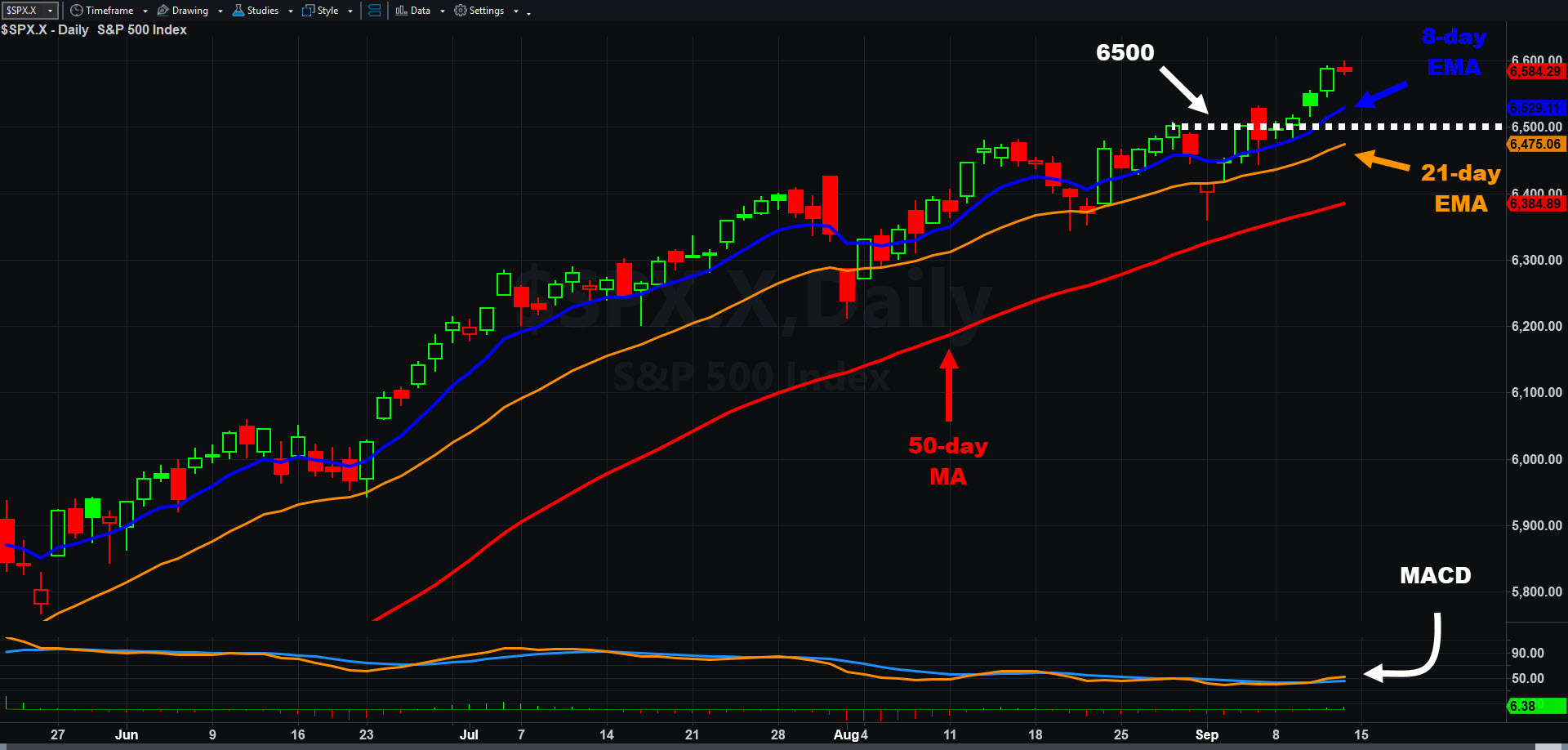
S&P 500, daily chart, with select patterns and indicators.
Wednesday’s Fed meeting is the most important event this week. There are a few other noteworthy items.
Nothing important is scheduled for today.
Retail sales are on Tuesday, along with industrial production and NAHB’s homebuilder-sentiment index.
Wednesday morning features housing starts, building permits and crude-oil inventories. The Fed announces interest rates and economic projections (including the “dot plot” forecast) at 2 p.m. ET. Chairman Jerome Powell will hold a press conference about 30 minutes later.
Meta Platforms (META) holds a developer conference in the afternoon, which runs through the following day.
Thursday brings initial jobless claims. FedEx (FDX) and Lennar (LEN) report earnings in the afternoon.
Friday may see greater activity because of quadruple witching. (See this article for more.) Nothing else important is scheduled.

Semiconductors have led stocks higher since the AI rally began, but they may face new risks as oil prices jump.

After a long bidding war for Warner Bros. Discovery, one big options trader is looking for the current deal to go through.

Apple has done little for a long time, and some traders may think the tech giant is rolling over.