
Weak Dollar Trades Return as Rates Hammer Tech
Weak-dollar trades could be returning as tech stocks hit resistance.
The S&P 500 fell 1.4 percent between Friday, August 14, and Friday, August 21. It was the first drop after three positive weeks. Selling was especially strong in technology hardware companies associated with AI datacenters. Metals and Bitcoin also surged.
U.S. Treasuries were at the center of it all. First on Tuesday, the yield on the 10-year U.S. note probed a 20-month high of 4.75 percent. That hurt tech companies that make the physical equipment that's often financed with borrowing:
Jabil (JBL) and Flex (FLEX): Contract manufacturing of servers and power systems
- Seagate Technology (STX): Data storage
- Intel (INTC): Data center chips and CPUs for AI inference
The next day, U.S. Treasury Secretary Scott Bessent responded by unexpectedly increasing purchases of long-dated U.S. Treasury debt. That pushed the U.S. dollar to a three-month low, boosting gold, silver and Bitcoin. Cryptocurrency names like Coinbase (COIN) surged and copper miner Freeport McMoRan (FCX) broke out to a new all-time high.
Biggest Decliners in the S&P 500 Last Week | |
|---|---|
| Reddit (RDDT) | -14% |
| Jabil (JBL) | -14% |
| Seagate Technology (STX) | -13% |
| Flex (FLEX) | -12% |
| Intel (INTC) | -12% |
| Source: TradeStation data | |
Some traders may see more catalysts from the greenback after a potential trade deal with Canada collapsed on Friday evening. (Tariffs will jump to 50 percent as a result.) Bessent is also expected to announce sanctions against Iran today. The big question is whether he will target China, the main buyer of Iranian oil. Such a move could trigger more volatility in U.S. Treasuries, the dollar and precious metals.
Another potential catalyst comes on Friday, when Federal Reserve chairman Kevin Warsh speaks in Jackson Hole, Wyoming.
Biotech Breakout
Biotech and health care stocks also broke out after Moderna (MRNA) released positive data for an mRNA-based cancer vaccine. The product might first be used against melanoma, but it could potentially fight other kinds of tumors. MRNA's partner, Merck (MRK), jumped 12 percent on the week. Iqvia (IQV) and Illumina (ILMN) climbed on optimism about personalized medicines.
Healthcare, the leading sector so far this month, may be attracting capital as investors take profits in AI and tech stocks.
Energy stocks broke out to new all-time highs as Iran threatened new military actions and claimed seizing a tanker in the Strait of Hormuz. Oil fell late Sunday after Axios reported the U.S. was helping energy exit the Persian Gulf.
Latin American stocks, lithium producers and uranium miners advanced. They can all benefit from a weaker U.S. dollar.
Airlines dropped as oil rose. Semiconductors, cybersecurity companies and solar energy fell -- all impacted by weakness in AI and data centers. Higher rates also weighed on banks, utilities and small caps.
Walmart (WMT) fell 10 percent, its biggest weekly drop in four years, after failing to raise guidance. Estee Lauder (EL) had its best week in 28 years (up 18 percent) after strong results suggested its turnaround could be working.
Biggest Gainers in the S&P 500 Last Week | |
|---|---|
| Moderna (MRNA) | +129% |
| Coinbase Global (COIN) | +26% |
| Estee Lauder (EL) | +18% |
| Freeport-McMoRan (FCX) | +15% |
| Robinhood Markets (HOOD) | +13% |
| Source: TradeStation data | |
Debt and Data Centers
Bessent plans to at least double purchases of U.S. Treasuries maturing in 10-30 years. The move has the benefit of retiring debt at a discount, letting the government pay less than the full amount due. But the Treasury must borrow at shorter-term rates that are higher than the coupons going away. This dynamic, and the associated fiscal pressures, may increase the importance of borrowing costs in the eyes of the market. Will interest rates become a bigger catalyst than record earnings growth -- especially with the national debt passing $40 trillion for the first time?
The drama occurs with the yield on 10-year Treasuries consolidating above 4.6 percent, a level they couldn't hold in May. The 30-year rate hit 5.33 percent, the highest since mid-2007.
This could become an issue for IT hardware that's partially financed with borrowed money. Reuters reported widening concessions demanded by investors purchasing bonds from hyperscalers like Amazon.com (AMZN) and Alphabet (GOOGL). Most of the companies providing these products have continued to announce strong results and issue bullish guidance. However, their prices have stalled or declined. That could reflect fears of demand weakening in coming quarters.
AI may face another challenge from politics after CNBC and Axios reported that some political consultants recommend more attacks on datacenters into the November midterms.
Charting the Market
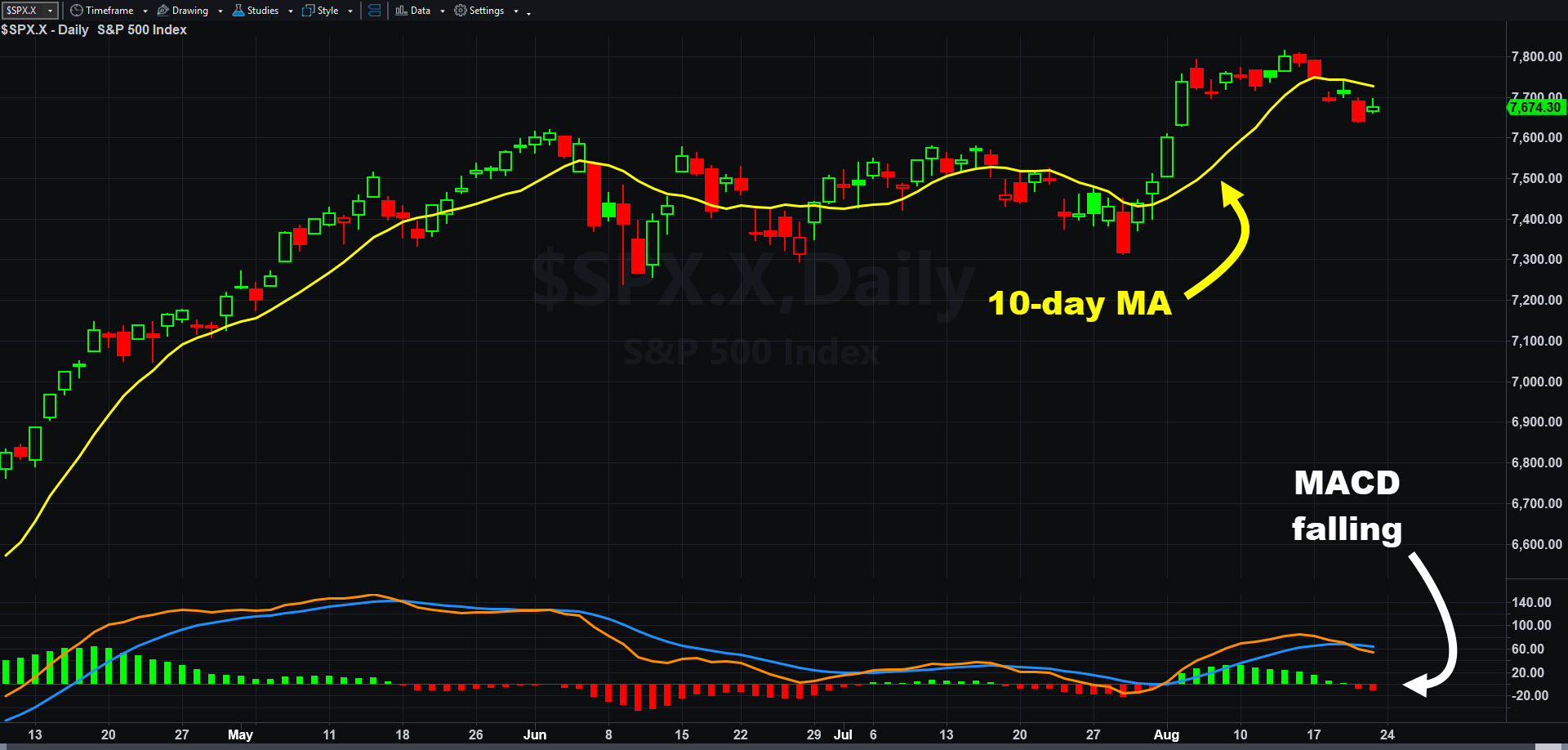
Those forces may be playing out in indexes like the Nasdaq-100, Philadelphia Semiconductor Index or the Technology Select Sector Index. All three benchmarks made slightly higher highs on Monday morning compared with the previous week, but fell and made lower lows. The resulting "bearish outside candles" are potential reversal patterns.
The broader S&P 500 may face similar uncertainty after dropping from an all-time high at a time of year when activity often slows. Some investors may also worry about weak seasonality in September, which is historically the weakest month.
Others may notice that most of the candles have recently been solid, which means prices closed near session lows.
Another potential risk is underperformance in the Nasdaq-100 and technology stocks. Can the broader market keep running when its leading groups are struggling?
Momentum oscillators like moving average convergence/divergence (MACD) and Wilder's Relative Strength Index (RSI) have also turned negative.
The Week Ahead
This week features a few important events. It's not clear which will have the most impact.
Today's main event could be Treasury Secretary Bessent's announcement of "the toughest sanctions in history" against Iran. He's expected to speak at 2 p.m. ET.
Consumer confidence follows tomorrow, along with results from Intuit (INTU) and Zoom Communications (ZOOM).
Wednesday features revised second-quarter gross domestic product and the personal consumption expenditures (PCE) inflation report. Crude-oil inventories are due later in the morning. Nvidia (NVDA), Salesforce (CRM) and HP (HPQ) report earnings.
Initial jobless claims are on Thursday. Best Buy (BBY) and Marvell Technologies (MRVL) report earnings.
Fed chairman Warsh delivers his Jackson Hole speech at 10 a.m. ET on Friday. Annual revisions to payroll growth at the same time could also be important.
.jpg&w=3840&q=75)