Healthcare Surges as Technology Falters

Change is sweeping the market as investors rotate from high-flying AI stocks to healthcare, airlines and housing.
The S&P 500 fell 2 percent between Thursday, June 18, and Friday, June 26. The index declined all five sessions, and its nine biggest members lost value. However, two-thirds of companies in the benchmark rose and the advance/decline (A/D) line climbed to a new high.
Moves like that often occur at the end of a quarter, and now they're exaggerated by the historic gains in AI stocks since the end of March. Some of the changes also suggest investors are looking beyond AI to consumer stocks that could benefit from lower energy prices and interest rates. That explains the rallies in airlines, homebuilders and banks.
But the most dramatic moves occurred in biotechnology and healthcare stocks. Seven of the index's 10 biggest gainers were in that group, fueled by Merck KGaA's acquisition of life-sciences firm Bio-Techne (TECH). AbbVie (ABBV) had its best week in eight years after regulators widened the use of its Skyrizi psoriasis drug from adults to children. Eli Lilly (LLY), the only trillion-dollar healthcare name, climbed as Medicare Part D added its Zepbound weight-loss drug. There were also positive developments that could significantly widen the market for its Jaypirca leukemia drug.
The result was a 7.3 percent rally in healthcare stocks, the sector's biggest weekly gain in more than four years.
Biggest Gainers in the S&P 500 Last Week | |
|---|---|
| Bio-Techne (TECH) | +23% |
| AbbVie (ABBV) | +17% |
| Charles River Laboratories (CRL) | +17% |
| Incyte (INCY) | +16% |
| United Airlines (UAL) | +15% |
| Source: TradeStation data | |
Technology Drops
Technology, on the other hand, declined 5.4 percent. ON Semiconductor (ON) had its biggest weekly drop since 2008 after agreeing to buy Synaptics (SYNA) for $7 billion. The deal is financed with stock, continuing a trend of equity dilution already seen in companies like Alphabet (GOOGL) and Oracle (ORCL).
Speaking of ORCL, the software company fell the most since August 2001. Other AI- and datacenter-related names that rallied earlier in the second quarter, like Western Digital (WDC), Seagate Technology (STX) and Marvell Technology (MRVL) also fell.
Some tech companies like International Business Machines (IBM) and Palo Alto Networks (PANW) rose last week. Are investors pivoting back to software after ringing the register in hardware?
Communications and consumer discretionaries also lagged the S&P 500. Their declines mostly resulted from weakness in megacap constituents like GOOGL, Meta Platforms (META), Amazon.com (AMZN) and Tesla (TSLA). GOOGL notably lost some prominent AI researchers to Anthropic. AAPL fell after high memory costs forced management to raise prices for MacBooks and iPads.
Interestingly, most consumer discretionary stocks rose last week as investors targeted travel stocks like Expedia (EXPE) and homebuilders like PulteGroup (PHM).
Those trends seem to highlight a shift away from large growth companies to non-AI stocks.
Biggest Decliners in the S&P 500 Last Week | |
|---|---|
| On Semiconductor (ON) | -25% |
| Western Digital (WDC) | -21% |
| Oracle (ORCL) | -19% |
| Albemarle (ALB) | -17% |
| Qualcomm (QCOM) | -16% |
| Source: TradeStation data | |
Strong Consumer
The pivot could make sense when investors consider the economic data. Personal income and spending rose more than expected, according to data last week that covered May. Initial jobless claims fell more than expected and consumer sentiment was revised higher.
Housing stocks rose 5.7 percent and are on pace for their best quarterly performance since the third quarter of 2024. Airlines are having their best quarter since at least the pandemic (depending on how they're measured).
In another interesting data point, S&P Global's PMI report showed manufacturing output growing at the fastest pace in five years as new orders jumped.
Optimism about energy prices and inflation helped support the improved conditions for both consumers and businesses.
Last week featured MU's quarterly report. Revenue quadrupled and net income rose 1,398 percent. Management raised guidance and capex plans, while analysts noted how new supply agreements could improve its business and make sales more predictable.
Separately, FactSet calculated that the S&P 500 will climb 21 percent to 8,918 in the next year if stocks rise to levels expected by Wall Street analysts. J.P. Morgan also raised its end-of-year target from 7,600 to 7,800. Barclays went from 7,650 to 7,800.
Charting the Market
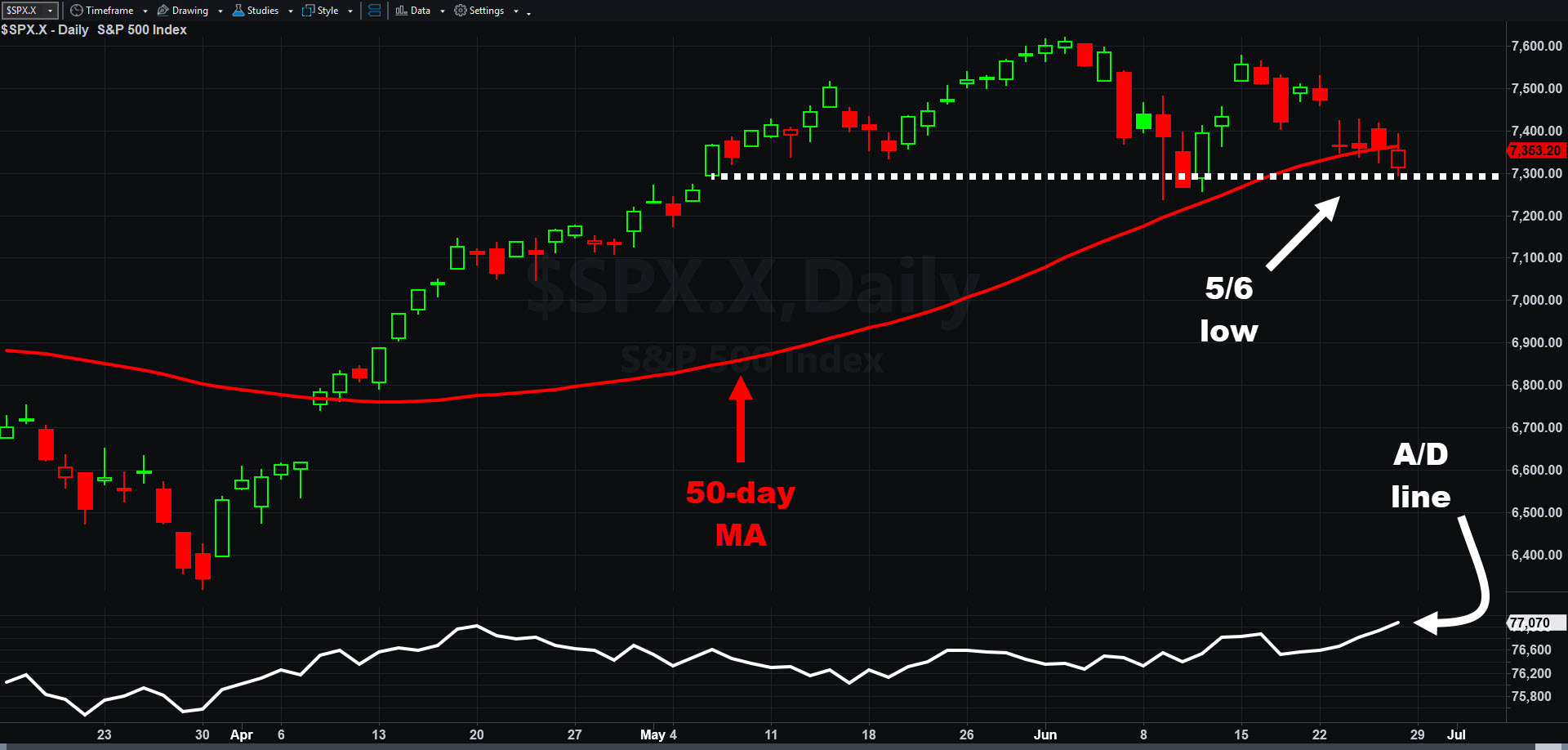
The S&P 500 has been rangebound so far in June. While the pullback seems to have done little damage to the longer-term uptrend, chart watchers may see potential for further consolidation.
Technicians may notice how the index held 7,300, near the low of a bullish candle on May 6. That may suggest support is in place.
Prices are also near the rising 50-day moving average.
The rising advance/decline shows more companies have participated to the upside. However, that may prove less bullish because pullbacks followed similar breadth improvements (like in late February, for example).
Traders could watch chip stocks for cues given their importance to the broader market. The Philadelphia Semiconductor Index made a new high, but closed below the previous week's low. That kind of bearish engulfing candle may be viewed as a reversal pattern.
The Week Ahead
This week is cut short by the observance of Independence Day on Friday. There are a few noteworthy events.
There are no economic reports today, but the Russell 2000 index begins trading with adjusted holdings. More than 200 companies were added or removed, while the maximum size for membership was raised by 24 percent.
The Labor Department's job openings report (JOLTS) is Tuesday morning along with consumer confidence.
Wednesday features TSLA's quarterly deliveries, the Institute for Supply Management's manufacturing index and crude-oil inventories. Federal Reserve Chairman Kevin Warsh speaks in Europe at 9 a.m. ET. Investors will monitor for comments to see if he addresses monetary policy or follows a path of less guidance.
June's non-farm payrolls report and initial jobless claims are on Thursday morning. The stock market closes three hours early at 1 p.m. ET.