Goldman Is Climbing as IPOs Arrive

Financials have mostly struggled this year, but Goldman Sachs has been rising as Wall Street comes to life.
The 157-year-old investment bank broke out to new highs in late May and has climbed steadily since. It's up 25 percent in 2026 and 75 percent in the last year. Those returns are more than twice the performance of both the S&P 500 and broader financial sector over the same periods.
A combination of strong investment banking, equities trading and wealth management has driven the gains. GS started its most recent leg higher in November as investors positioned for major IPOs like Space Exploration Technologies (SPCX), which was led by Goldman's team. Executives commented multiple times on the prospect of increased dealmaking and underwriting activity.
Those trends helped drive earnings and revenue past estimates last quarter. Goldman may also be benefiting from a less crowded competitive landscape. Since the 2008 global financial crisis, Lehman Brothers and Bear Stearns have disappeared, while Merrill Lynch and Credit Suisse were absorbed by larger banks. GS has gained market share in an environment with fewer top-tier competitors, particularly in merger advisory.
But the biggest drivers may be the ongoing bull market in stocks and demand for investment banking services. The prospect of lower interest rates, interrupted by the recent spike in oil prices, could provide another catalyst if inflation moderates. (A decline in borrowing costs could potentially increase debt issuance and reduce credit losses, which were a drag on GS last quarter.) That could also make today's Federal Reserve meeting important.
Charting Goldman
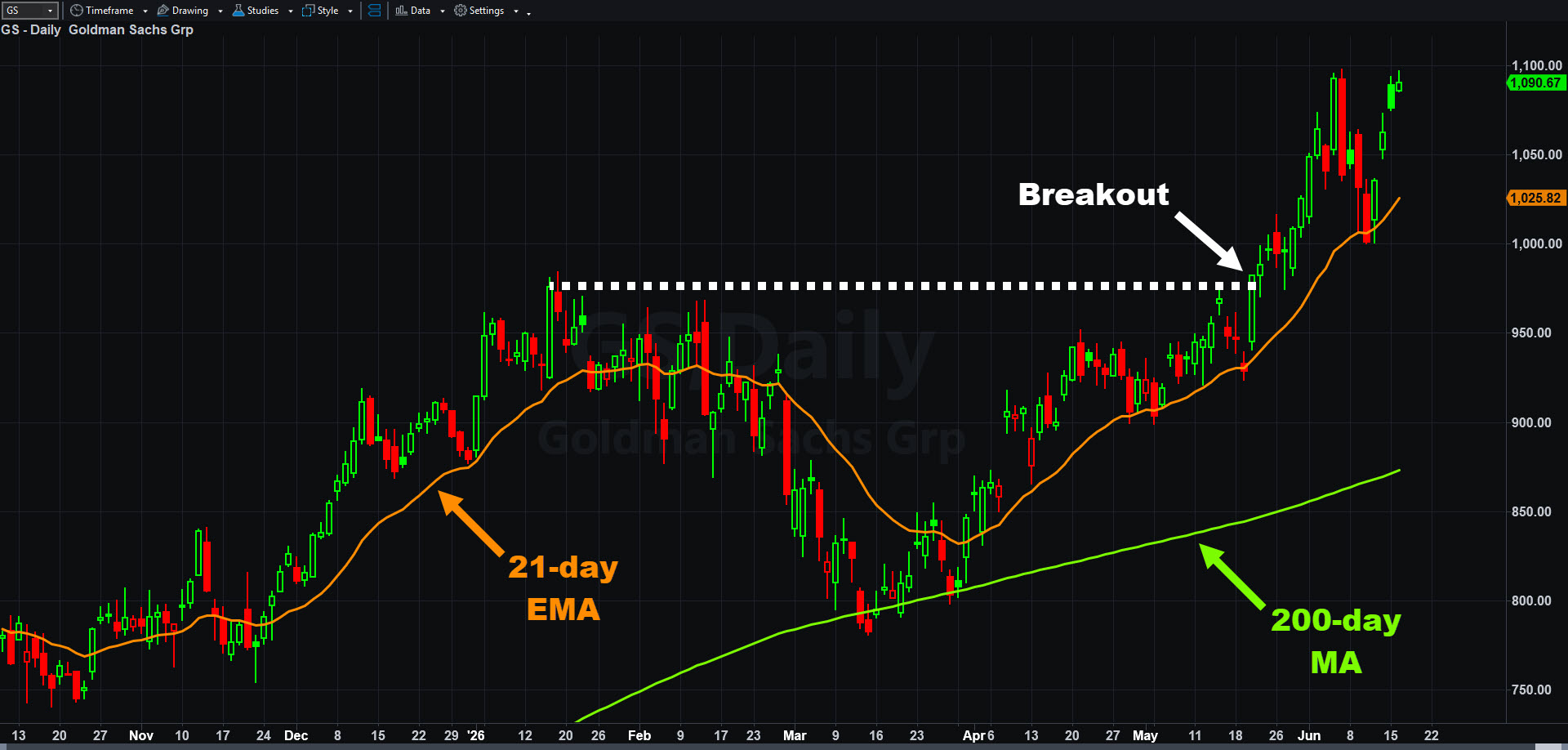
GS hit a record high above $975 in January. It pulled back with the broader market during the Iran war, but stabilized at its rising 200-day moving average. That potentially signaled that its long-term uptrend remained intact. The shares bounced in early April on news of the ceasefire but remained in a relatively tight range until May 20, shortly after The Wall Street Journal reported GS would lead the SPCX IPO. The stock ended that session at a new all-time high and it has continued higher since.
GS rose another 1.4 percent to $1,090.67 yesterday. Aside from owning shares, traders may consider using options to position for continuation of the trend.
One potential strategy is a call vertical spread, which involves buying one contract near the money and selling another at a higher strike. It can profit from GS climbing toward the higher strike, potentially generating leverage from a modest rally.
For example, a trader might purchase the July 1160 calls and sell the July 1200 calls for a net cost of roughly $8. That spread could be worth $40 if GS closes at $1,200 or higher on expiration. That could translate into a 400 percent profit from the stock climbing 10 percent.
Goldman Options
Another potential strategy is a calendar spread, which involves buying a longer-dated call and selling a shorter-dated call at the same strike price. That can also profit from limited upside in the shares, but with additional room for adjustment.
For example, a trader might purchase the July 1200 calls (monthly calls expiring on July 17) and sell the 2-July 1200 calls for a net cost of about $9.65. If GS remains below $1,200 on July 2, the shorter-dated contracts will expire worthless. Traders could then sell other contracts to earn more premium. They could also sell a higher-strike call like the July 1240s (also expiring July 17), effectively "legging into" a vertical spread.
Either transaction could potentially capture movement around the next earnings report on July 14.
Finally, other major Wall Street firms have also been moving. That could suggest a bigger trend is taking shape -- especially as investors await more IPOs from companies like Anthropic and OpenAI. Here are some key names that are also active in the same space as GS:
- Morgan Stanley (MS): Another lead underwriter on the SPCX IPO, MS closed at a new record high yesterday.
- Citi (C): The most global major U.S. bank with a major position on Wall Street closed yesterday at its highest level since October 2008.
- JPMorgan Chase (JPM): The biggest U.S. commercial bank and investment bank is still trapped below its early-January high, but has started climbing this week.
- Bank of America (BAC): The giant lender, wealth manager and investment banker is still below its peaks from January and February. It's also slightly above its previous record highs from 2006 before the financial crisis.
Hypothetical examples are for educational purposes only.
Options trading is not suitable for all investors. Your TradeStation Securities’ account application to trade options will be considered and approved or disapproved based on all relevant factors, including your trading experience. See www.TradeStation.com/DisclosureOptions. Visit www.TradeStation.com/Pricing for full details on the costs and fees associated with options.
Margin trading involves risks, and it is important that you fully understand those risks before trading on margin. The Margin Disclosure Statement outlines many of those risks, including that you can lose more funds than you deposit in your margin account; your brokerage firm can force the sale of securities in your account; your brokerage firm can sell your securities without contacting you; and you are not entitled to an extension of time on a margin call. Review the Margin Disclosure Statement at www.TradeStation.com/DisclosureMargin.