Growth Stocks Return as Nasdaq Breaks Out
Stocks Climb as AI Demand Shifts to CPUs, Analog
The next phase of the AI trade could be taking shape as investors scramble for CPUs and analog chips.

Call toll-free 800.328.1267
Growth stocks could be staging a comeback as May begins.
The S&P 500 rose 1 percent between Friday, April 24, and Friday, May 1. The tech-heavy Nasdaq-100 outperformed for the fifth straight week, which may confirm growth stocks have regained favor after an extended pause.
Most of the largest growth companies announced quarterly results. Some rose and others fell, but the common theme was a doubling down on AI. Alphabet (GOOGL), Microsoft (MSFT), Amazon.com (AMZN) and Meta Platforms (META) increased capital-spending plans by 8.9 percent, according to estimates by CNBC and Bank of America.
AMZN closed at a new record high as AI workloads boosted AWS and AI tools helped drive 22 percent growth in its high-margin advertising business. GOOGL rose the most in three years thanks to strong demand for its cloud-based AI tools.
GOOGL was also the ninth-biggest gainer in the S&P 500. Seven of the other top eight had some connection to AI and technology. The boom in data storage and memory lifted Seagate Technology (STX) and SanDisk (SNDK). Intel (INTC) kept climbing on CPU demand (for agentic AI). Qualcomm (QCOM) embraced custom AI chips and CPUs, overcoming weakness in its legacy wireless business.
Some non-tech companies helping power data centers also jumped: Caterpillar (CAT), Quanta Services (PWR) and Generac (GNRC). Bloom Energy (BE), which isn’t in the S&P 500, also surged as data centers embrace fuel cells.
| Centene (CNC) | +28% |
| Seagate Technology (STX) | +24% |
| NXP Semiconductor (NXPI) | +21% |
| Intel (INTC) | +21% |
| SanDisk (SNDK) | +20% |
| Source: TradeStation data |
Apple (AAPL) contributed to the Nasdaq’s gains with better-than-expected earnings, revenue and guidance. The top line grew 17 percent, its fastest pace since the pandemic.
iPhone sales rose 22 percent, and have increased at a double-digit pace in three of the last four quarters. (It was flat to negative for years before.) This is potentially consistent with a strengthening iPhone upgrade cycle.
Growth also accelerated in “Rest of Asia Pacific” to 25 percent from 18 percent in the previous quarter. The region excludes China and Japan, but includes India, Indonesia and Pakistan. Those countries have about 2 billion people, with iPhone market share below 10 percent.
“I’m over the moon excited about India,” CEO Tim Cook said on the conference call. “There are a lot of people moving into the middle class there.”
AAPL’s smaller businesses like Services and Mac beat estimates, as well. Mac minis and Mac Studios benefited from developers using them in combination with agentic AI tools like OpenClaw.
Those points helped establish the stock at a new record weekly close for the first time since November, which may reflect longer-term bullishness. This could be important for megacaps and the broader Nasdaq because AAPL is the third-largest U.S. company by market cap.
Last week was potentially interesting because some non-hardware companies rallied on strong results. That could be more consistent with a return to long-duration growth stocks following a long period of underperformance.
Video streamer Roku (ROKU) and software company Twilio (TWLO) closed at four-year highs. Social media platform Reddit (RDDT) also jumped. All three companies reported strong earnings, supported in various ways by AI.
Oracle (ORCL) also bounced above $160.14, a weekly close on February 13 that represented the top of its range in the two subsequent months. If old resistance has become new support, it could be meaningful for the broader technology sector because ORCL’s slide since September was a major drag on the broader group.
Even the economic data confirmed strong AI investment: Gross domestic product rose 2 percent in the first quarter, with computer equipment and software accounting for almost two-thirds of the increase. Another report showed core capital goods orders up 3.3 percent in March. That was the highest reading since June 2020 and the second-highest reading in the last decade.
| Teradyne (TER) | -17% |
| Builders FirstSource (BLDR) | -16% |
| Pentair (PNR) | -14% |
| Robinhood Markets (HOOD) | -13% |
| Alexandria Real Estate Equities (ARE) | -13% |
| Source: TradeStation data |
Centene (CNC) rose the most in the S&P 500 last week after medical costs were lower than feared. (The health insurer also had its best week in almost 20 years.)
Energy stocks were the biggest gainers overall as oil climbed. Software companies, pharmaceuticals and solar energy also climbed.
Materials, homebuilders and precious metals fared the worst.
Last week also marked the end of April, which had some noteworthy achievements:
FactSet reported that S&P 500 earnings are growing 27.1 percent so far this reporting season. That would be the fastest pace since the end of 2021. Wall Street analysts also boosted estimates by 2.1 percent for the second quarter (ending in June). That goes against the normal pattern of lowering estimates once a quarter begins. That 2.1 percent increase was the biggest since the second quarter of 2021, according to FactSet.
HSBC responded to the strong earnings trends by upgrading U.S. stocks to overweight. Logistics firm FreightWaves reported that the trucking and transportation services may accelerate in May, with domestic carriers benefiting from tight capacity.
The S&P 500 closed at a record high for the third straight week. The index has remained more than 2 percent above its previous peak in January, which may confirm a longer-term breakout.
Chart watchers may see potential for retests toward 7,170, near the peaks of April 24-27.
The Nasdaq-100 has led the breakout and is above its old highs. The Dow Jones Industrial Average, on the other hand, is still in its old range.
The Russell 2000 is also showing relative strength with a breakout above its old peaks. The small cap index lagged for years, but some of its big companies are benefiting from the AI boom. That list includes BE, Fabrinet (FN), Credo Technology (CRDO), Advanced Energy Industries (AEIS), Sterling Infrastructure (STRL), Modine Manufacturing (MOD) and TTM Technologies (TTMI).
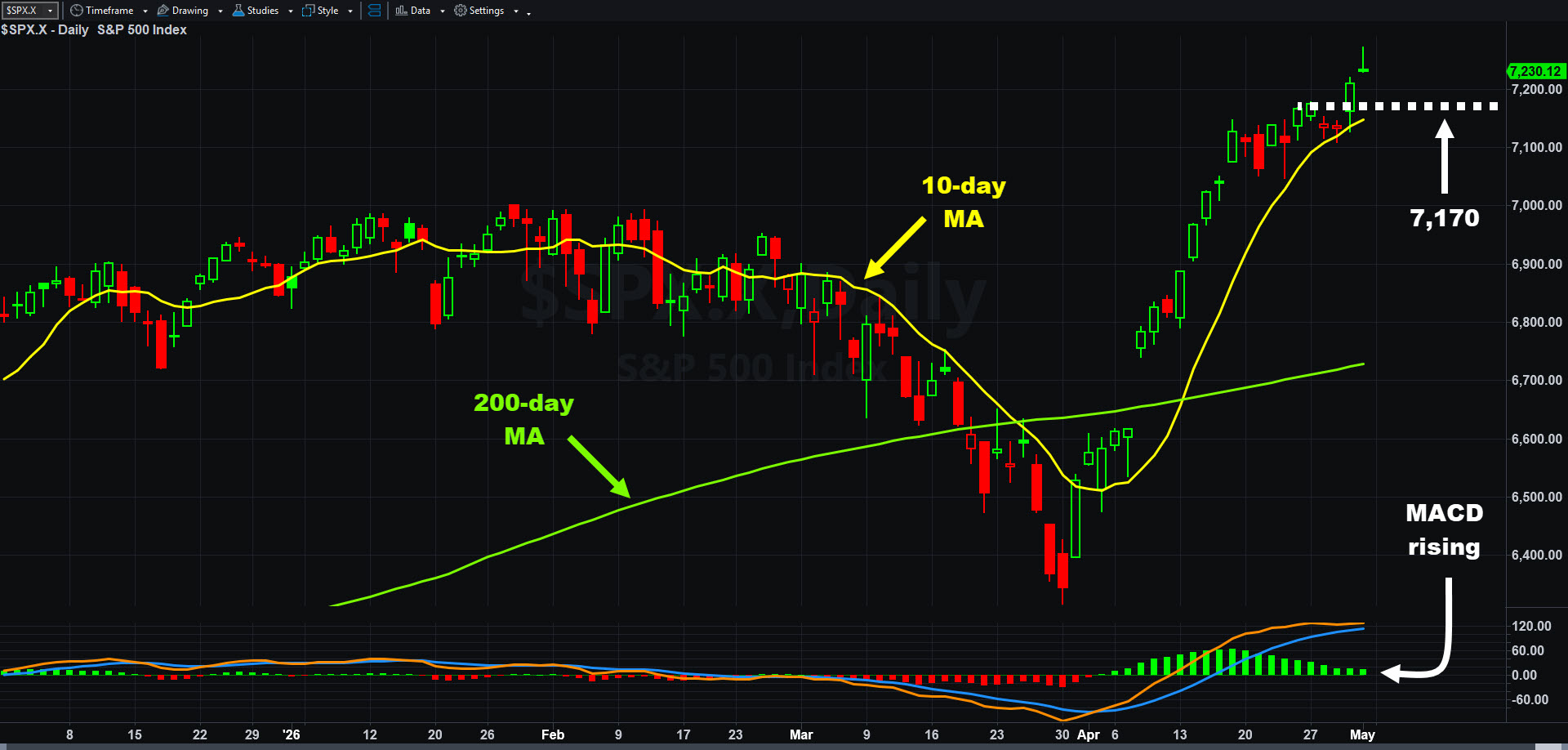
S&P 500, daily chart, with select patterns and indicators.
This week brings more earnings and some important economic events. The software industry, which has been showing signs of recovery, is especially active.
Norwegian Cruise Line (NCLH) reports this morning, followed by Palantir Technologies (PLTR) and On Semiconductor (ON) in the afternoon.
Tomorrow brings the Institute for Supply Management’s service-sector index and the government’s JOLTs job openings report. Pfizer’s (PFE) results are due in the premarket. Advanced Micro Devices (AMD), Super Micro Computer (SMCI) and Arista Networks (ANET) issue their numbers after the closing bell.
Tuesday also marks the beginning of the three-day Consensus conference, which may draw attention to cryptocurrencies.
Crude-oil inventories on Wednesday morning could matter more than usual because of the global energy crunch. ADP’s private-sector payrolls report and Walt Disney (DIS) earnings are also on the agenda.
Thursday features initial jobless claims and results from companies like Datadog (DDOG), McDonald’s (MCD) and Coinbase (COIN).
Friday brings the Labor Department’s key non-farm payrolls report and the preliminary reading of consumer sentiment.

The next phase of the AI trade could be taking shape as investors scramble for CPUs and analog chips.
First-quarter earnings season has begun with an explosive move in semiconductor and IT hardware stocks.

Is Oracle finally bottoming? Some traders may think it has.