
Stocks Climb as AI Demand Shifts to CPUs, Analog
The next phase of the AI trade could be taking shape as investors scramble for CPUs and analog chips.
The S&P 500 rose 0.5 percent between Friday, April 17, and Friday, April 24. While the index inched to a new all-time high, most of the big moves occurred in a narrow set of companies associated with the AI trade. Chipmakers led the surge again — especially companies providing CPUs.
“The CPU is reinserting itself as the indispensable foundation of the AI era,” Intel (INTC) CEO Lip-Bu Tan said after strong quarterly results drove the stock to a new record high. He added that data centers are using more CPUs as an “orchestration layer and control plane” as AI moves “from inference to agentic.”
Simply put, AI models are built (“trained”) with accelerators like Nvidia’s (NVDA) Blackwell GPUs. Those same chips were mostly used for inference (text and image generation). However more of that work is moving to simpler CPUs, especially as agents perform lower-level tasks.
Spreading awareness of CPU demand triggered rallies in other companies like Advanced Micro Devices (AMD) and Arm (ARM). Both report next week.
AI Halo Effect
NVDA had a new record closing price, returning above $5 trillion in market cap. That helped make semiconductors the leading group last week. They’re up 39 percent so far in April, putting them on pace for their biggest monthly gain since February 2000.
| Advanced Micro Devices (AMD) | +25% |
| United Rentals (URI) | +22% |
| Texas Instruments (TXN) | +21% |
| Intel (INTC) | +20% |
| On Semiconductor (ON) | +19% |
| Source: TradeStation data |
Many of last week’s other big gainers also benefited from AI demand. Texas Instruments (TXN) rose the most in 25 years after earnings and revenue beat estimates. Data centers are using more of its analog chips, which perform tasks like power management and signal handling. Rival On Semiconductor (ON) also jumped ahead of its quarterly report next week. MaxLinear (MXL), a smaller analog-chip firm, more than doubled on strong results and guidance. STMicroelectronics (STM), a larger European peer, climbed on similarly positive news.
United Rentals (URI), a provider of countless machines and tools, isn’t normally associated with technology. The same goes for oil-services provider Baker Hughes (BKR). However both beat estimates in part because of AI demand. URI noted data-center construction as a source of demand, while BKR helps install power in the complexes. Speaking of power, GE Vernova (GEV) said data-center orders in the first quarter alone exceeded all of last year.
Solar-energy companies (another beneficiary of AI power demand) rose last week. Oil and gas stocks rebounded from three weeks of downside. Steel Dynamics (STLD) rallied after management noted improving industry fundamentals. Fellow steelmaker Nucor (NUE) also jumped.
Charter, Lockheed
Charter Communications (CHTR) had its biggest weekly drop ever, according to TradeStation data. The cable company continues to struggle with the loss of traditional video customers. Rival Comcast (CMCSA) also fell despite strong results.
Tractor Supply (TSCO) had its worst week in decade after a shift towards pets missed expectations. Lululemon Athletica (LULU) dropped after announcing its new CEO won’t take the helm until September.
Lockheed Martin (LMT) had its biggest drop in six years after earnings and revenue missed estimates. Northrop Grumman (NOC) had its worst week since 2009 after reporting inline results. Both defense contractors are struggling despite increased military spending and conflict in the Middle East.
ServiceNow (NOW) and International Business Machines (IBM) declined on so-so quarterly results. The highlights the ongoing weakness in software companies in contrast to the strength in chips and hardware.
Fewer than 40 percent of S&P 500 members rose last week. Healthcare and communications were the weakest sectors. Goldminers and airlines also lagged.
Warsh and Powell
Last week had some big events that could help Kevin Warsh succeed Jerome Powell as Federal Reserve Chairman. Warsh first appeared before the Senate Banking committee for a confirmation hearing. Then on Friday, the Justice Department dropped a criminal probe into Powell. That potentially opens the door to Warsh getting the top job next month.
Speaking of the Fed, policymakers announce interest rates on Wednesday. Markets broadly expect little from the meeting.
| Charter Communications (CHTR) | -24% |
| Tractor Supply (TSCO) | -18% |
| Lululemon Athletica (LULU) | -14% |
| Northrop Grumman (NOC) | -14% |
| Lockheed Martin (LMT) | -13% |
| Source: TradeStation data |
Retail sales and pending home sales also rose more than expected last week.
FactSet separately noted strong earnings trends so far this season. Profits are rising 15.1 percent and margins hit the widest reading since at least 2009. Analysts expect further expansion, according to the research firm.
Charting the Market
The S&P 500 fluctuated just 1.7 percent between its high and low last week. That was its narrowest range since mid-January, a potential sign of limited selling pressure.
The index remained more than 2 percent above its previous peaks from late 2025 and early 2026, which may confirm a longer-term breakout.
Given the speed of its recent surge, chart watchers may expect consolidation and minor pullbacks. They may also view last week’s lows around 7,050 as potential support — especially if the Fed meeting triggers volatility.
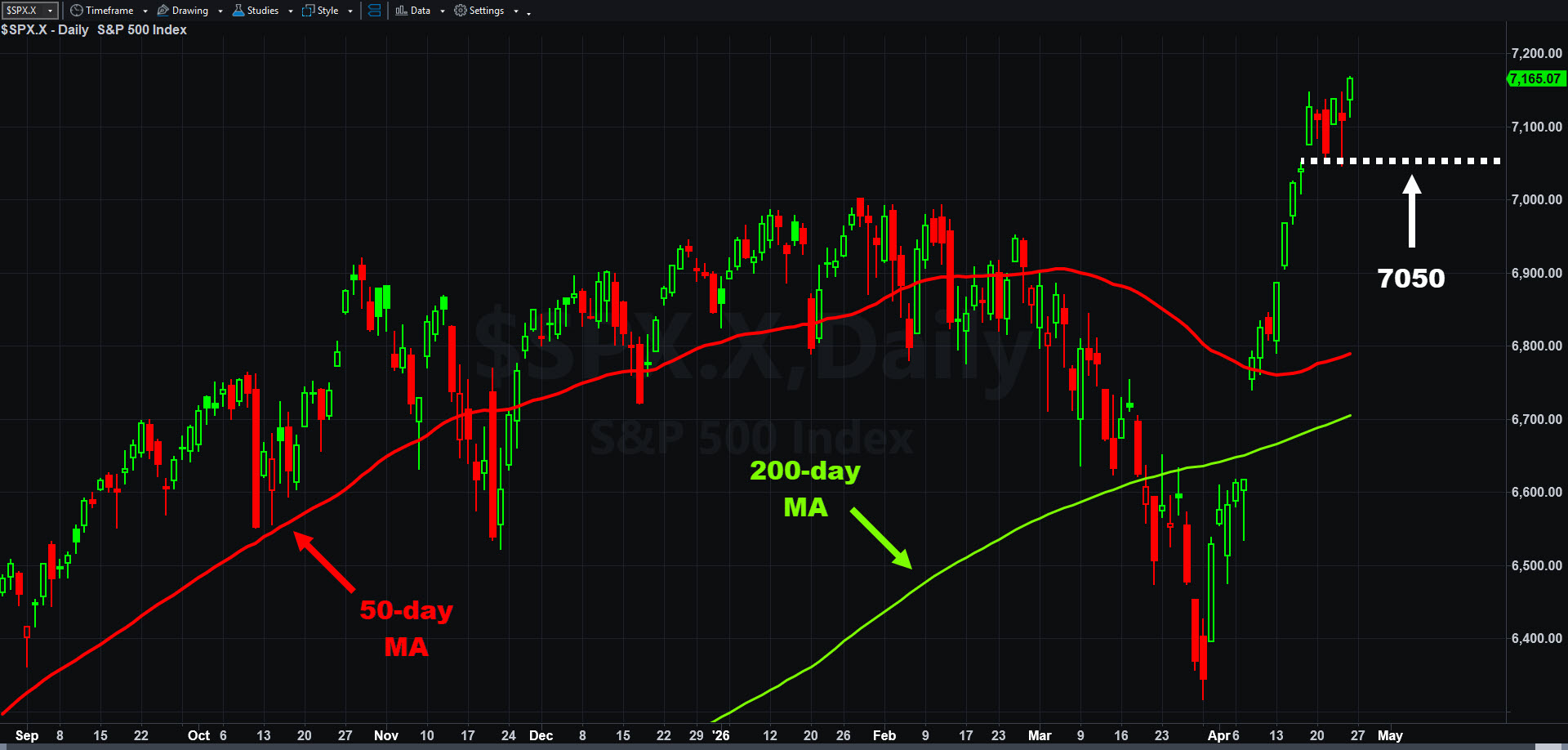
S&P 500, daily chart, with select patterns and indicators.
The Week Ahead
This week has a busy calendar. More than one-third of S&P 500 members announce quarterly results, including five companies with trillion-dollar market caps. There are also some important economic events.
Verizon Communications (VZ), Amkor Technology (AMKR), Celestica (CLS) and NUE report earnings. AMKR and CLS are related to some of the hardware themes that have recently outperformed.
Tomorrow brings consumer confidence, along with results from General Motors (GM), Coca-Cola (KO), Seagate Technology (STX), Corning (GLW), Robinhood (HOOD), Teradyne (TER), NXP Semiconductor (NXPI) and Visa (V). STX, GLW TER and NXPI are related to outperforming groups associated with AI datacenters.
Wednesday is a big day, with building permits, housing starts and crude oil inventories in the morning. The Fed’s monetary-policy announcement is at 2 p.m. ET, followed by a press conference 30 minutes later. Amazon.com (AMZN), Alphabet (GOOGL), Microsoft (MSFT) and Meta Platforms (META), Qualcomm (QCOM), Ford Motor (F) and eBay (EBAY) report in the post market.
Thursday morning brings more data points:
- The initial estimate of first-quarter gross domestic product
- Personal income, spending and the personal consumption expenditures (PCE) price index for March
- Initial jobless claims
Apple (AAPL), Caterpillar (CAT), MasterCard (MA), SanDisk (SNDK) and Western Digital (WDC) are some of the big earnings reports. SNDK and WDC are part of the memory and data-storage groups benefiting from the AI hardware boom.
The Institute for Supply Management’s manufacturing index is on Friday morning, along with results from Exxon Mobil (XOM), Chevron (CVX) and Moderna (MRNA).
.jpg&w=3840&q=75)