How Have Tech Stocks Traded Since Earnings?

Call Volume Spikes: Has Oracle Bottomed?
Is Oracle finally bottoming? Some traders may think it has.

Call toll-free 800.328.1267
Most technology companies have reported earnings, and prices are down.
The headlines began on January 28 when Microsoft (MSFT) and Meta Platforms (META) announced results. MSFT plunged on the news, enduring its sharpest decline since the pandemic. META tried to rally but immediately ran into a wall of sellers, finding itself below where it started.
Other companies like Advanced Micro Devices (AMD) have been swept lower. That combination of price action has depressed the tech-heavy Nasdaq-100, making it the worst-performing major index since earnings season began.
At least three major trends seem to be at work in the group.
First, technology outperformed for years as investors focused on its long-term growth potential. That pushed their valuations above most other sectors, and now they’re starting to normalize.
Second, investors are worried about data center costs. MSFT reported more capital spending than expected. META also faces higher outlays and Alphabet (GOOGL) is issuing debt to finance construction. Amazon.com (AMZN) fell sharply after saying it would spend $200 billion, about $50 billion more than expected.
Third, fundamentals are an issue as Wall Street questions both the quality and durability of earnings. MSFT predicted weaker margins and is increasing its reliance on OpenAI — a single unprofitable customer. There are also anxieties about AI cannibalizing businesses like data analytics, consulting and software development.
Traders positioning for downside before the reports could have profited as the broader indexes fell. Let’s consider two strategies customers might have used to capitalize on the move.
First is the bearish debit spread using puts on QQQ Trust (QQQ), which tracks the Nasdaq-100. MSFT, AMZN and META are among its biggest holdings.
A debit spread involves buying calls or puts near the money. These can appreciate from a directional move. (Puts fix the price where a stock can be sold, so they gain value to the downside. Calls set a buying price, so they perform the opposite way.)
Debit spreads also involve selling an equal number of options further from the money. This reduces the overall cost of the position, creating potential leverage from a defined move.
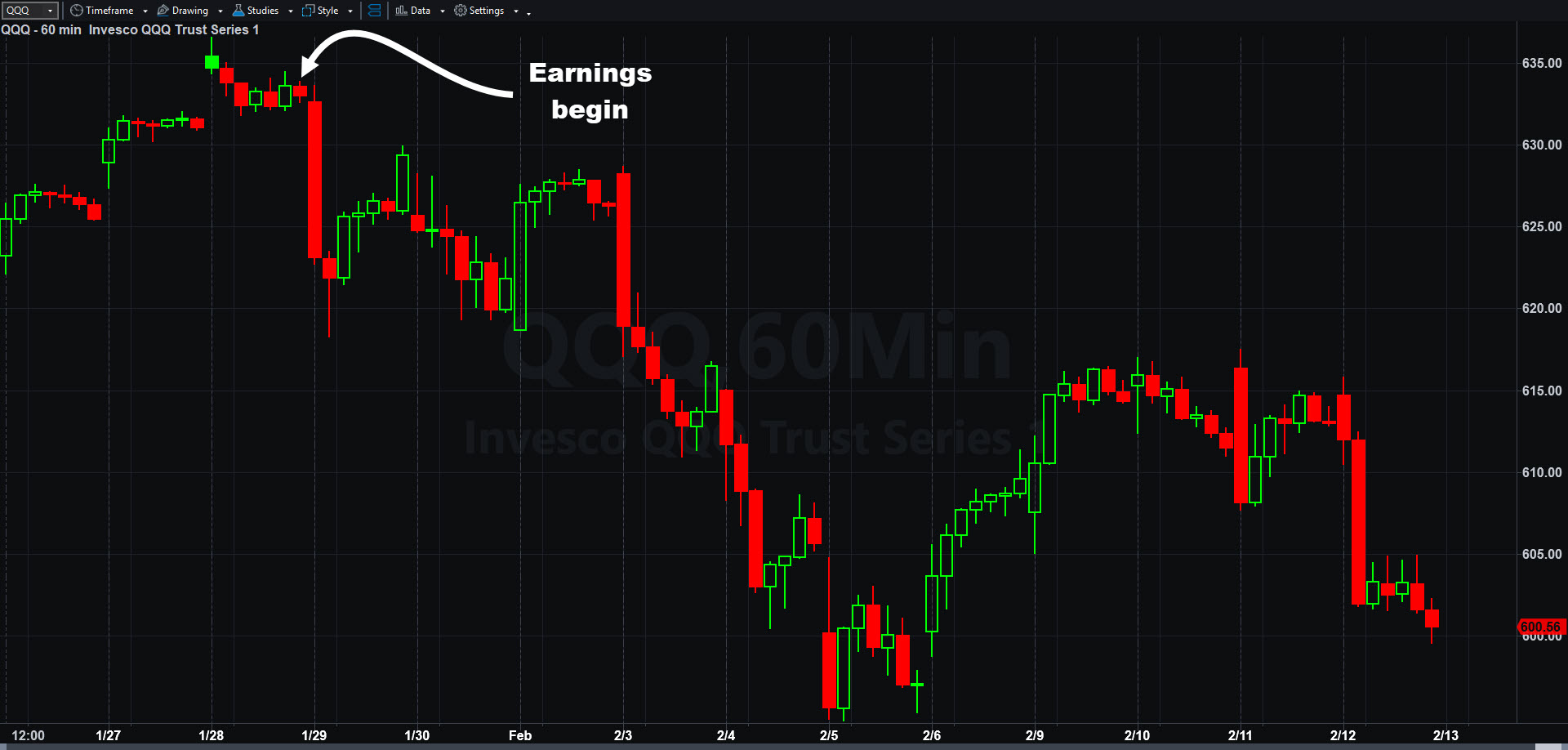
QQQ Trust (QQQ), hourly chart, showing the start of tech earnings.
Bearish put spreads mostly profit from prices falling. Traders can use them to simulate short positions in stocks and ETFs. They’re often used for hedging around big events like earnings or economic news.
Debit spreads are also called “vertical” spreads because they use different strikes with the same expiration.
QQQ closed at $633.22 on January 28, immediately before MSFT issued results. A trader might have used monthly options, with contracts expiring next Friday, February 20.
He or she could have purchased the 620 puts for about $6.65 and sold the 615 puts for $5.30, translating into a cost of $1.35. The position was worth about $3.50 yesterday and could expand to $5 if QQQ remains below $615 at the closing bell today. That could translate into a gain of 270 percent from the underlier moving 2.9 percent.
Another potential downside trade could have used CME’s E-Mini Nasdaq-100 futures, which track the same underlying index. Traders can go short Nasdaq futures to position for a decline or long to profit from a rally. Futures trade virtually around the clock, letting orders get filled outside normal U.S. hours. (The QQQ spread cited above, on the other hand, can only be transacted between 9:30 a.m. ET and 4 p.m. ET.)
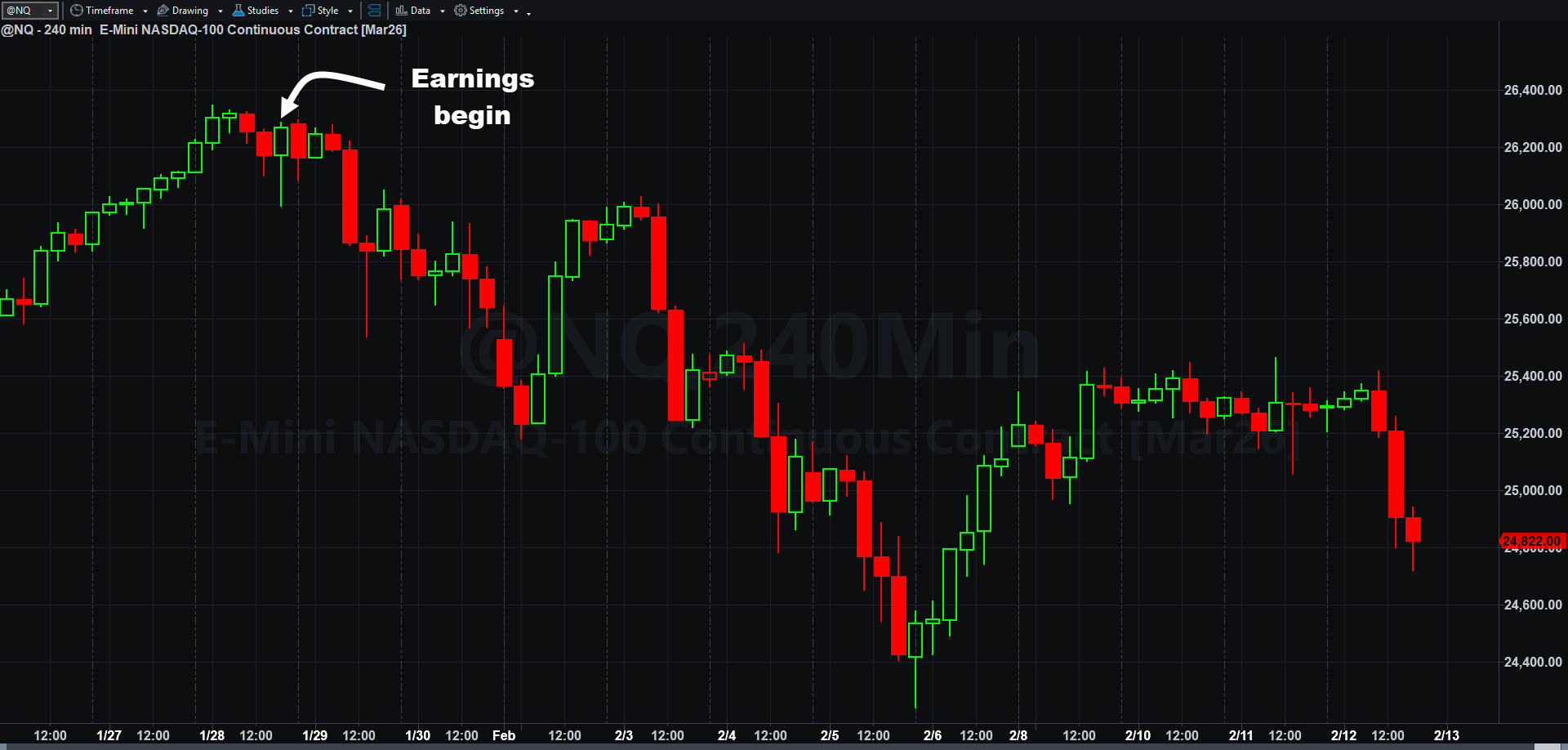
E-Mini Nasdaq-100 futures (@NQ), with four-hour bars, showing the start of tech earnings.
CME’s E-mini Nasdaq-100 futures track the Nasdaq-100 with a value of $20 per point. A trader short one contract will see his or her account increase by $20 every 1 point the index falls. Conversely, they stand to lose $20 each point it rises.
E-mini Nasdaq-100 futures trade in quarter points, which each having a value of $5.
The root symbol is NQ. Futures also have expiration months (expressed with a unique letter) and years. The current contract expires in March.
“H” is the identifier for March, so its symbol is NQH26. (Natural born traders using TradeStation know “@NQ” tracks previous contracts historically over time, giving continuous price data for years into the past.)
NQH26 traded for 26,149.50 shortly before MSFT announced results on January 28. It’s mostly trended lower and closed at 24,822 yesterday. A single short contract would have gained about $26,550. (See our margin requirements page for more.)
Two more key technology companies have yet to report earnings:
Their numbers could potentially impact the Nasdaq-100 and technology stocks.
Attention could also focus on borrowing by large technology companies. GOOGL sold $20 billion of debt securities this week. ORCL and META have issued notes and bonds since late 2025. Wall Street may increasingly monitor how those securities trade in the secondary market as a gauge of sentiment.
In conclusion, large technology companies have lagged in 2026 following years of outperformance. Investors have seized on earnings season as an opportunity to exit positions, even when companies beat estimates. That may suggest the market has entered a longer period of profit taking and volatility. If that’s the case, active traders may find more opportunities for using the options and futures strategies discussed above.
| ETF | 1 Year | 5 Years | 10 Years |
| Invesco QQQ Trust (QQQ) | +19.07% | +97.83% | +498.47% |
| As of January 30, 2026. Based on TradeStation data. |
Exchange Traded Funds (“ETFs”) are subject to management fees and other expenses. Before making investment decisions, investors should carefully read information found in the prospectus or summary prospectus, if available, including investment objectives, risks, charges, and expenses. Click here to find the prospectus.
Performance data shown reflects past performance and is no guarantee of future performance. The information provided is not meant to predict or project the performance of a specific investment or investment strategy and current performance may be lower or higher than the performance data shown. Accordingly, this information should not be relied upon when making an investment decision.
Futures trading is not suitable for all investors. To obtain a copy of the futures risk disclosure statement visit www.TradeStation.com/DisclosureFutures.
Options trading is not suitable for all investors. Your TradeStation Securities’ account application to trade options will be considered and approved or disapproved based on all relevant factors, including your trading experience. See www.TradeStation.com/DisclosureOptions. Visit www.TradeStation.com/Pricing for full details on the costs and fees associated with options.
Margin trading involves risks, and it is important that you fully understand those risks before trading on margin. The Margin Disclosure Statement outlines many of those risks, including that you can lose more funds than you deposit in your margin account; your brokerage firm can force the sale of securities in your account; your brokerage firm can sell your securities without contacting you; and you are not entitled to an extension of time on a margin call. Review the Margin Disclosure Statement at www.TradeStation.com/DisclosureMargin.

Is Oracle finally bottoming? Some traders may think it has.

Chipmakers are trying to break out as investors brace for a potential oil shock.

Discover how TradeStation’s TITAN X simplifies options trading with a fast, intuitive interface
built for strategy-focused traders. From analyzing setups to executing a bull call spread,
learn how to analyze risk, customize trades, and manage positions with precision.