Anxiety Grows as Software Crumbles

Is the Clock Ticking With Hormuz Still Closed?
Stocks face big tests as investors watch for signs of the Hormuz crisis improving.

Call toll-free 800.328.1267

Anxiety may be growing in the stock market as a key industry crumbles.
The S&P 500 rose 0.3 percent between Friday, January 23, and Friday, January 30. It was the smallest weekly move since the period before Christmas.
Still, there was drama beneath the surface as software stocks ended January down 15 percent. It was the industry’s worst month since the subprime crisis of October 2008. Semiconductors, on the other hand, climbed 13 percent. It was the widest divergence between the two tech buckets in over 20 years, according to TradeStation data.
Companies like Microsoft (MSFT) and ServiceNow (NOW) both fell despite beating profit and revenue estimates. There were concerns about MSFT’s growing reliance on OpenAI and capital spending, but something bigger might be going on.
After all, other software firms like Palantir Technologies (PLTR), Intuit (INTU) and Salesforce (CRM) slid without quarterly results. There has also been a steady trickle of analyst markdowns, with price targets lowered on firms like Commvault (CVLT), Varonis Systems (VRNS), Doximity (DOCS), Atlassian (TEAM) and C3.ai (AI). (That followed a similar pattern the previous week.)
Most of these companies can be considered “long-duration” assets because they’re valued on long-term growth expectations. That makes them vulnerable to higher interest rates, which raise the cost of capital. Last week was potentially negative on that front, with yields rising and wholesale inflation exceeding expectations.
| Humana (HUM) | -27% |
| Axon Enterprise (AXON) | -21% |
| UnitedHealth (UNH) | -19% |
| Trade Desk (TTD) | -17% |
| Carvana (CVNA) | -15% |
| Source: TradeStation data |
Second, many software companies face worries about slower growth.
In other words, the macro environment could be getting less favorable at the same time their fundamentals weaken. Will this backdrop be a factor when PLTR reports this afternoon? (It’s arguably the “most expensive” member of the S&P 500, with a price-to-sales ratio of 93 times.)
Last week also saw dramatic moves in metals like gold, silver and copper. Each hit new record highs but closed down after dramatic reversals in the overnight session between Thursday and Friday. The drops followed three months of uninterrupted gains in precious metals.
The triggering event was President Trump announcing he would nominate Kevin Warsh to replace Jerome Powell as chairman of the Federal Reserve. Warsh is viewed as a conventional pick, with less risk of bending to political pressure. That stabilized the U.S. dollar after it touched its lowest level in almost four years.
Health insurers like UnitedHealth (UNH) and Humana (HUM) dropped last week after the government proposed lower than-expected Medicare Advantage rates. Trade Desk (TTD) fell along with other software companies and Carvana (CVNA) dropped after a bearish report from Gotham City Research.
SanDisk (SNDK) and Seagate Technology (STX) rallied on strong demand for data storage. Deckers Outdoors (DECK), Royal Caribbean (RCL) and Southwest Airlines (LUV) jumped after announcing results.
Energy stocks were the best performers last week as crude-oil futures hit a six-month high. Communication stocks rose after strong earnings lifted Meta Platforms (META), AT&T (T) and Verizon Communications (VZ).
The Fed left interest rates unchanged last week after cutting in September, October and December. It was an uneventful meeting, with policymakers noting the strong economy and lingering inflation.
Speaking of inflation, the producer price index (PPI) rose more than twice estimates as companies started passing along some tariff costs.
Consumer confidence fell more than expected to its lowest level in more than a decade amid worries about inflation and jobs.
| SanDisk (SNDK) | +22% |
| Deckers Outdoors (DECK) | +19% |
| Seagate Technology (STX) | +18% |
| Royal Caribbean (RCL) | +13% |
| Southwest Airlines (LUV) | +13% |
| Source: TradeStation data |
The S&P 500 remained in a tight range, apparently reflecting investor uncertainty.
The index tested 7,000 for the first time on Wednesday before pulling back. It’s made slightly higher highs for months without a significant breakout. (Last week’s peak was 1.2 percent above the late October.)
While chart watchers may not view the price action as explicitly bearish, it could reflect weak momentum and develop into a topping pattern.
The small moves have compressed Bollinger Band Width to the bottom of its long-term range. That may suggest prices are stalling, with more risk of a downside reversal.
The stochastics oscillator has additionally turned lower after hitting an overbought condition.
Traders could watch the 50-day moving average or the January 20 low of 6,789 as potential support. Crossing under those levels may be viewed as a breakdown. Crossing decisively above 7,000 and remaining there could be viewed as a bullish breakout.
Price action outside the S&P 500 may show risks as well. For example, the 10-year U.S. Treasury yield has crossed above a potentially important level at 4.20 percent. Cboe’s volatility index (VIX) has also been trending higher since Christmas.
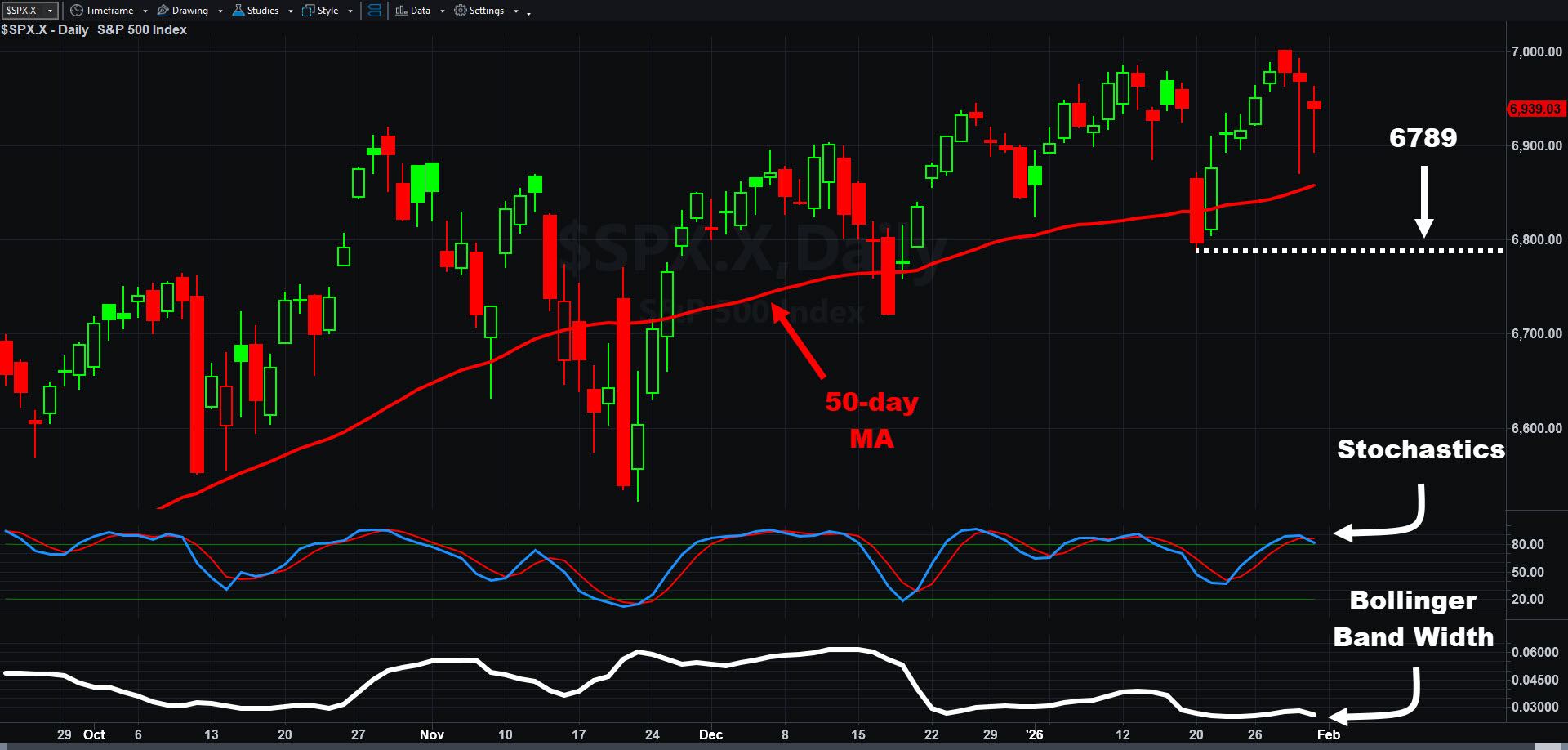
S&P 500, daily chart, with select patterns and indicators.
This week is the busiest reporting time of earnings season, with about one-quarter of the S&P 500 issuing results.
Today’s main items are news from the last OPEC+ meeting and the Institute for Supply Management’s manufacturing index. Walt Disney (DIS) reports in the premarket, followed by PLTR after the closing bell.
Tomorrow brings the JOLTs job openings report in the morning and results from Advanced Micro Devices (AMD) in the afternoon.
ADP’s private-sector payrolls report, ISM’s service-sector index and crude-oil inventories are due on Wednesday. Eli Lilly (LLY) and Alphabet (GOOGL) report earnings.
Thursday features initial jobless claims and results from Amazon.com (AMZN).
The key monthly nonfarm payrolls report is on Friday morning, along with consumer sentiment.

Stocks face big tests as investors watch for signs of the Hormuz crisis improving.

Transocean began the year with a steady rally. Now, after a brief period of consolidation, some traders may expect further gains.

The pain is growing on Wall Street as fighting escalates in the Middle East.