Could Peace with Iran Change the Stock Market?

Investors could be rotating to small caps and value stocks as the Iran conflict winds down and Kevin Warsh takes over the Federal Reserve.
The S&P 500 bounced 0.6 percent between Friday, June 5, and Friday, June 12, following a sharp drop the previous week. However the Russell 2000 climbed 4.6 percent, outperforming the S&P 500 by the widest margin since President Trump's reelection in November 2024. Airlines, banks, retailers and materials were some of the top gainers. Those are the kind of stocks that could benefit from lower oil prices and lower inflation.
"Assessments and expectations of personal finances and business conditions all rose this month," economist Joanne Hsu noted in the University of Michigan's preliminary consumer sentiment report. The "improvement in sentiment was widespread, seen across age, education, and political party" because of lower gasoline prices, she added. Inflation expectations also fell.

Pakistan said on Saturday that the U.S. and Iran could sign a preliminary peace deal over the weekend, followed by more talks this week. Oil slid in anticipation of the agreement, causing interest-rate futures to anticipate fewer rate hikes. CME's FedWatch tool shows a 40 percent probability of the target rate staying the same this year, up from 29 percent a week before. There's still a 42 percent chance of at least one increase, but odds of two or three hikes diminished.
Chips vs Software
Semiconductors remained the top-performing group last week, bouncing 9.4 percent. The industry also accounted for the five biggest gainers in the S&P 500. However software providers like Oracle (ORCL) and Adobe (ADBE) fell sharply. That continued a pattern of the AI boom favoring chips and hardware while software companies struggle.
Biggest Gainers in the S&P 500 Last Week | |
|---|---|
| KLA (KLAC) | +32% |
| SanDisk (SNDK) | +27% |
| Intel (INTC) | +26% |
| Applied Materials (AMAT) | +25% |
| Lam Research (LRCX) | +25% |
| Source: TradeStation data | |
ORCL had its biggest weekly drop in eight years after saying it would raise more capital to finance AI infrastructure. Super Micro Computer (SMCI) also fell on capital raising, even though it's not a software company.
ADBE had its biggest drop in more than three years after saying it will offer more free access as the spread of AI changes customer behavior.
Business software company PTC (PTC) had its biggest weekly drop since 2012. It's lost 44 percent of its value since August on AI threats to its business and slower recurring revenue growth. Autodesk (ADSK), which competes in some markets, declined the most in over four years.
These cases are potentially consistent with the "SaaS-pocalypse" that has dragged on software companies since late 2025.
SpaceX IPO
Space Exploration Technologies (SPCX) -- widely known as SpaceX -- sold $75 billion of shares in the biggest IPO ever. The offering confirmed Elon Musk's status as the world's first trillionaire. The deal was designed to attract retail investors. The price was also kept at $135 despite heavy demand, resulting in a 19 percent jump on the first day.
Biggest Decliners in the S&P 500 Last Week | |
|---|---|
| Super Micro Computer (SMCI) | -27% |
| Adobe (ADBE) | -19% |
| PTC (PTC) | -17% |
| Oracle (ORCL) | -14% |
| Autodesk (ADSK) | -14% |
| Source: TradeStation data | |
Other major IPOs of technology and growth stocks are expected to follow later this year. The Wall Street Journal reported that OpenAI may target a $1 trillion valuation in September. Anthropic has eyed a similar timing and valuation. Databricks and Perplexity are also expected in late 2026 or early next year.
Last week also had a few noteworthy comments from analysts and strategists:
- Cameron Dawson of NewEdge Wealth said profit growth may continue to beat estimates, given strong new orders tracked by the Institute for Supply Management.
- Jefferies raised its price forecast for copper from $6 to $8 based on strong demand.
- Bank of America upgraded Intel (INTC) two notches from Underperform to Buy, citing demand for CPUs and contract chipmaking.
- Citi raised Advanced Micro Devices (AMD) from Neutral to Buy, citing demand for GPUs.
- Apple (AAPL) declined after its Worldwide Developers Conference (WWDC), but some analysts modestly increased their price targets.
Inflation and the Fed
The consumer price index (CPI) rose 4.2 percent year-over-year in May, the highest reading in three years. While energy drove the surge, there were signs of price trends easing. Shelter and clothing both rose 0.3 percent month over month, half the reading in April. New car prices fell 0.3 percent and auto insurance dropped 1.7 percent. Food prices excluding soft drinks mostly fell. Core inflation was slightly below estimates on a month-over-month basis.
Inflation-protected securities (TIPS) saw their breakeven rates drop to 2.39 percent, comparable with levels before the Iran war.
Those points will be important as Warsh takes leadership of the Fed at the meeting tomorrow and Wednesday. Policymakers are expected to leave rates unchanged, especially because of the recent inflation spike and strong employment trends.
However, some investors may look past those issues if energy prices moderate. The statement and forecasts (including the "dot plot") are released at 2 p.m. ET on Wednesday, followed by Warsh's press conference 30 minutes later. The new chairman has given few clues about his views of the economy and expressed skepticism about central bank messaging, so the impact of his comments is unclear.
Charting the Market
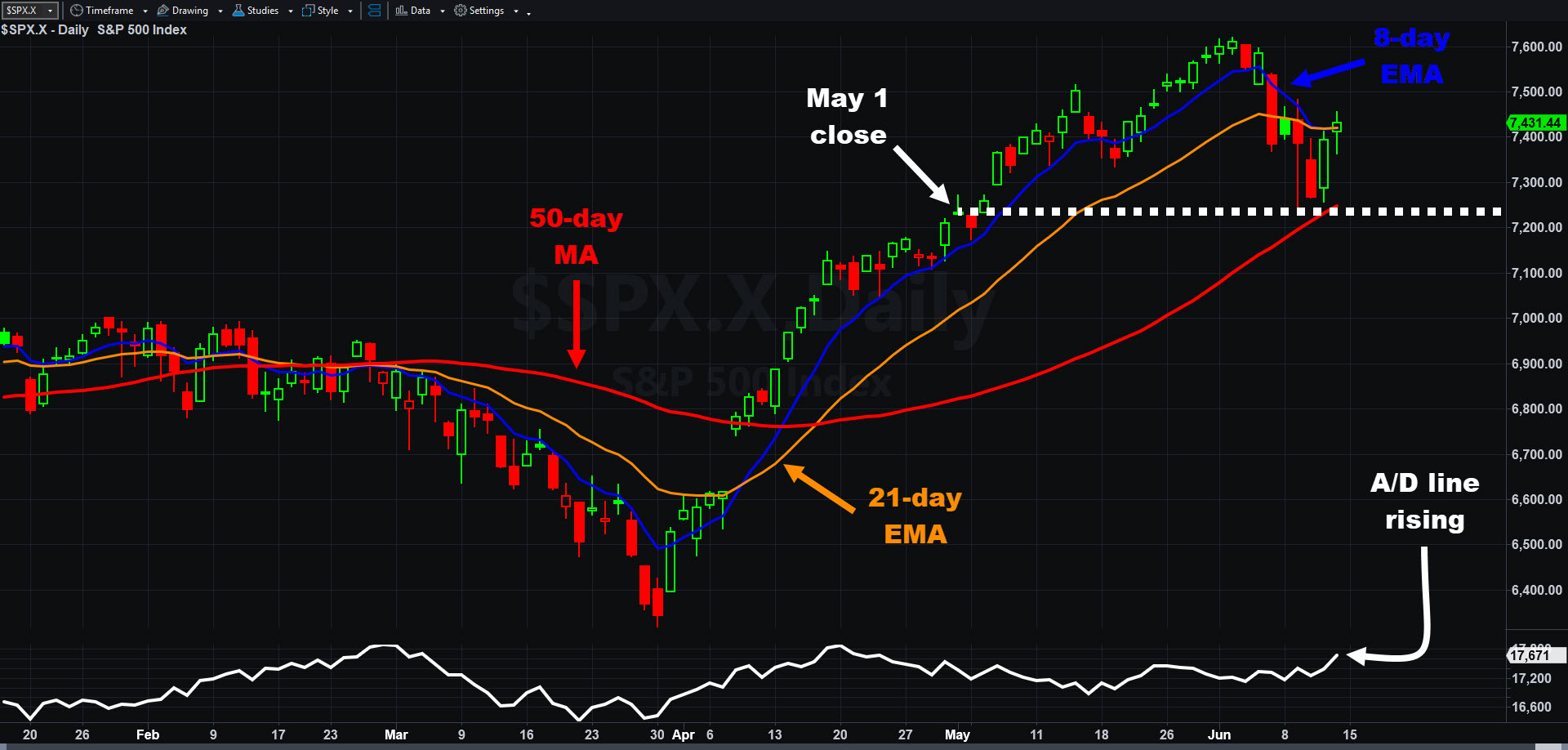
Last week's price action may suggest the S&P 500 remains in an uptrend following its recent pullback.
First came a small bullish inside candle on Monday, followed by a large bearish outside bar on Tuesday. A bearish inside day occurred the next session, and then a bullish outside move on Thursday. Those four candles may reflect a tug-of-war between sellers and buyers that ended with resolution to the upside.
Second were signs of improving breadth: The number of index members above their 20-day moving average rose sharply and the advance/decline (A/D) line reached its highest level since April 21. More than two-thirds of the S&P 500's members rose last week.
Third, prices stabilized around the converging 8- and 21-day exponential moving averages.
Next, the weekly low occurred around the weekly closing price on May 1. (It was a record at the time.) Has an old high become new support?
Some traders may also notice that Cboe's volatility index (VIX), the U.S. dollar index and the 10-year Treasury yield have stayed below recent peaks. Those intermarket conditions may reflect positive risk appetite.
A survey by the American Association of Individual Investors (AAII) also showed bullishness hitting the lowest level since March. The National Association of Active Investment Managers (NAAIM) reported similar caution. Those sentiment measures are often viewed as contrary indicators that may suggest selling has already taken place.
The Week Ahead
The Juneteenth holiday on Friday limits this week to four trading sessions. Wednesday is likely the busiest day, and developments involving the Strait of Hormuz could also impact trading.
This morning features NAHB's homebuilder sentiment index.
Housing starts and building permits tomorrow could also impact homebuilders.
Wednesday morning brings retail sales and earnings from Jabil (JBL). The Fed's announcement is at 2 p.m., followed by Warsh's public comments.
Initial jobless claims are on Thursday morning. Accenture (ACN) and Kroger (KR) report earnings. It's also quadruple witching day, with options and futures contracts expiring.
Markets are closed on Friday.