Global markets trade almost around the clock, and many active traders follow price action overseas before the U.S. session begins. Two noteworthy European futures products are the DAX Index futures and Euro Bund futures. Both trade on Eurex, a Frankfurt-based derivatives exchange focusing on stocks and fixed-income.
The DAX index tracks 40 of Germany’s largest and most actively traded companies. It’s similar to the S&P 500 for the United States, a broad list of widely known companies. Some of its big members include SAP, Siemens and and Allianz.
DAX Futures
Traders can access the DAX in three sizes:
- Standard DAX futures: The largest product, which fluctuates 25 euros per index point.
- Mini-DAX futures: A mid-sized product that moves 5 euros per index point.
- Micro-DAX futures: The most accessible for retail investors, moving 1 euro per index point.
DAX futures share the same expirations as CME’s contracts tracking the S&P 500 (@ES) or Nasdaq-100 (@NQ).
- They have the same expiration dates on “quadruple witching days”: the third Fridays of March, June, September and December.
- They’re also cash-settled. That means gains are credited to accounts and losses are debited. There’s no delivery of underlying securities.
The main difference is the hours: DAX futures trade from 1:10 a.m. to 10:00 p.m., Frankfurt time. That translates to 7:10 p.m. to 4:00 p.m. ET, though start times may shift by one hour during the spring and fall time changes.
Within that time window, some traders target activity around these key times for stock markets:
- 3 a.m. ET: European stock market opens
- 9:30 a.m. ET: U.S. stock market opens
- 11:30 a.m. ET: European stock market closes
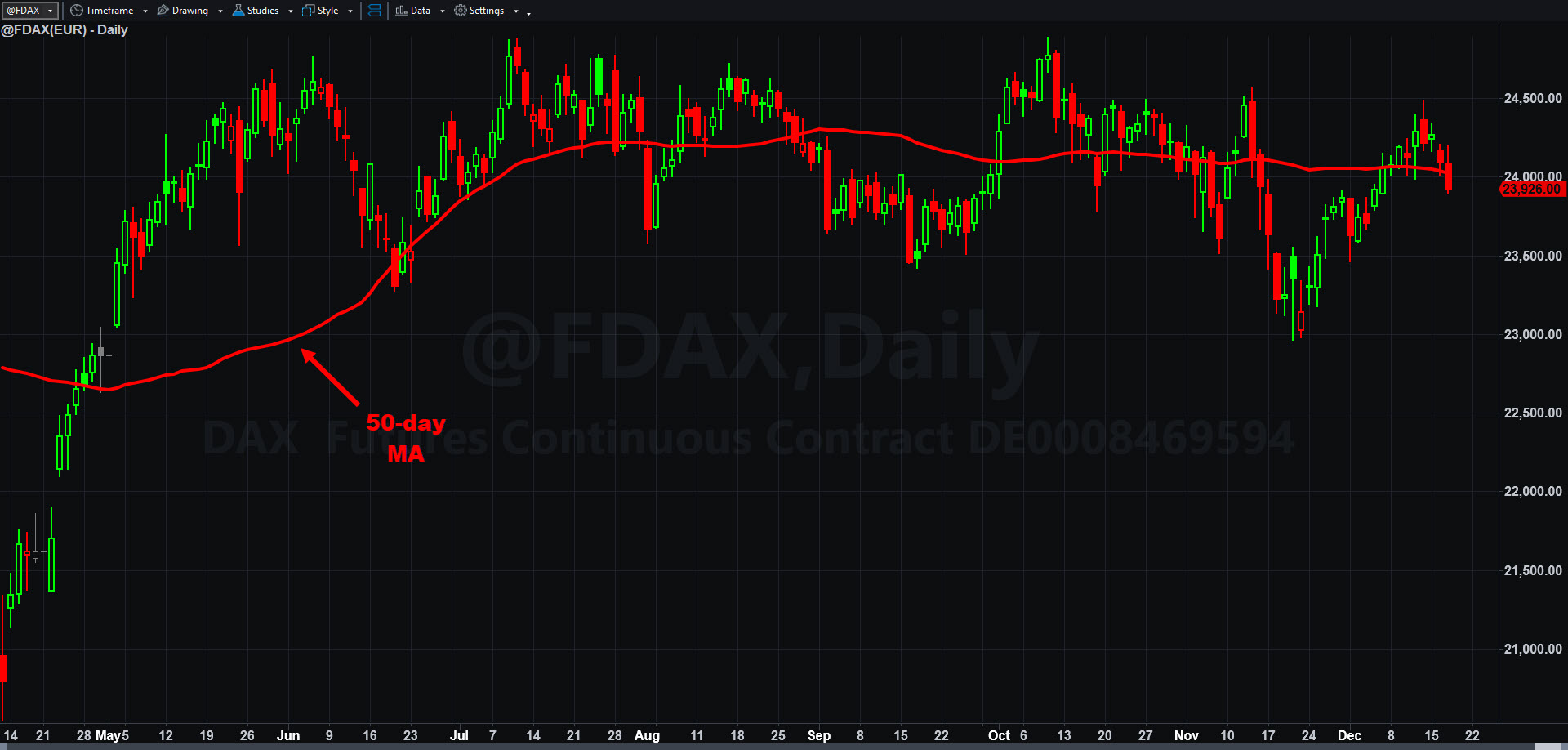
DAX Futures (@FDAX), daily chart, with select studies.
Euro Bund Futures
Euro Bund futures are another Eurex product available to U.S. customers. They track German government bonds with maturities similar to 10-year U.S. Treasury notes. (Actual maturities range from 8.5 to 10.5 years.) The yields on these securities play a key role in setting eurozone borrowing costs.
Euro Bund futures expire in March, June, September and December. They also follow the same trading hours as DAX futures. Unlike DAX futures, they are physically deliverable and stop trading earlier in the contract month (before quadruple witching day).
They tend to follow interest-rate trends (although prices and yields move in the opposite direction). They may be especially active during European Central Bank meetings.
| Product |
Expiration |
Next Contract |
Continuous
Contract |
| DAX Futures (FDAXZ25) |
12/19/25 |
FDAXH26 (3/20/26) |
@FDAX |
| Mini-DAX Futures (FDXMZ25) |
12/19/25 |
FDXMH26 (3/20/26) |
@FDXM |
| Micro-DAX Futures (FDXSZ25) |
12/19/25 |
FDXSH26 (3/20/26) |
None |
| Euro Bund Futures (FGBLH26) |
3/6/26 |
FGBLM26 (6/8/26) |
@FGBL |
| Source: TradeStation data |
|
|
|
Futures trading is not suitable for all investors. To obtain a copy of the futures risk disclosure statement visit www.TradeStation.com/DisclosureFutures.