
Trade War Hits Stocks Before Earnings Reports
Stocks tumbled last week as the trade war against China resumed, but the tune could change as earnings arrive.
The S&P 500 rose between Monday and Thursday, and at one point was up 0.7 percent. But the index plunged on Friday after President Trump threatened new tariffs against China, resulting in a 2.4 percent decline between October 3 and October 10 — the biggest weekly drop since May.
Futures dropped another 1 percent in extended hours after Trump added the tariff rate would be 100 percent. He also announced export controls on “all critical software.” However, prices rebounded Sunday night after the president said “don’t worry about China, it will all be fine.”
The red ink was widespread: Some 83 percent of the S&P 500’s members lost value. Seventeen fell at least 10 percent, while only one rose double digits. Of the 11 major sectors, the only two with gains were utilities and consumer staples — normally considered safe havens.
Energy fell the most. Crude-oil inventories rose more than expected and the Gaza ceasefire eased geopolitical risks. Bloomberg and Vortexa also noted large amounts of unused liquids on tankers because of rising global output. The resulting selloff in crude oil and energy stocks broke a tight range on both charts. Will traders press the downside?
Homebuilders had their worst week since June 2022 after Evercore ISI downgraded D.R. Horton (DHI). Automakers, retailers and casinos also fell. That made consumer discretionary stocks the second-worst U.S. sector last week. That may reflect worries about the holiday-shopping season. See below for more.
AppLovin (APP) rallied in September after being added to the S&P 500. Last week it fell after Bloomberg reported that the U.S. Securities and Exchange Commission was investigating potential terms-of-service violations.
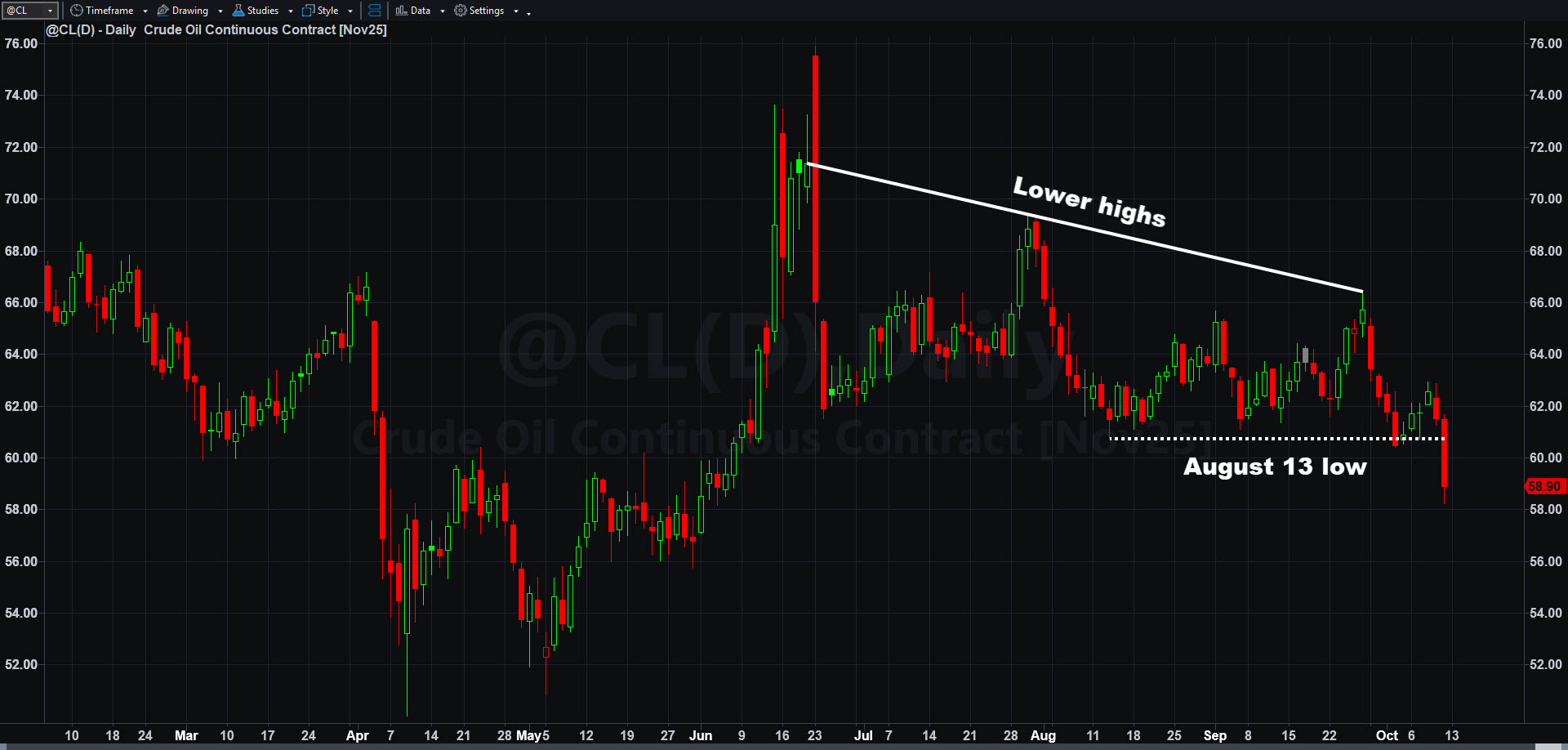
Crude oil futures (@CL), daily chart, with select patterns marked.
Cyclical Weakness
Stanley Black & Decker (SWK) fell for no clear reason, however the decline was consistent with the theme of weakness in cyclical names like energy and retail.
Data-storage firm Seagate Technology (STX) pulled back after more than tripling in the last six months.
| AppLovin (APP) | -17% |
| Seagate Technology (STX) | -15% |
| Stanley Black & Decker (SWK) | -15% |
| D.R. Horton (DHI) | -13% |
| Dow (DOW) | -13% |
| Source: TradeStation data |
Other groups that fell last week included Chinese stocks like Alibaba (BABA) and Baidu (BIDU). Banks and Latin American stocks also struggled.
Chemical companies like Dow Chemical (DOW) declined broadly amid weakening demand and bloated inventories. Citi lowered estimates on several companies in the group and predicted more “downward revisions.” Trade wars have hurt the industry by reducing global demand and disrupting supply chains.
Biotechs and metals were green. Gold traded above $4,000 per ounce for the first time and silver flirted with $50.
Speaking of precious metals, Goldman Sachs said bullion may reach $4,900 by the middle of next year. Bank of America strategist Michael Hartnett is eyeing $6,000.
Tariffs and Trade
Trump’s announcement on Friday wasn’t the only tariff-related news last week. Other headlines accumulated as the U.S. and China prepared for negotiations between Presidents Trump and Xi.
On Thursday, Beijing tightened control on exports of rare-earth minerals, boosting stocks like Critical Metals (CRML), USA Rare Earth (USAR), Metals Co. (TMC) and MP Materials (MP). The Pentagon also bought a 10 percent stake in Trilogy Metals (TMQ), which has interests in North American mineral deposits. (It’s not a “rare earth” play because it focuses on base metals like copper and cobalt.)
Several headlines appeared on Friday in addition to the 100 percent tariff announcement:
- Beijing imposed fees on U.S. ships docking at Chinese ports in response to a similar action by Trump in April slated to take effect tomorrow. (China’s move is largely symbolic because the U.S. builds and owns few vessels.)
- Qualcomm (QCOM) dropped 7.3 percent after Chinese regulators probed an acquisition by the U.S. company.
- The Financial Times reported Beijing would tighten import restrictions on Nvidia (NVDA) chips.
- U.S. Federal Communications Commission Chair Brendan Carr said U.S. retailers have removed listings for millions of Chinese electronics.
- The U.S. announced tariffs of at least 100 percent on Chinese container cranes used in ports.
Separately, the impact of tariffs was felt in a handful of companies issuing results. Levi Strauss (LEVI) warned of margin pressure in the current quarter and McCormick (MKC) lowered its full-year forecast. Jefferies also downgraded Dollar Tree (DLTR), in part because of tariff costs.
Shutdown, Shipping, Fed
The federal government shutdown entered its first full week with lawmakers still far from reaching an agreement. The White House reversed an earlier policy granting backpay for lost time and started laying off employees. Economists may start worrying about the economic impact the longer the impasse continues.
There was also negative news in the shipping space, which may reflect the impact of tariffs and a weakening economy. The Logistics Manager’s Index defied normal seasonal trends by falling in September. The survey showed spare capacity for shipping capacity at a time that’s usually active into yearend.
“Inventory is going to be lean this holiday shopping season,” CNBC reporter Lori Ann LaRocco said of the report. She added that merchandise should be moving in this month, but ocean shipping data suggests “it isn’t there.”
Separately, J.P. Morgan downgraded FedEx (FDX) to Neutral, saying the company’s turnaround requires a healthy freight market.
The Federal Reserve also released minutes from its last meeting. Policymakers expressed mixed views, favoring more rate cuts while also remaining alert to further inflationary pressures.
AMD Breaks Out
| Advanced Micro Devices (AMD) | +31% |
| Dell Technologies (DELL) | +7% |
| Arista Networks (ANET) | +5.9% |
| Netflix (NFLX) | +5.8% |
| PepsiCo (PEP) | +5.7% |
| Source: TradeStation data |
Advanced Micro Devices (AMD) had its biggest weekly gain in nine years after agreeing to provide OpenAI with 6 gigawatt of chips. OpenAI, the parent of ChatGPT, will also receive warrants for 160 million AMD shares.
Dell Technologies (DELL) climbed after roughly doubling its long-term growth estimates from 3-4 percent to 7-9 percent.
Applied Digital (APLD) jumped to a new all-time high after beating estimates. Analysts also made positive comments about the data-center operator’s long-term growth.
AI stocks another boost after NVDA CEO Jensen Huang told CNBC that computing demand “has gone up substantially.” He added that the industry may be at the start of a new buildout.
Charting the Market
Friday’s selloff was the biggest drop in six months, breaking a period of calm that began in the late spring. It brought the index back to its lowest closing price in a month.
Chart watchers may now consider whether it’s a buyable pullback or the start of a deeper correction.
Bullish investors may say equities were due for a pullback after five months of gains. They may think the S&P 500’s intermediate-term trend remains positive because prices are still above their 50-day moving average. Wilder’s Relative Strength Index (RSI) also dipped to its lowest level since late April — a potential sign it’s no longer overbought.
Bears, on the other hand, may notice that the index closed sharply lower after making a higher high. The resulting bearish outside week is a potential reversal pattern.
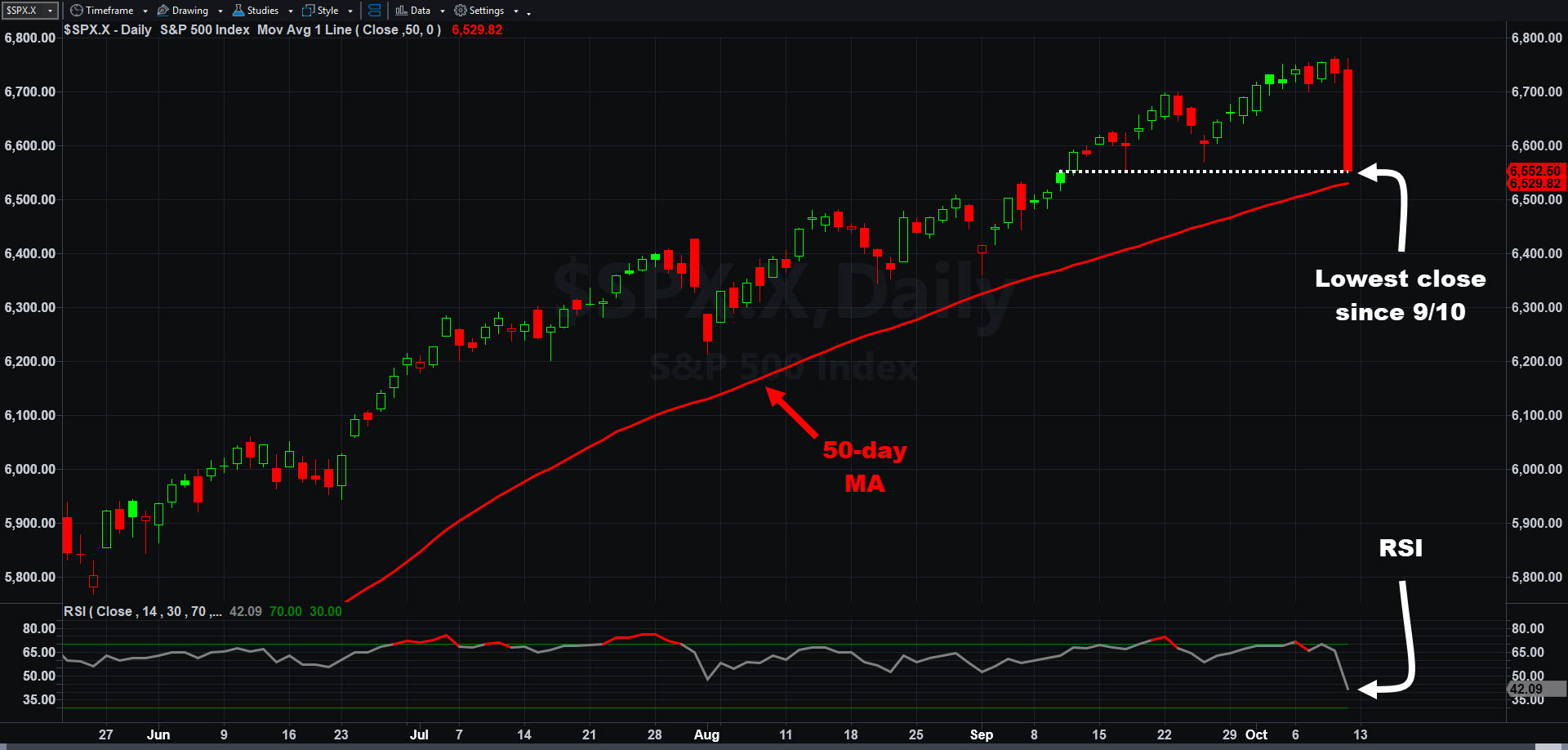
S&P 500, daily chart, with select patterns and indicators.
The Week Ahead
Earnings get active this week, starting with major financials. The consumer price index (CPI), originally scheduled for Wednesday, was moved to Friday, October 24, because of the government shutdown. Other regular releases will be delayed.
Fastenal (FAST) announces quarterly results today. As a major industrial supplier, it could provide clues on the economy.
JPMorgan Chase (JPM), Citi (C), Goldman Sachs (GS), Wells Fargo (WFC) and Johnson & Johnson (JNJ) report earnings tomorrow morning. Fed Chair Jerome Powell speaks at 12:20 p.m. ET.
Wednesday features Bank of America (BAC), Morgan Stanley (MS), ASML (ASML) and United Airlines (UAL).
NAHB’s homebuilder sentiment index is on Thursday, along with earnings from Taiwan Semiconductor Manufacturing (TSM) and Charles Schwab (SCHW).
Friday brings industrial production and earnings from American Express (AXP) and Schlumberger (SLB).
.jpg&w=3840&q=75)