Are Brighter Spirits Lifting Risk Appetite?

AI Stock ‘Stays Cool’ as Iran War Rages
Vertiv has been a quiet beneficiary of the AI boom and now it’s getting noticed.

Call toll-free 800.328.1267

Risk appetite may be increasing in the stock market as sentiment shows signs of improving.
The S&P 500 inched higher last week, advancing 0.3 percent between Friday, November 28, and Friday, December 5. The index ended the period at 6870, its highest weekly close ever.
While the move was small, some changes beneath the surface were dramatic. “Safe havens” like utilities and healthcare fell sharply as “risk-on” groups advanced. Those included a mix of industries like software, semiconductors, retailers and airlines.
A combination of positive earnings and steady economic news powered the moves. Microchip Technology (MCHP), which had fallen on worries about an AI slowdown, said quarterly results will be at the high end of guidance. Dollar General (DG), Ulta Beauty (ULTA), Macy’s (M) and American Eagle (AEO) jumped on strong quarterly results.
Trucking firm Old Dominion Freight Line (ODFL) climbed on optimism about improved demand for shipping. AppLovin (APP) rallied after Bank of America said business is growing more quickly than expected this quarter.
Other S&P 500 laggards in risk-on sectors had double-digit gains: Deckers Outdoor (DECK), DoorDash (DASH) and Synopsys (SNPS). All told, 13 members of the index rose at least 10 percent last week. Only four dropped 10 percent. Tesla (TSLA) was the top-performing megacap with a gain of 6 percent.
| Microchip Technology (MCHP) | +23% |
| Dollar General (DG) | +21% |
| NXP Semiconductors (NXPI) | +17% |
| AppLovin (APP) | +15% |
| Old Dominion Freight Line (ODFL) | +15% |
| Source: TradeStation data |
Salesforce (CRM) had its biggest weekly gain (up 13 percent) in more than two years after announcing strong growth in its Agentforce and Data 360 products. That suggested the software giant’s AI initiatives are finally gaining traction.
“From software to cybersecurity to infrastructure… this is just the beginning of the monetization of the AI revolution,” Wedbush analyst Dan Ives told CNBC on Monday.
Several other noteworthy companies had positive news:
Recent months have seen a shift in semiconductors from makers of high-end processors like Nvidia (NVDA) to simpler chips performing lower-end functions. This trend started with the rally in memory and data-storage companies like MU. Now, it may be shifting to providers of microprocessors, ASICs and power-management chips.
Marvell Technology (MRVL), for example, jumped to a nine-month high after issuing a strong two-year forecast. Several banks responded with positive reports, including Citi, Morgan Stanley and Jefferies. Piper Sandler raised its price forecast from $85 to $135.
Texas Instruments (TXN), Analog Devices (ADI), On Semiconductor (ON) and NXP Semiconductors (NXPI), which sell similar items, have also climbed.
Some other less-prominent tech companies have advanced as the widening AI boom increases demand for their infrastructure products:
| Paramount Skydance (PSKY) | -17% |
| Alexandria Real Estate Equities (ARE) | -13% |
| W.R. Berkley (WRB) | -14% |
| LyondellBasell Industries (LYB) | -12% |
| Block (XYZ) | -8.5% |
| Source: TradeStation data |
This week’s big event will likely be the Federal Reserve’s meeting at 2 p.m. ET on Wednesday.
The market widely expects an interest-rate cut of 25 basis points. Traders will focus heavily on the “dot plot” estimate of future policy. They will also monitor the mix of votes and potential dissents to assess the outlook for further cuts.
Other items last week seemed to reflect improved sentiment. The American Association of Individual Investors said only 31 percent of respondents in its latest poll were bearish — the lowest reading since January. The University of Michigan’s consumer sentiment index surprised to the upside. Inflation expectations fell more than expected to the lowest level since January.
The personal consumption expenditures (PCE) inflation gauge for September also fell more than expected.
There are signs of healthy corporate earnings, as well. FactSet reported that analysts are raising estimates for the current quarter for the second time in a row. (That’s unusual because projections typically fall immediately before getting reported.) Separate data from S&P Global showed Wall Street’s forward numbers rising for 2026.
Last week’s trading action may have bolstered hopes of a further upside in the S&P 500.
Prices had been trapped under 6,852 for more than a month. (That was the low on October 29 before November’s slide.) They were in a tight range below the resistance most of last week, but closed above it on Friday.
The index fluctuated just 1.4 percent between its high and low of the week. It was the smallest weekly range since the summer doldrums immediately before Labor Day.
That kind of small move, combined with strength in risk-on sectors, may reflect a lack of selling pressure. It also pushed Cboe’s volatility index (VIX) to its lowest reading since mid-September.
The moving average convergence/divergence (MACD) indicator has also started rising. Chart watchers may additionally think the index has broken a falling trendline. Those signals may be consistent with an uptrend resuming after a period of consolidation.
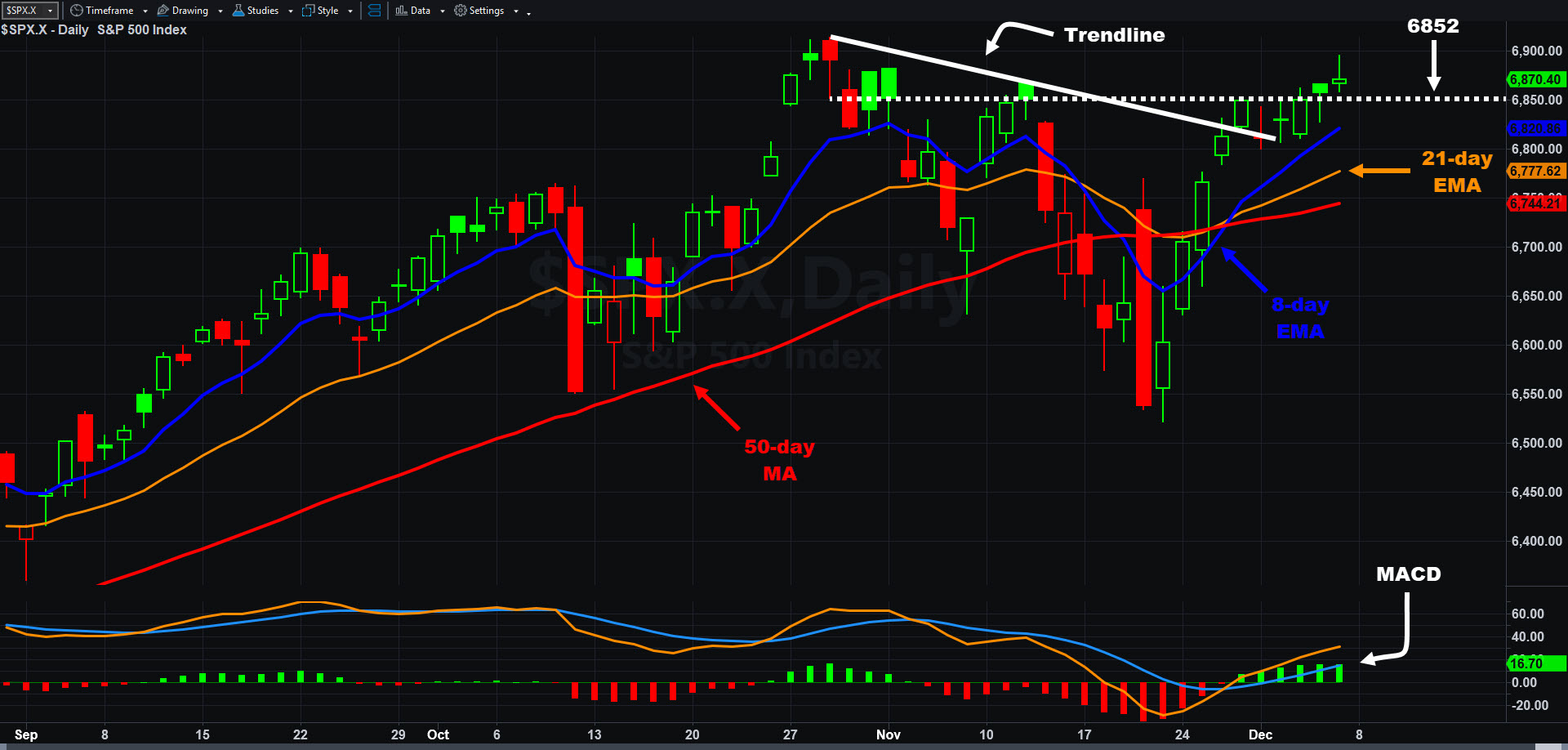
S&P 500, daily chart, with select patterns and indicators.
Aside from Wednesday’s Fed meeting, this week brings a handful of events. Broadcom (AVGO) is the only trillion-dollar company to report earnings.
Homebuilder Toll Brothers (TOL) announces results tonight.
Tomorrow features the government’s JOLTS report on job openings. There’s also a 10-year Treasury note auction.
Crude-oil inventories are the first item on Wednesday, followed by the Fed meeting at 2 p.m. ET and Chairman Powell’s press conference 30 minutes later. SNPS reports earnings in the postmarket.
Thursday brings the producer-price index. Results from AVGO and Costco (COST) are due in the postmarket.
Some Fed officials speak on Friday, but they may have limited impact shortly after the meeting.

Vertiv has been a quiet beneficiary of the AI boom and now it’s getting noticed.

Stocks are whipsawing after the White House suggested it may de-escalate the Iran war.

Volatility is rising as geopolitical and economic risks increase. How will natural born traders react?