Stocks Snooze Into Big Events Despite New Tariffs

AI Stock ‘Stays Cool’ as Iran War Rages
Vertiv has been a quiet beneficiary of the AI boom and now it’s getting noticed.

Call toll-free 800.328.1267

Stocks have been snoozing, but that might change with potentially big news coming soon.
The S&P 500 fell 0.3 percent between Thursday, July 3, and Friday, July 11. The index fluctuated just 89 points between its high and low. It was the smallest weekly range since mid-December, according to TradeStation data. Declining stocks outnumbered gainers by a narrow margin.
The S&P’s small move followed a breakout to new highs the two previous weeks. There were several headlines involving tariffs:
In addition to those moves, the Administration escalated its conflict with Jerome Powell of the Federal Reserve. Trump first accused the chairman of mismanaging a construction project. Budget Director Russell Vought added that Powell might have misled Congress. The attacks seemed to be part of an ongoing campaign to pressure the Fed to lower interest rates.
Separately, minutes from the central bank’s last meeting showed policymakers divided on when to start easing. Some officials seem eager to start while others prefer to wait because they think tariffs will spur inflation.
Speaking of inflation, June’s consumer price index (CPI) is due at 8:30 a.m. ET tomorrow. As the first major price index for the month, it could shape expectations about future interest rates.
Tuesday morning also marks the first busy part of earnings season, with key financials reporting: Citi (C), JPMorgan Chase (JPM) and Wells Fargo (WFC).
| Fair Isaacson (FICO) | -17% |
| First Solar (FSLR) | -12% |
| Datadog (DDOG) | -11% |
| Autodesk (ADKS) | -11% |
| ServiceNow (NOW) | -10% |
| Source: TradeStation data |
Given the S&P 500’s small moves recently and the potential importance of news on tariffs, the Fed, earnings and inflation, some traders may see potential for a stronger reaction to headlines this week.
Wednesday morning features results from Bank of America (BAC), Goldman Sachs (GS), Morgan Stanley (MS) and Johnson & Johnson (JNJ). The producer price index (PPI) and crude-oil inventories are also due. United Airlines (UAL) reports after the closing bell.
Retail sales on Thursday could also have an impact on interest rates. Other items include initial jobless claims and results from Netflix (NFLX), PepsiCo (PEP) and U.S. Bancorp (USB).
America Express (AXP), Charles Schwab (SCHW), Schlumberger (SLB) and 3M (MMM) are on Friday morning.
Metals rallied last week on several positive developments. First, Trump announced a 50 percent tariff on imported copper. Second, the Defense Department acquired a stake in MP Materials (MP) to increase its access to rare-earth minerals. Third, silver broke out to a new 14-year high as the U.S. dollar remained weak.
Energy was the strongest major sector overall, continuing to rebound from a drop two weeks prior. There was no clearly positive news for oil and gas stocks. However they often follow Treasury yields, which also rose for a second straight week.
Utilities and industrials eked out small gains.
Financials, communications and consumer staples performed the worst. There wasn’t much news for those sectors.
| Delta Airlines (DAL) | +11% |
| Moderna (MRNA) | +10% |
| PTC (PTC) | +10% |
| AES (AES) | +9.3% |
| Tapestry (TPR) | +9.1% |
| Source: TradeStation data |
Software makers struggled as companies like Autodesk (ADSK), Datadog (DDOG) and ServiceNow (NOW) slid more than 10 percent.
Fair Isaacson (FICO) was the biggest decliner in the S&P 500 last week after the government allowed greater competition for its consumer-credit ratings. (The move let Fannie Mae and Freddie Mac use the competing VantageScore 4.0 on mortgage applications.)
First Solar (FSLR) dropped after jumping the previous week. It’s been trending lower as the government reduces support for alternate energy.
Delta Air Lines (DAL) had the biggest gain in the S&P 500 last week after earnings and revenue surprised to the upside. The carrier also restored a full-year outlook withdrawn in April because of tariffs. That helped spread confidence toward travel stocks.
Other S&P 500 members like PTC (PTC) and AES (AES) climbed on reports of potential takeovers.
Another noteworthy mover last week was Levi Strauss (LEVI), which beat estimates and raised guidance. The apparel company is focusing on direct sales to customers and reducing its products to overcome tariff pressures.
Red Cat (RCAT), Kratos Defense & Security Solutions (KTOS) and AeroVironment (AVAV) rallied after Defense Secretary Pete Hegseth fast-tracked the drone technology.
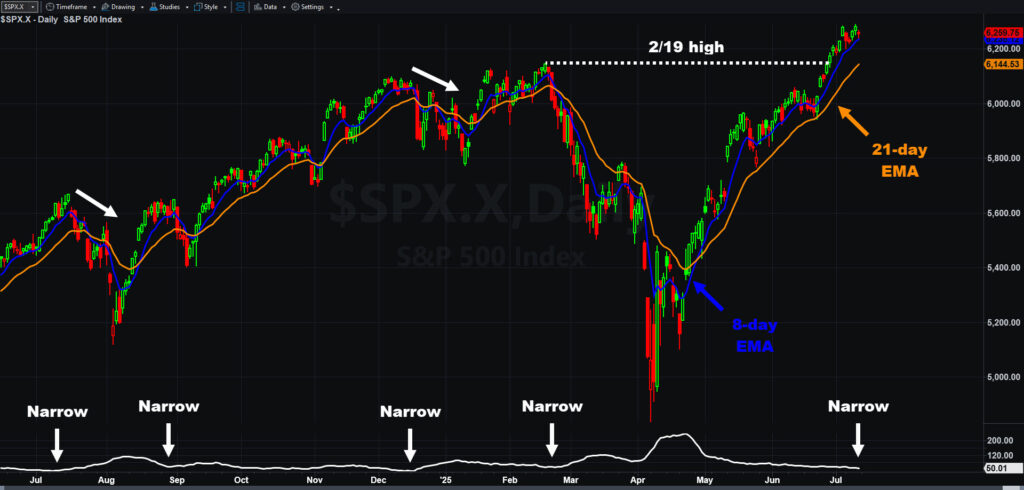
S&P 500, daily chart with select events and indicators. Average True Range (ATR) is the white line at bottom.
The S&P 500 has climbed steadily for the last three months with few clearly bearish patterns. The index remains above its February highs and short-term signals like the 8- and 21-day exponential moving averages are potentially consistent with uptrends.
However, some chart watchers may see potential risks.
First, narrowing price action sometimes reflects slowing uptrends. Average true range (ATR) had its smallest reading since peaking in mid-December. Similar moments like mid-July 2024 and December were also followed by declines.
Second, the yield on the 10-year Treasury note made a higher low above 4.2 percent. Its range has narrowed for more than two years, which may create potential for another push higher. Such a move could hurt equities and risk appetite by increasing borrowing costs and pressuring multiples.
Those potential signals could become important if investors start to react more dramatically to news involving tariffs, earnings or inflation.

Vertiv has been a quiet beneficiary of the AI boom and now it’s getting noticed.

Stocks are whipsawing after the White House suggested it may de-escalate the Iran war.

Volatility is rising as geopolitical and economic risks increase. How will natural born traders react?