This New S&P 500 Member Leading in 2025. Why?

AI Stock ‘Stays Cool’ as Iran War Rages
Vertiv has been a quiet beneficiary of the AI boom and now it’s getting noticed.

Call toll-free 800.328.1267

Palantir Technologies has been soaring as investors come to appreciate its fast-growing data-crunching software products.
The stock is up 55 percent this year and 287 percent since its addition to the S&P 500 was announced on September 6. That’s the biggest gain in the entire index over both time periods, according to TradeStation data.
PLTR started with a focus on military and government contracts. It went public in late 2020, rallied briefly along with other technology stocks and then plunged as the Federal Reserve hiked interest rates. The stock was rangebound through early last year, when it started climbing on a string of better-than-expected quarterly reports.
The move accelerated last summer with earnings, revenue and guidance shooting past estimates. That was also when PLTR recorded dramatic growth in its commercial business. That meant it was successfully migrating from government customers to the larger corporate market. Additional bullish price gaps occurred in November and February.
Analysts emphasized how PLTR’s technology can understand a variety of data from different sources. It also uses AI to help customers take action based on their information.
The rally has boosted PLTR’s popularity with active traders and investors. For example, it’s the third-most active stock on TradeStation’s platform this year. Option volume is also averaging 930,000 contracts per session in the last month. That’s tripled since the beginning of last year, according to TradeStation data.
That kind of excitement has boosted valuations to some of the highest readings in the entire market. For example, its price-to-earnings ratio of 632 times is the top in the entire S&P 500. The same is true for its price-to-sales ratio of 90 times.
Given those relatively lofty multiples, some analysts have said the stock needs to pause after its big run. For example, Citi warned of a potential pullback after its last earnings report and Jefferies called the pricing “irrational.”
“The bears hated it at $30, despised it at $50 and absolutely said it was expensive at $100,” Wedbush analyst Dan Ives told CNBC on May 5. However, he emphasized its rapid growth saying “this is going to be a trillion dollar market cap in the next 2-3 years.”
That would imply upside of 255 percent based on the company’s $281 billion value on Friday.
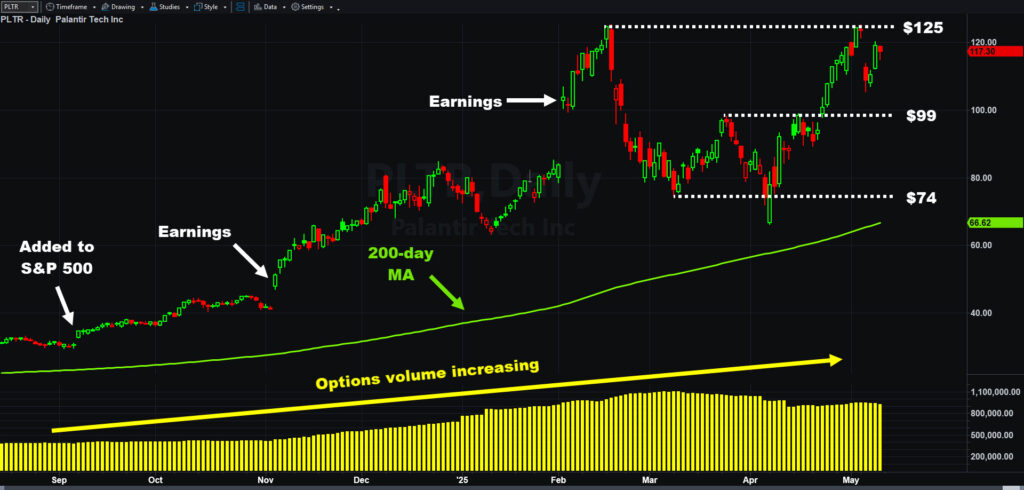
Palantir Technologies (PLTR), daily chart, with select patterns and indicators.
Chart watchers may think it’s already stopped going up. For example, PLTR peaked around $125 in February before dipping back under $100. It stalled at the same level on May 5, creating a potential “double top” reversal pattern.
It’s also noteworthy that prices retreated from that level on high volume — despite reporting another strong set of quarterly numbers. That could mean the good news is priced in for now. Such price action could make traders think PLTR is pausing after its dramatic run. That could give them a few ideas.
One possibility is that prices may enter a period of consolidation within the context of a longer-term uptrend. In that case, investors may look for tests of lower levels.
Here are some places they may look:
Regardless of what investors expect, they may find ways to put their beliefs into action with options.
Say, for example, PLTR probes the $99 area. Market participants thinking it’s near a low may consider selling a put credit spread. The same could be true at lowest points.
Say, on the other hand, they think it will stall below its old highs. They may consider selling a call credit spread. Both of those approaches would generate credits up front and profit from the shares not moving beyond certain prices.
Investors who have owned the shares and are sitting on profits may also consider writing covered calls. That strategy involves selling calls against their stock. If they expect the recent high near $125 to remain the peak, they could target strikes above that point. They could also use options closer to the money if they see risk of a deeper decline.
Alternately, traders looking for big moves may consider buying vertical spreads. See this article for more.
Options trading is not suitable for all investors. Your TradeStation Securities’ account application to trade options will be considered and approved or disapproved based on all relevant factors, including your trading experience. See www.TradeStation.com/DisclosureOptions. Visit www.TradeStation.com/Pricing for full details on the costs and fees associated with options.
Margin trading involves risks, and it is important that you fully understand those risks before trading on margin. The Margin Disclosure Statement outlines many of those risks, including that you can lose more funds than you deposit in your margin account; your brokerage firm can force the sale of securities in your account; your brokerage firm can sell your securities without contacting you; and you are not entitled to an extension of time on a margin call. Review the Margin Disclosure Statement at www.TradeStation.com/DisclosureMargin.

Vertiv has been a quiet beneficiary of the AI boom and now it’s getting noticed.

Stocks are whipsawing after the White House suggested it may de-escalate the Iran war.

Volatility is rising as geopolitical and economic risks increase. How will natural born traders react?