
Micro E-mini futures allow retail investors to trade the major indices with a lower capital outlay than traditional futures contracts.
How to Trade Micro E-Mini Futures at TradeStation


Setting up a trading account with an online broker gives retail investors access to sophisticated technical analysis tools and charts.
As the notional value of the major stock indices has risen over time, many retail traders have found it difficult to trade futures contracts. The margin requirements have priced many retail investors out of the market. In response, the Chicago Mercantile Exchange1 (CME) created micro E-mini futures.
Here’s how micro E-mini futures work and how you can learn to trade them.
What Are Micro E-Mini Futures?
Micro E-mini futures contracts are 1/10 the size of the older E-mini futures, which makes them accessible to traders using smaller amounts of capital.
Take the highly traded S&P 500 E-mini with the symbol /ES as an example. It has a multiplier of $50 for each point in the S&P 500 index. This means that if the S&P 500 is currently trading at 4,500, an /ES contract would have a notional value of $225,000. A 10-point gain in the S&P 500 would increase the value of an /ES contract by $500.
On the other hand, the S&P 500 micro E-mini with the symbol /MES has a multiplier of $5. At the same S&P 500 level of 4,500, an /MES contract would have a notional value of $22,500, which is 1/10 the notional value of the /ES. This means that if the S&P 500 index goes up 10 points, the /MES contract will gain $50.
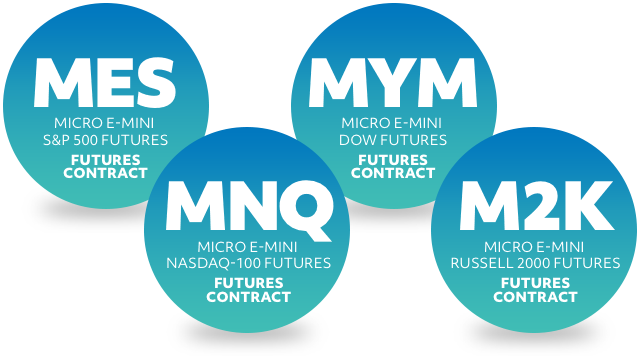
CME offers micro E-mini futures for the S&P 500 (/MES), the Dow Jones Industrial Average (/MYM), the NASDAQ 100 (/MNQ), and the Russell 2000 (M2K). And traders have nearly 24/7 access to the market.
Opening a Trading Account
You can open an account with an online broker and begin trading micros with lower margins. You’ll want to find a platform with powerful technical analysis, robust trading tools, and customer service support with experienced representatives. On the TradeStation website, you’ll find educational resources and information about our award-winning platform.
Developing Trading Strategies
After opening your account, you can begin to develop your own trading strategies and learn how to detect signals in the market. By using your online broker’s technical analysis tools, you may be able to interpret the price and volume statistics to spot trends.

Trading micro-E mini futures is a great way to access the futures market without risking a large amount of capital. You can use your broker’s backtesting model to test your strategies, or try paper trading to see how your ideas turn out without risking capital.
Monitoring the Status of Trades
If your plan is to day trade, you’ll want to watch the status of your positions carefully, since day trading regulations can impact margins and access.
If you plan on holding open futures contracts for longer time periods, you’ll need to watch the price movements to make sure your positions are moving as expected. Price movements in futures contracts can be swift and volatile. Unexpected changes in market direction may warrant quick action on the part of investors. Stop-loss orders are one type of protection against sudden, large price changes, but you should still check your position often.
Sources
- Chicago Mercantile Exchange: “Micro E-mini Equity Futures” “ https://www.cmegroup.com/trading/equity-index/us-index/micro-e-mini-futures.html”
