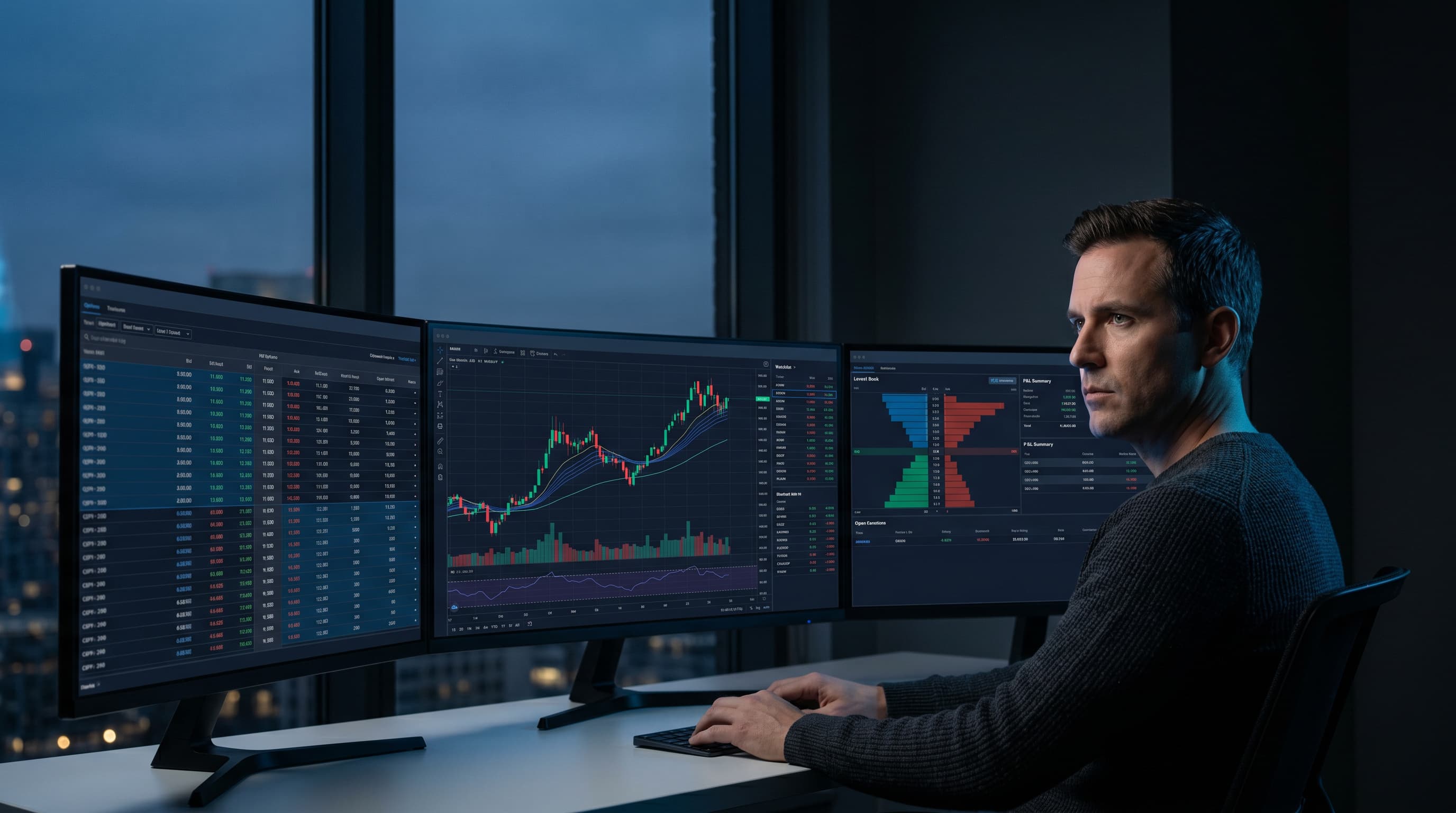
Institutional order execution at TradeStation

Key takeaways
- Institutional order execution covers how large organizations buy or sell securities, often slicing and routing large trades to reduce market impact and execution costs.
- Best execution is a regulatory obligation. It weighs price, cost, speed, and likelihood of execution, not only the best price at a single moment.
- TradeStation Institutional supports professional order flow with 30+ order types, direct market access, smart order routing, and institutional algorithms (VWAP, TWAP, POV, and more).
- In Q1 2026, average equity market order execution speed was approximately 63 milliseconds, with a 91.43% at-or-better execution rate on equities and 96.03% at-or-better on options (1–50 contracts).*
- Technology drives institutional trading. EMS workflows, APIs, algorithms, real-time analytics, and TCA help desks evidence and refine execution quality.
Next steps
Explore TradeStation Institutional →
See order types and execution →
Institutional order execution in today's markets
Institutional order execution differs from retail in scale. Retail flow involves individuals trading small positions, routed to market makers for quick fills, with little measurable effect on a security's price.
Institutional traders may manage orders exceeding thousands of contracts or blocks of tens or hundreds of thousands of shares, large enough to move the market.
For registered investment advisors (RIAs), hedge funds, proprietary trading firms, family offices, and other institutional clients, the goal is not simply to trade quickly. It is to control execution price, execution window, liquidity access, information leakage, and settlement risk.
This is where execution quality comes in. There's risk between the trading decision and the final fill, and fast moves, high volatility, and thin liquidity can increase the chance of slippage. The sections that follow look at what best execution means under U.S. and European rules, the order types and algorithms institutions use, and how TradeStation approaches execution for professional order flow.
Regulatory and fiduciary context for best execution
Best execution is broader than best price. Broker-dealers and investment firms have an obligation to seek favorable outcomes for client orders under applicable rules, which in the U.S. include SEC and FINRA standards. Meeting that obligation means weighing several factors together: not just price, but cost, speed, and likelihood of execution, along with order size, order type, and settlement considerations.
These factors carry accountability. Brokers must publish order-routing reports under U.S. regulations, and regulatory frameworks increasingly call for quantitative evidence that execution quality is being measured and managed. Transaction cost analysis (TCA) is how firms connect policy to outcomes, comparing expected cost, arrival price, benchmarks, fills, and slippage to see whether routing decisions actually serve the client.
Execution policy is not static. When a material change occurs in execution policy, routing logic, or client instructions, firms should review whether client consent or updated disclosure is required. Firms evaluating electronic execution platforms should also review the detailed trading risk and regulatory disclosures that apply.
Institutional order types and execution arrangements at TradeStation
TradeStation's Institutional order types and execution capabilities include 30+ order types, configurable triggers, routing choices, and platform-level risk controls, reflecting its broader order types and execution solutions for institutional traders.
- Market orders are designed to execute promptly at the best available price. They prioritize speed and likelihood of execution, though the final price can differ from the expected price in fast markets.
- Limit orders execute only when the security reaches a specified price. A limit order improves price control but may not fill if there is not sufficient liquidity.
- Core orders include buy, sell, sell short, and buy to cover, with support for reversals, flattening, partial exits, and pyramiding.
- Timed and conditional orders include market-on-open, market-on-close, next-bar entries, stop orders, stop-limit orders, time-based triggers, profit targets, break-even orders, and trailing stops.
- Iceberg orders split a large order into small visible slices, helping institutions avoid revealing full size.
TradeStation's self-clearing infrastructure supports near-real-time monitoring of positions, open orders, strategy performance, margin, and exposure.
Execution factors, deep liquidity, and institutional priorities across asset classes
Institutional trading aims to minimize slippage between expected and actual execution prices. Strategy focuses on the timing, size, and placement of orders, and decisions depend on market conditions, liquidity depth, and the instrument being traded, with many desks relying on dedicated block trade allocation solutions for large orders.
- Equities and ETFs: Institutions seek price improvement, deep liquidity, and minimal signaling. Common practices include working smaller blocks and using algorithms.
- Listed options and equity derivatives: Traders manage spreads, greeks, volatility, and multi-leg risk. Strategy-level routing can matter more than leg-by-leg prices.
- Futures and futures options: Traders watch central limit order book depth, contract rolls, margin, and event risk.
- Across asset classes: Liquidity structure varies by market, so execution approach should adapt to the depth, transparency, and impact profile of each instrument.
TradeStation supports equities, ETFs, options, futures, and futures options, so institutions can apply consistent policies while tuning execution to each market structure.
Get started
Algorithmic trading execution: key strategies, tools, and advanced trading APIs
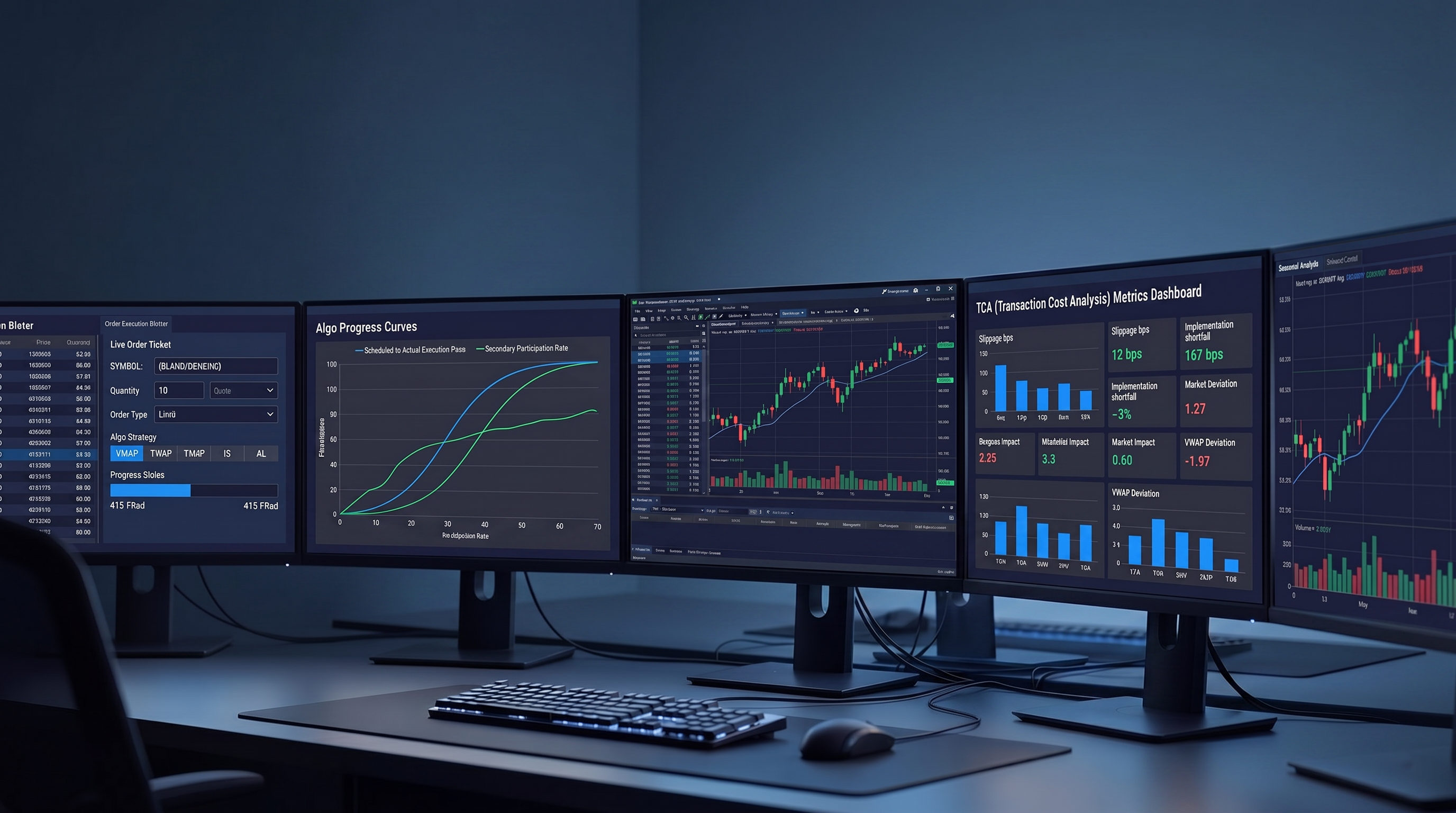
Algorithmic execution breaks a large order into smaller pieces to reduce market impact, working the order across time, price, or volume according to a defined schedule. Execution algorithms such as VWAP, TWAP, and POV govern how an order is worked, not whether to trade; that decision sits with the trader or the firm's strategy logic, which may incorporate technical indicators, quantitative models, or discretionary judgment. Institutions use these execution strategies, often alongside smart order routers, to manage signaling and cost. Firms developing their own strategy logic can backtest models against historical market data before deployment, and robust APIs like ours provide deep tick-level and candlestick history to support that work. Desks can configure urgency, participation rate, price limits, slice size, venue inclusion, and passivity using TradeStation's institutional algorithmic trading solutions and oversight tools.
Order routing, venues, and market structure
Market structure shapes execution quality. Institutional execution may route across lit exchanges, dark pools, electronic communication networks (ECNs), market makers, RFQ platforms, and other liquidity providers, each with different transparency and market-impact characteristics. Routing decisions should align with the firm's execution obligation, client instructions, and documented best execution policies.
Monitoring execution quality and managing execution costs
Execution quality measures whether an order produced a competitive execution price relative to quoted prices, VWAP, TWAP, or arrival price, and it also considers fill rate, partial fills, latency, and realized costs. Institutional execution depends on quantitative measurement to benchmark performance and refine strategy. Post-trade TCA measures implementation shortfall and slippage after orders fill, and many firms lean on institutional trading desk solutions with integrated analytics to operationalize these reviews.
Useful metrics include:
Metric | Why it matters |
| Effective spread | Shows implicit trading cost versus the quoted spread |
| Slippage vs arrival price | Measures timing and market-movement cost |
| VWAP/TWAP performance | Compares fills against benchmark execution strategies |
| Fill rate | Shows completion and likelihood of execution |
| Venue analysis | Compares execution venues |
Explicit execution costs include commissions, exchange fees, and clearing fees. Implicit costs include spread, opportunity cost, adverse selection, and market impact.
In Q1 2026, TradeStation reported average price improvement of $3.04 per equity market order and $18.34 per options market order (1–50 contracts), with $17.3 million in total price improvement across equities and options (source: S3 Matching Technologies LP).*

Technology stack: how TradeStation supports institutional execution and API trading
TradeStation's ecosystem includes its desktop platform, TITAN X, TradeStation Mobile, TradeStation MCP, and TradeStation APIs. The platform can serve as both a trading interface and an execution management system within a broader set of customizable institutional trading services.
Institutional clients can connect OMS and EMS workflows through FIX, REST, and streaming APIs to automate execution, manage orders, access real-time market data, integrate custom models, and use direct market access across supported products. TradeStation MCP can connect LLM-based workflows to accounts with pre-trade checks and configurable guardrails around order size, frequency, and permitted asset classes.
Institutional use cases: applying execution strategies in practice
- Equity long/short rebalance: A fund executing 250,000 shares across mid-cap names may use VWAP, POV, iceberg orders, and a mix of dark and lit routing to reduce market impact.
- Systematic options strategy: A volatility trader may use multi-leg tickets, limit orders, stops, and time triggers around FOMC events to balance price control and event risk.
- CTA futures roll: A CTA rolling S&P 500 or NASDAQ futures may use TWAP or Implementation Shortfall within a defined window to reduce slippage, supported by TradeStation's dedicated brokerage services for Commodity Trading Advisors.
- Proprietary trading firm: A prop desk may connect in-house models via FIX API, run custom logic alongside TradeStation algorithms, and monitor execution quality through our built-in dashboards, leveraging TradeStation's specialized support for proprietary trading desks.
Risk, controls, and governance in institutional order execution
Risk controls are part of execution, not an afterthought. Institutional workflows should include pre-trade checks for order size, notional exposure, leverage, margin, and account permissions.
TradeStation supports real-time monitoring of positions, P&L, margin utilization, and open orders. Audit trails can document every order and modification, supporting compliance, surveillance, and review for professional traders including futures commission merchants using TradeStation.
Electronic trading depends on computer systems, networks, and market data. TradeStation discloses that system access, order placement, and execution may be delayed or fail during volatility, quote delays, software issues, internet disruptions, or other conditions.
What TradeStation Institutional onboarding looks like
Engagements typically begin with discovery; mapping asset classes, trading style, order flow, risk limits, connectivity, and reporting needs. From there, TradeStation works with the firm to configure routing, algorithms, and API connectivity. Detailed API setup and authentication guidance is available through the TradeStation developer resources at developer.tradestation.com.
Rollouts are typically phased, starting with a single desk or asset class and then expanding, to reduce migration risk.
On an ongoing basis, the Private Brokerage team can support custom reporting, TCA frameworks, and periodic reviews of routing and algorithm usage, acting as an extension of the firm's trading operations for registered investment advisers and asset managers as well as multi-asset family offices.
Firms evaluating execution arrangements can weigh execution speed, fill quality, analytics, and risk controls. To see how TradeStation Institutional fits your workflow, contact the Institutional team to scope discovery, integration, and testing.
FAQ: institutional order execution with TradeStation
What asset classes can I execute institutionally through TradeStation?
TradeStation provides institutional execution for U.S. equities, ETFs, listed options, futures, and futures options, with access to major U.S. exchanges and select global futures venues. Clients should confirm specific market access, margin requirements, and product availability during onboarding.
Can I use my own algorithms alongside TradeStation's execution stack?
Yes. Institutions can integrate proprietary models and execution logic via FIX, REST, and streaming APIs, running custom algos alongside TradeStation's native algorithmic strategies, subject to risk controls and approval.
How does TradeStation help me monitor and evidence best execution?
TradeStation provides real-time analytics, post-trade reports, and order-level audit trails that can support internal TCA, best execution committees, and regulatory inquiries. Common measures include slippage versus benchmarks, effective spread, fill rates, and venue-level performance.
Is TradeStation suitable only for high-frequency or fully automated trading?
No. TradeStation supports fully automated strategies, hybrid workflows where traders supervise algos, and discretionary institutional trading that still benefits from advanced order types, routing controls, and analytics across both low- and high-frequency styles.
What are the main risks I should consider when using electronic execution platforms?
Key risks include market risk, liquidity risk, operational risk, and execution risk. System access and order execution may be delayed or fail, especially during high volatility or low liquidity. Trading involves risk, including the potential loss of principal. Clients should review TradeStation's risk disclosures before trading.
Where to go from here
Browse TradeStation Institutional →
Compare execution and order types →
This information is for institutional investor use only. This information may not be provided or forwarded to anyone that is not an institutional investor. Retail investors should not act or rely on this information.
*Statistics provided by S3 Matching Technologies LP, an independent company that is not affiliated with TradeStation Securities Inc. Data shown for Q1 2026 calendar year.
Securities and futures trading is offered to customers by TradeStation Securities, Inc., a broker-dealer registered with the U.S. Securities and Exchange Commission (SEC) and a futures commission merchant registered with the U.S. Commodity Futures Trading Commission (CFTC). TradeStation Securities is a member of the Financial Industry Regulatory Authority (FINRA), the National Futures Association (NFA), and a number of exchanges.
TradeStation Securities, Inc. and TradeStation Technologies, Inc. are each wholly owned subsidiaries of TradeStation Group, Inc., both operating, and providing products and services, under the TradeStation brand and trademark.