Netflix Falters as AI Lifts Other Stocks
Nasdaq Keeps Running as Bulls Move to Software
The Nasdaq-100 keeps running as the AI boom widens across the technology sector.

Call toll-free 800.328.1267

Netflix has struggled as AI trades dominate the market. Is the long-term growth stock finally stalling?
The streaming video company has gone almost a year without hitting new highs. It’s down 6.5 percent in 2026 and 22 percent in the last six months. That contrasts with healthy gains in both the S&P 500 and Nasdaq-100 over the same periods.
NFLX’s slide began with quarterly results on October 21. While earnings missed estimates because of a one-time item, the real worry focused on growth. Revenue only matched consensus, and the forward-looking numbers were only in line. That contrasted with stronger numbers the two previous quarters.
More weak guidance on January 20 and April 16 further weighed on the stock.
The slowing growth also suggested that embracing ads — a turnaround strategy launched from late 2022 — had run its course. The plan involved lower-cost monthly subscriptions with commercials. It worked for several quarters, helping lift the stock almost 400 percent by the middle of last year. But management also stopped reporting total subscribers and the shares soon reversed.
Competition is another growing issue. Alphabet’s (GOOGL) YouTube has presented a triple threat to NFLX. First, it’s now leading in sheer numbers. Nielsen data showed YouTube leading for at least eight months, with 12.7 percent of the market in December. NFLX was second at 9 percent.
Second, YouTube was created primarily as an ad-based platform. It also draws on GOOGL’s huge advertising and Search businesses, with the ability to target customers based on web activity. Third, YouTube draws on a broader array of content creators.
On top of that, other services have gradually increased viewership.
AI is another potential problem for NFLX. On one hand, most of the leading stocks this year are tied to data center investment. The list includes semiconductor names like SanDisk (SNDK) and Intel (INTC), plus fiber-optic companies like Ciena (CIEN).
On the other hand, AI makes content creation easier and cheaper. That also increases potential competition for NFLX.
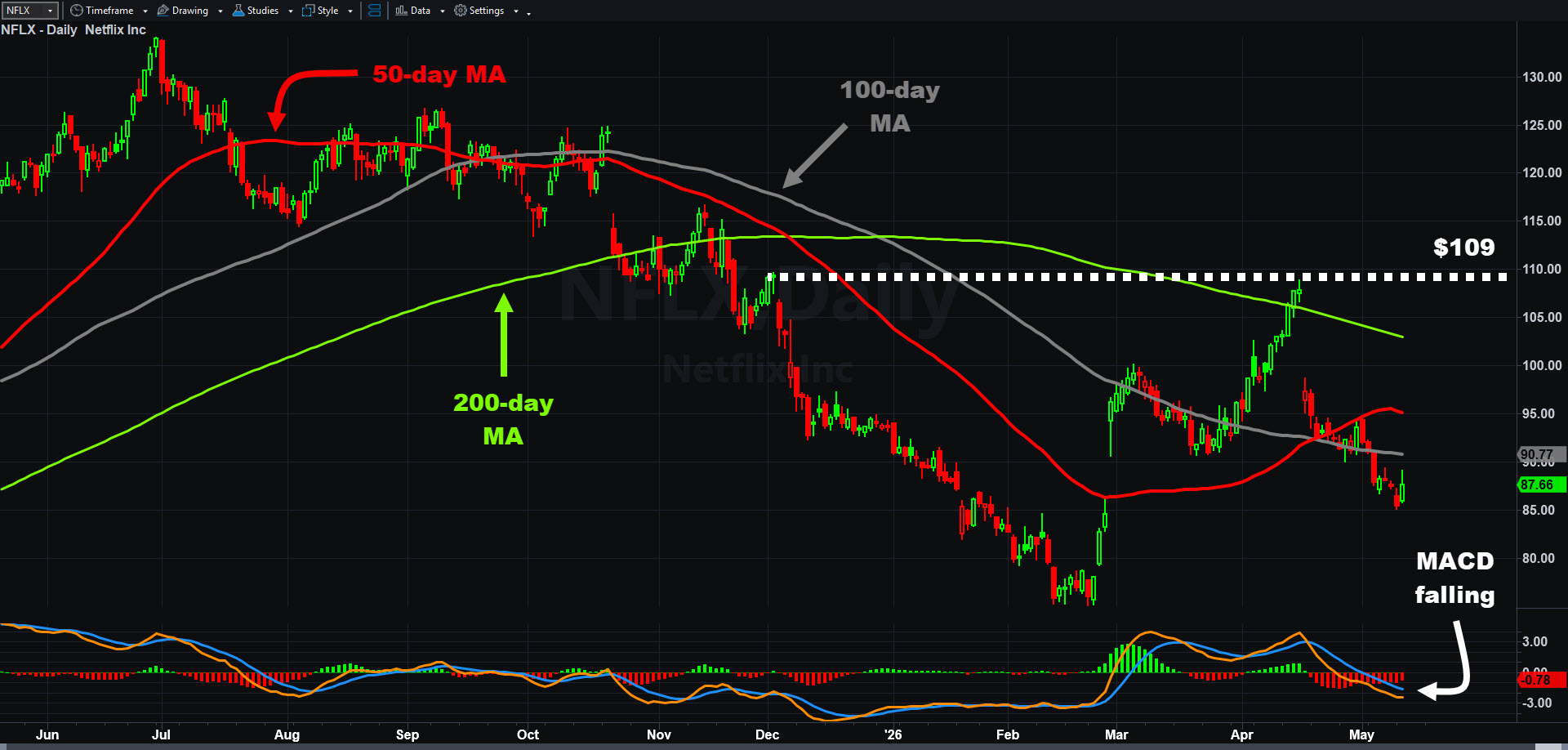
Netflix (NFLX), daily chart, with select patterns and indicators.
NFLX’s last all-time high was June 30. The stock drifted for the four months before starting to slide and dropping more than 40 percent by late February. It rebounded after abandoning the proposed takeover of Warner Bros. Discovery (WBD) and continued higher when calming tensions in the Persian Gulf drove the overall market higher.
Some chart watchers may think greater technical damage occurred during the drawdown. First, the 50-day moving average had a “death cross” under the 200-day moving average. Second, prices have slipped back under the falling 100-day moving average.
NFLX also stalled at $109, slightly below a peak from early December. Has a lower high become new resistance?
Given the potential downtrend, some traders may see potential for lower stock prices. They might also consider using options to manage risk.
One potential strategy is a vertical put spread, which involves buying a put near the money and selling another at a lower strike. It can profit from the shares falling to the lower strike, potentially generating significant leverage from a modest decline. (The key mechanism is selling downside puts to collect premium. That lowers the overall cost and increases the potential appreciation in percentage terms.)
For example, a trader might purchase the July 80 puts and sell the July 75 puts for a net cost of about $1.15. The spread could be worth $5 if NFLX closes at $75 or lower on Friday, July 17. That could translate into a 335 percent gain from the shares falling 15 percent.
In conclusion, NFLX was a major growth stock between 2012 and 2025. However, it’s decoupled from the broader market as investors pivot to AI capex themes. Hopefully, this article explains the moves and helps traders understand the trends.
Options trading is not suitable for all investors. Your TradeStation Securities’ account application to trade options will be considered and approved or disapproved based on all relevant factors, including your trading experience. See www.TradeStation.com/DisclosureOptions. Visit www.TradeStation.com/Pricing for full details on the costs and fees associated with options.
Margin trading involves risks, and it is important that you fully understand those risks before trading on margin. The Margin Disclosure Statement outlines many of those risks, including that you can lose more funds than you deposit in your margin account; your brokerage firm can force the sale of securities in your account; your brokerage firm can sell your securities without contacting you; and you are not entitled to an extension of time on a margin call. Review the Margin Disclosure Statement at www.TradeStation.com/DisclosureMargin.

The Nasdaq-100 keeps running as the AI boom widens across the technology sector.
You’ve mapped the ratio diagonal, but the picture fractures when you try to model the actual risk.

Amazon.com is fighting to new highs, and one big options trader seems to expect a bigger move.