Nasdaq Keeps Running as Bulls Move to Software

Chart of the Day: Potential Breakout in Apple
Apple has been snoozing for months, but there could be signs of a breakout

Call toll-free 800.328.1267

The Nasdaq-100 keeps running as the AI boom widens across the technology sector.
The growth-focused index rose 5.5 percent between Friday, May 1, and Friday, May 8. NDX crossed both 28,000 and 29,000 for the first time last week. It also outpaced the broader S&P 500 by the widest margin (3.1 percentage points) since the AI boom was starting in May 2023.
How dominant was technology? It accounted for nine of the S&P 500’s 10 biggest gainers and more than half the double-digit gainers. Technology was the only sector to outperform the S&P 500, according to TradeStation data. Without the tech sector’s members, barely one-third of the S&P 500 managed to rise last week.
Semiconductors drove the rally again, led by Micron Technology (MU). However last week also saw more strength in software as earnings lifted cybersecurity and infrastructure companies. Could that mean recent worries about AI crushing software were overblown?
Just look at Akamai Technologies (AKAM). The content-delivery giant crashed in February and April on worries about competition from Anthropic’s Claude AI model. But quarterly results shot past estimates and the company announced a surprise $1.8 billion AI infrastructure deal with an undisclosed customer. That propelled its biggest weekly gain in more than two decades.
| Datadog (DDOG) | +42% |
| Akamai Technologies (AKAM) | +42% |
| Micron Technology (MU) | +38% |
| Fortinet (FTNT) | +32% |
| SanDisk (SNDK) | +32% |
| Source: TradeStation data |
“We’re enabling customers to run complex models within milliseconds of their end users,” AKAM CEO Frank Thomson Leighton said on the conference call. “We’re leveraging our global footprint and years of experience supporting the world’s largest enterprises to become an indispensable infrastructure provider for the AI-driven economy.”
Datadog (DDOG) and Fortinet (FTNT) both had their best weeks as public companies. The cybersecurity companies beat estimates as AI enhanced their products and increased demand for their services. That’s big change for niche companies that some investors recently saw as potential dinosaurs in the Darwinian jungle of AI disruption.
Micron Technology (MU) and SanDisk (SNDK) continued to rise on strong momentum after significant hikes to their earnings and revenue estimates in recent weeks. Both are benefiting as the spread of AI increases demand for computer memory chips. (The trend is also lifting Samsung Electronics and SK Hynix, making South Korea the top-performing global market this year.)
Server maker Super Micro Computer (SMCI) was one of the first major beneficiaries of the machine-learning boom. It rose more than 1,000 percent between May 2023 and March 2024, but then crashed and went almost nowhere for two years.
However last week SMCI jumped after earnings beat estimates. Gross margins, which were squeezed by product changes and competition, showed signs of recovery. The stock had its highest weekly close since November. It trades at lower multiples than peers like Hewlett Packard Enterprise (HPE) and Dell Technologies (DELL), despite faster revenue growth. Could investors look for SMCI to play catch-up?
Advanced Micro Devices (AMD) climbed to a new all-time high after earnings and revenue beat estimates. The semiconductor company benefitted from ongoing demand for Instinct GPUs (used for AI training and inference). It’s also enjoying a newer surge in EPYC CPUs used agentic AI.
Speaking of CPUs, Intel (INTC) hit another record high. The once-struggling chipmaker got a boost after The Wall Street Journal reported it could produce mobile chips for Apple (AAPL). INTC is the second-best performing member of the S&P 500 this year, trailing only SNDK.
| Zoetis (ZTS) | -27% |
| CDW (CDW) | -23% |
| Arista Networks (ANET) | -18% |
| Cencora (COR) | -14% |
| Leidos (LDOS) | -13% |
| Source: TradeStation data |
Last week also featured strong economic data. Payrolls increased more than expected, according to separate reports from ADP and the Labor Department. Initial jobless claims were lower than feared and job openings surprised to the upside.
RBC raised its price target for the S&P 500 from 7,750 to 7,900 based on strong earnings.
Semiconductors were the top-performing industry group overall. Software, solar energy and emerging markets were also strong. Energy, utilities and homebuilders fared the worst. Financials continued to struggle.
The S&P 500 rose 2.3 percent last week. It’s climbed for five straight weeks, the longest positive streak since October 2024.
The strong advance since late March could make some chart watchers think it’s in a longer-term uptrend. Traders looking for pullbacks may look for support around 7,270. That’s near the high on May 5, which was followed by a bullish price gap.
Attention could also focus on oil and U.S. Treasury yields. Both jumped in March when the Iran war began and have held most of their gains. Further upside could potentially weigh on risk appetite.
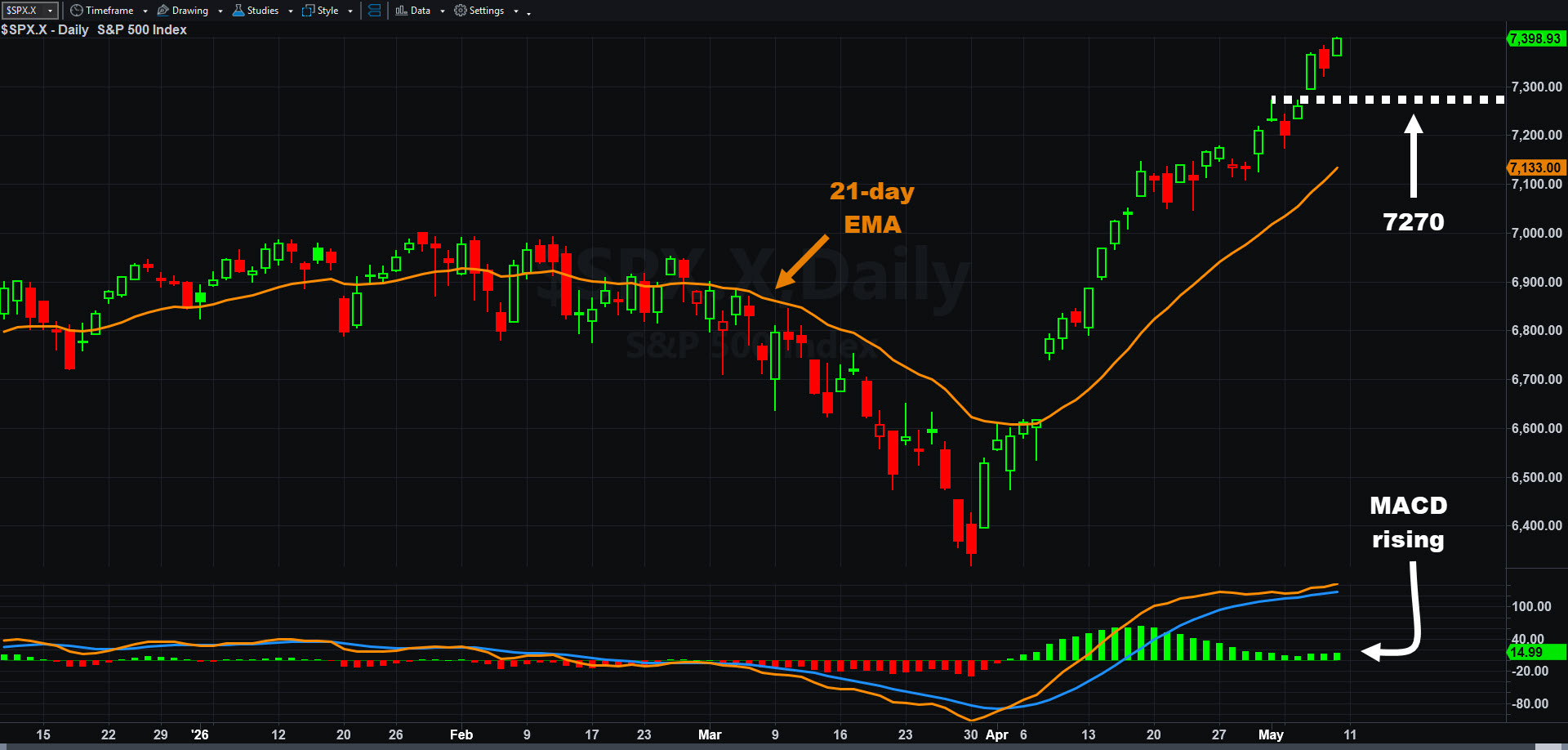
S&P 500, daily chart, with select patterns and indicators.
This week could see attention return to macro-level catalysts, especially with fewer big earnings reports scheduled. Events in the Middle East could gain importance after President Trump yesterday dismissed Iran’s peace proposal as “TOTALLY UNACCEPTABLE.”
This week could also bring some technology IPOs, led by AI chip maker Cerebras Systems (CBRS).
Today’s calendar is relatively quiet, with existing home sales as the only noteworthy event.
The consumer price index (CPI) inflation report is due at 8:30 a.m. tomorrow.
Wednesday features producer prices, crude-oil inventories and results from Alibaba (BABA) and Cisco Systems (CSCO).
Initial jobless claims are on Thursday. President Trump is also expected to travel to Beijing for a summit with Chinese leader Xi Jinping. Applied Materials (AMAT) reports earnings.
Industrial production and capacity utilization are on Friday.

Apple has been snoozing for months, but there could be signs of a breakout

Growth stocks could be staging a comeback as May begins. Learn more about AI’s broadening effect and the growth in Apple.
The next phase of the AI trade could be taking shape as investors scramble for CPUs and analog chips.