Volatility Is Rising. How Do Born Traders React?

Chart of the Day: Are the Bears Riding Uber?
Uber Technologies has dropped since late 2025, and some traders may see further downside in the ride-sharing stock.

Call toll-free 800.328.1267

Volatility is rising as geopolitical and economic risks increase. How will natural born traders react?
This blog will cover some basic points to help navigate this market.
A few factors explain the drop we’re seeing this week.
First, stagflation is a growing risk. Yesterday’s producer price index (PPI) was twice the estimated level. Even worse, it only covered February so it didn’t include the spike in energy costs from the Iran war. It follows a sharp downward revision to fourth-quarter economic growth last week.
Second, the Federal Reserve might be trapped. It kept interest rates unchanged, but the average inflation forecast rose. The number of officials supporting lower rates dropped from two to just one. Are policymakers quietly discarding the idea of rate cuts?
Third, the credit market has been weakening. Higher rates could worsen the situation, resulting in lower asset values and slower economic growth.
Fourth, the S&P 500’s recent topping pattern was significant and unusual. Prices moved in a narrow range for an entire quarter, causing its Bollinger Bands to narrow. Such compression has often marked reversals — especially when combined with momentum slowing over the longer term. (Notice the 50-day moving average turning lower, similar to early 2025.)
The tighter band width, sometimes called a volatility squeeze, can also produce higher volatility once prices start moving again.
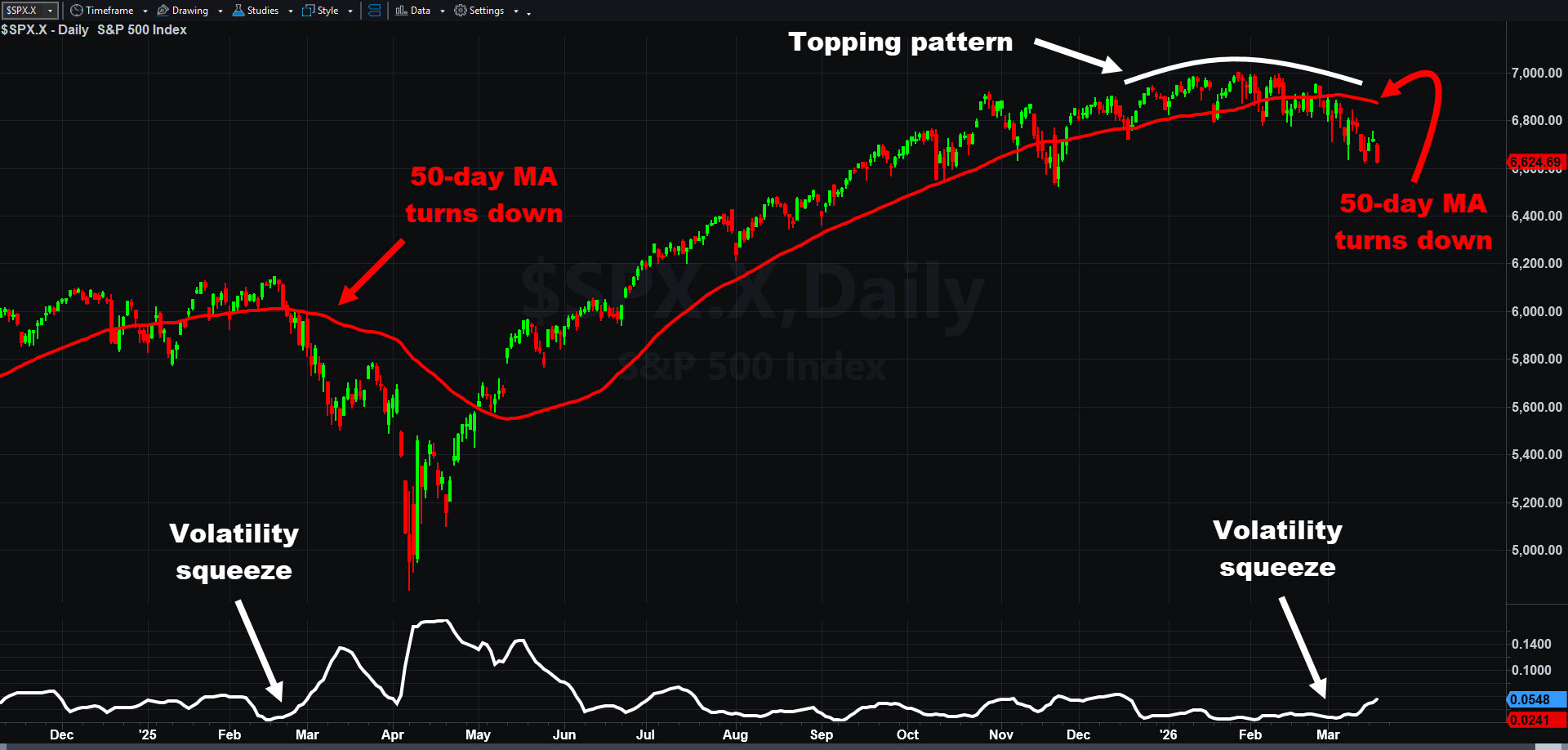
S&P 500, with select patterns and indicators.
Volatility can behave like a fire because it spreads once it starts burning.
As the illustration below shows, markets pass through periods of complacency and fear. Once fear begins, it can widen and overshadow the company-level fundamentals. Correlation increases as individual stocks follow the broader market.
So the first takeaway is that volatility spreads. Traders often respond to this by focusing on fewer names or trading the entire index. Futures can be especially useful at such times because they track benchmarks like the S&P 500 or Nasdaq-100. They can also be bought and sold most times during the week.
Second, Cboe’s volatility index ($VIX.X) may be useful for judging volatility. It typically peaks during times of panic and starts dropping before the market bottoms.
Third, the VIX doesn’t normally stay high for long. TradeStation data shows that fewer than 2.4 percent of all sessions since 1992 had closes above 40. Less than 1 percent of sessions saw closes above 50.

Next, volatility increases the price of options. That means traders might avoid owning calls when the market rebounds. (A market rebound will lower volatility, which often reduces the value of calls — even if stock prices move higher.) They might instead focus on selling put spreads or buying vertical spreads. Alternately, they might stick with futures for the initial bounce.
After a period of topping, traders might expect the market to go nowhere for a while. This is especially true because the catalysts driving market, like inflation and geopolitical risk, will likely need time to dissipate.
The result could be a period of ranges, with prices rebounding to resistance levels and then dropping to support. It can be frustrating for long-term investors but a target-rich environment for natural born traders focused on levels and technical patterns.
Another trend in a volatile market is that few stocks might be immune to selling. Strong names that recently rallied might be sitting near long-term highs, but they might not stay there if the weakness persists. Some traders will scan for stocks that haven’t dropped significantly as short-selling targets.
However these stocks can also drop in a bearish market, and often languish when the rebound comes.
This “safe haven” trap could apply to precious metals, which have rallied sharply in the last year. Fewer rate cuts from the Fed often lift the U.S. dollar and depress commodities. Not surprisingly, gold and silver miners are the worst-performing industries so far this month.
Finally, pullbacks don’t last forever. Selling pressures and bearish catalysts eventually fade.
This can create opportunities to purchase good stocks at attractive levels. Traders might start considering and researching names they’d like to own for years. Times of bearishness open windows for accumulating stocks at favorable long-term prices. Be sure to keep reading Market Insights and our ideas on TradingView for more.
In conclusion, market drawdowns might feel frustrating and emotional. But in reality, they are simply different than bullish periods and require a distinct mindset. Hopefully this article helps you navigate the changing environment.
Futures trading is not suitable for all investors. To obtain a copy of the futures risk disclosure statement visit www.TradeStation.com/DisclosureFutures.
Options trading is not suitable for all investors. Your TradeStation Securities’ account application to trade options will be considered and approved or disapproved based on all relevant factors, including your trading experience. See www.TradeStation.com/DisclosureOptions. Visit www.TradeStation.com/Pricing for full details on the costs and fees associated with options.
Margin trading involves risks, and it is important that you fully understand those risks before trading on margin. The Margin Disclosure Statement outlines many of those risks, including that you can lose more funds than you deposit in your margin account; your brokerage firm can force the sale of securities in your account; your brokerage firm can sell your securities without contacting you; and you are not entitled to an extension of time on a margin call. Review the Margin Disclosure Statement at www.TradeStation.com/DisclosureMargin.

Uber Technologies has dropped since late 2025, and some traders may see further downside in the ride-sharing stock.

Energy stocks are leading the market again as inflation surges and earnings season winds down.

Netflix has struggled as AI trades dominate the market. Is the long-term growth stock finally stalling?