Can Anything Stop General Motors?

Call Volume Spikes: Has Oracle Bottomed?
Is Oracle finally bottoming? Some traders may think it has.

Call toll-free 800.328.1267

General Motors has been quietly outperforming the market, and traders may think the auto giant still has gas in the tank.
GM is up 47 percent in the last six months, more than 6 times the gain of the S&P 500 index. The stock also jumped after its last two earnings reports as investors applaud its fundamentals and shareholder payouts.
The first thing they seem to like is improving profitability. The automaker’s adjusted EBIT margin expanded by a full percentage point in the fourth quarter from a year prior. That helped earnings beat estimates despite revenue coming up short. It followed a similarly positive report in October.
Second, the company has achieved these results by focusing on legacy products like pickup trucks and SUVs. That has helped the company improve North American market share. (Higher market share is often associated with higher profitability because it can mean customers are willing to pay a premium for its vehicles.) GM has also slowed electric-vehicle production to match tepid demand.
Third, GM is returning more of its cash to investors. The company reduced its share count by 12 percent over the course of 2025. The quarterly dividend has also increased from $0.12 to $0.18 in the last year.
Analysts at firms including J.P. Morgan, Barclays and UBS raised price targets after the last report.
Another factor potentially favoring GM is its relatively low valuation. The company trades for less than half its revenue and less than 10 times forward earnings. Both metrics are much lower than those of large technology firms like Nvidia (NVDA) and Apple (AAPL).
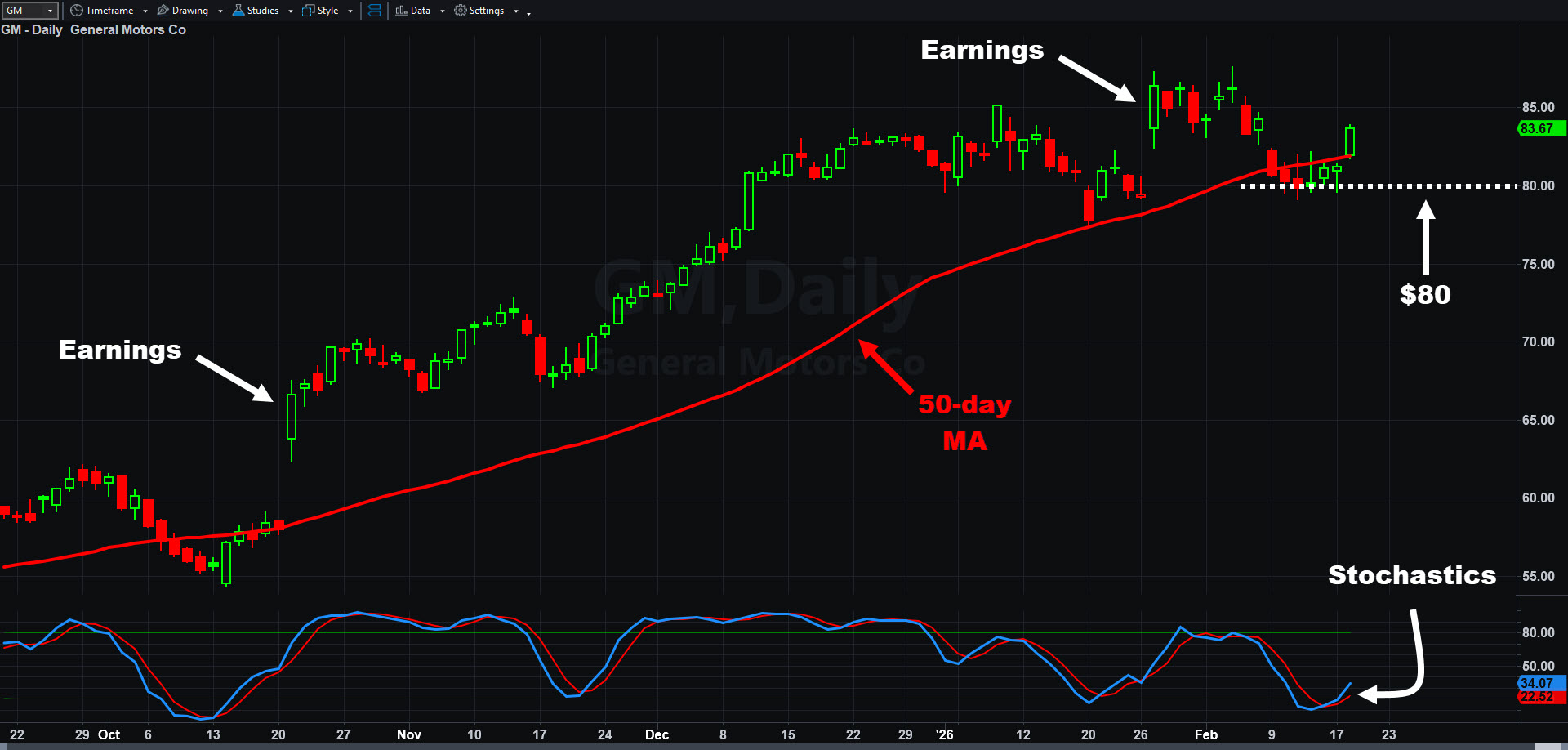
General Motors (GM), daily chart, with select patterns and indicators.
GM rose 3 percent to $83.67 yesterday. The rebound followed a week of consolidation around the $80 level. Prices also jumped back above their rising 50-day moving average and the stochastics oscillator has rebounded from an oversold condition.
Those patterns could make some chart watchers think the stock has completed a period of short-term weakness with potential for a longer-term uptrend to resume.
Traders looking for GM to keep climbing might consider a vertical spread. The strategy involves buying calls near the money and selling another call with the same expiration at a higher strike. It can profit from the shares climbing to the higher strike, potentially generating significant leverage from modest appreciation.
For example, a trader might purchase the June 87.50 calls and sell the June 92.50s for a net cost of about $1.78. The position could expand to $5 if GM closes at $92.50 or higher on expiration. That’s a potential gain of 181 percent from the shares rising 11 percent.
Traders may alternately consider put credit spreads — especially if GM dips after Wednesday’s breakout. They could potentially sell the March 80 puts and buy the March 75s for a credit of about $1. Downside in the stock could increase that premium, so limit orders could potentially be set for about $1.25.
If filled, the $1.25 credit would be the maximum profit as long as GM stays above $80 through expiration.
Calls can gain value to the upside because they fix the price where a security can be purchased. Puts are just the opposite, locking in a selling price and potentially appreciating when shares decline.
In conclusion, GM has benefited from improved profitability and a shift to value investing. It’s drifted for two months, but now could show signs of moving again. Hopefully this article explains some of the ways traders may consider taking positions with options.
Options trading is not suitable for all investors. Your TradeStation Securities’ account application to trade options will be considered and approved or disapproved based on all relevant factors, including your trading experience. See www.TradeStation.com/DisclosureOptions. Visit www.TradeStation.com/Pricing for full details on the costs and fees associated with options.
Margin trading involves risks, and it is important that you fully understand those risks before trading on margin. The Margin Disclosure Statement outlines many of those risks, including that you can lose more funds than you deposit in your margin account; your brokerage firm can force the sale of securities in your account; your brokerage firm can sell your securities without contacting you; and you are not entitled to an extension of time on a margin call. Review the Margin Disclosure Statement at www.TradeStation.com/DisclosureMargin.

Is Oracle finally bottoming? Some traders may think it has.

Nebius consolidated for months, but some traders may think the datacenter stock is breaking out. The first pattern on today’s chart is the long basing pattern between November and late March. (It could also be viewed as a cup and handle following the rally between...

Chipmakers are trying to break out as investors brace for a potential oil shock.