Small Caps Lead as Money Shifts to Real Economy

Chart of the Day: Are the Bears Riding Uber?
Uber Technologies has dropped since late 2025, and some traders may see further downside in the ride-sharing stock.

Call toll-free 800.328.1267

Small caps are leading as investors focus on real-economy stocks and avoid large growth names.
The Russell 2000 small cap index rose 2 percent between Friday, January 9 and Friday, January 16. It made new highs along with the S&P MidCap 400 index, which advanced 1.3 percent.
The broader S&P 500, in contrast, slid 0.4 percent and closed below its old peak. The tech-heavy Nasdaq-100 declined 0.9 percent and hasn’t made a new high since October 29.
Chip stocks kept rising, but most of the gainers were smaller names. Industrials, metals, real-estate and energy also climbed. Those companies are mostly exposed to general economic growth, with several benefiting from the AI boom.
The worst performers were mostly software makers like Salesforce (CRM) and communications companies like Meta Platforms (META). These companies trade at relatively high multiples and have mostly outperformed the market for years. They also offer limited exposure to a growing economy or capital investment.
| Intuit (INTU) | -16% |
| Salesforce (CRM) | -13% |
| Biogen (BIIB) | -12% |
| AppLovin (APP) | -12% |
| Royal Caribbean Cruises (RCL) | -11% |
| Source: TradeStation data |
Does their weakness confirm the start of a long-awaited rotation away from megacap growth stocks?
Last week was full of political drama. It began with Federal Reserve Chairman Jerome Powell saying the Trump Administration was trying to intimidate him with a criminal investigation. The controversy faded after lawmakers and global central bankers came to his defense.
Next, plans to attack Iran were apparently canceled at the last minute. The U.S. Supreme Court also didn’t rule on the constitutionality of the White House’s tariff regime. (Although a decision may be issued today.)
Another Presidential proposal — capping credit-card rates at 10 percent — hit banks and consumer finance companies.
The White House threatened more tariffs. Buyers of Iranian oil were the first potential target, followed by countries opposing a U.S. annexation of Greenland.
Friday saw more headlines. First, President Trump indicated he won’t nominate Kevin Hassett to lead the Fed. That boosted the odds of Kevin Warsh, who may have more credibility as a potential policymaker. Second, the Republican president sided with Democratic governors in an effort to lower electricity costs. That weighed on some utility stocks.
Last week featured a mix of relatively unimportant economic news. Most of it seemed to confirm strong activity and stable employment:
| Moderna (MRNA) | +22% |
| Advanced Micro Devices (AMD) | +14% |
| KLA (KLAC) | +12% |
| CoStar (CSGP) | +12% |
| Jabil (JBL) | +11% |
| Source: TradeStation data |
More than half the S&P 500’s members rose last week despite the index’s small decline.
Moderna (MRNA) led the gains after reiterating its revenue guidance. The vaccine maker had lost more than half its value in the preceding year.
Advanced Micro Devices (AMD) was the only prominent technology stock with a big advance. The chipmaker received an upgrade from KeyBanc and a positive note from Wells Fargo. Most of the commentary focused on its AI growth potential.
Taiwan Semiconductor (TSM), the giant foundry company, further supported bullishness in the chip space with strong quarterly results. That supported equipment company KLA (KLAC).
Other hardware names associated with data centers and electrical investment advanced, including Corning (GLW), Comfort Systems USA (FIX) and GE Vernova (GE).
Real-estate investment trusts and consumer staples were the strongest sectors overall. Little news explained the shift, which may illustrate how investors are diversifying away from large growth companies.
Gold and silver miners, steelmakers and solar energy were other strong groups.
Software companies declined more than 6 percent. It was their biggest weekly drop since tariff fears hammered equities in early April.
The S&P 500 has been grinding upward, but some chart watchers may see potential early warnings of weakness.
First, smaller and less-important companies have driven the gains as historic leaders struggle. Can obscure and less-popular sectors keep driving the market higher?
Second, the index has inched to new highs without a decisive move above 7,000. That may create risk of a failed breakout.
Third, last week saw a higher high and a lower low compared with the previous week. Such a bearish outside candle is a potential reversal pattern.
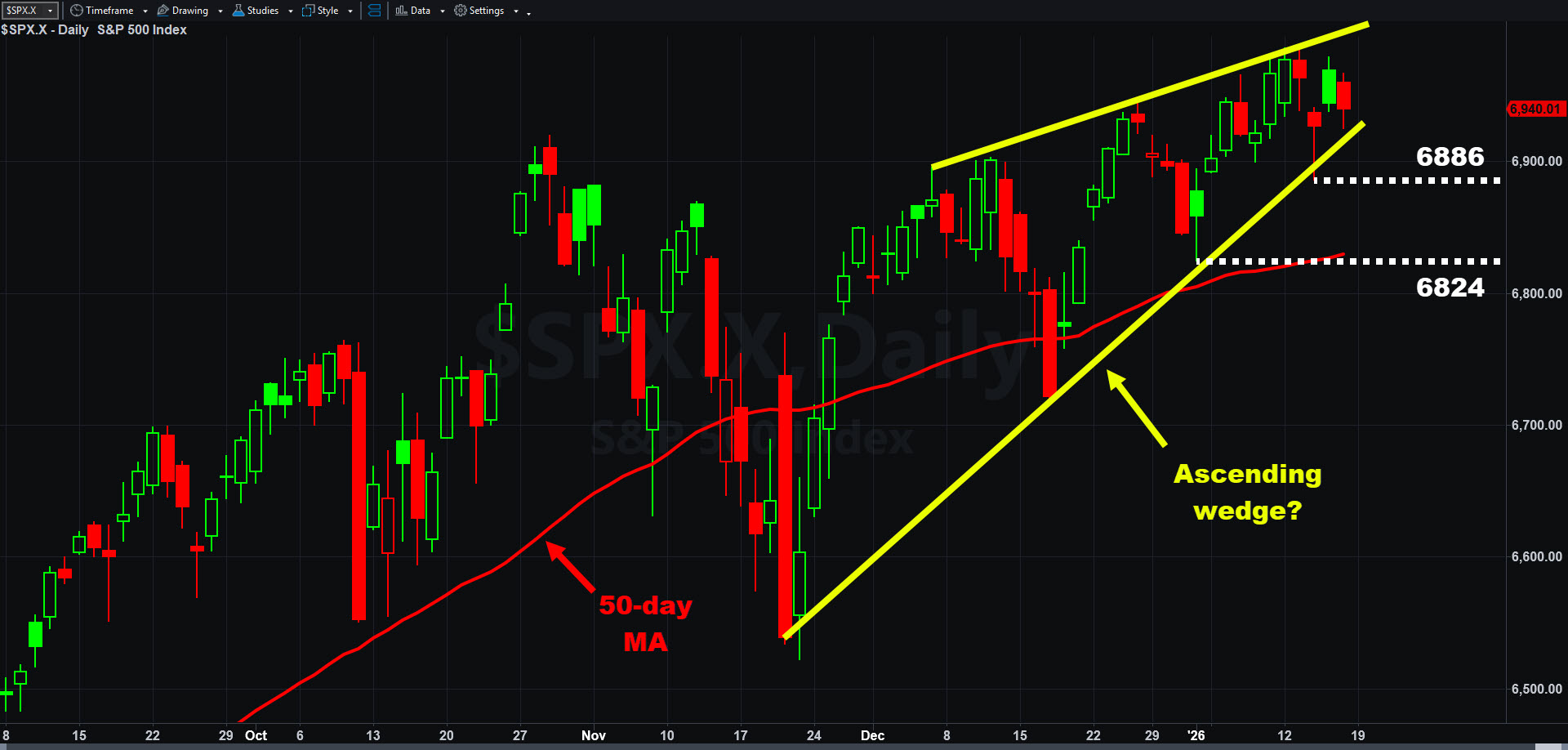
S&P 500, daily chart, with select patterns and indicators.
Fourth, lows have risen at a sharper angle than the highs. The result is a potentially bearish ascending wedge.
While those signals could appear negative, traders may want confirmation of a breakdown. That could prompt them to watch last week’s low of 6,886 as an important level. Below that is the January 2 low of 6,824, which is also near the 50-day moving average.
This holiday-shortened week has a few economic reports and earnings releases. Two potential developments from the Supreme Court could also impact sentiment.
A tariff ruling may come today, and companies like D.R. Horton (DHI), 3M (MMM) and Netflix (NFLX) issue quarterly results.
Tomorrow, justices will hear oral arguments on whether President Trump can remove Lisa Cook from the Fed’s Board of Governors. The process could impact interest rates and precious metals.
Housing starts and results from Halliburton (HAL) and Johnson & Johnson (JNJ) are also due.
Initial jobless claims and crude oil inventories are scheduled for Thursday, followed by Intel (INTC) earnings in the postmarket. The morning also features some old economic data delayed by last year’s government shutdown.
Schlumberger (SLB) earnings are on Friday morning, along with consumer sentiment.

Uber Technologies has dropped since late 2025, and some traders may see further downside in the ride-sharing stock.

Energy stocks are leading the market again as inflation surges and earnings season winds down.

Netflix has struggled as AI trades dominate the market. Is the long-term growth stock finally stalling?