Chips Break Out as Investors Return to Tech

Options Alert: Why Puts Surged in Warner Bros.
After a long bidding war for Warner Bros. Discovery, one big options trader is looking for the current deal to go through.

Call toll-free 800.328.1267
Money is streaming back to technology stocks as semiconductors and software makers break out.
The S&P 500 rose 1.2 percent between Friday, September 12, and Friday September 19. It was the sixth positive week in the last seven. Technology companies and other large growth stocks led the advance.
Instead of a single catalyst, several positive developments seemed to keep money flowing into stocks.
First, Apple (AAPL) climbed to a six-month high on optimism about strong demand for its new iPhone 17. (Firms including JP Morgan, Wedbush Securities, Morgan Stanley, TR International Securities and Deepwater Asset Management issued positive comments.)
Second, Nvidia (NVDA) took a $5 billion stake in Intel (INTC) and will integrate some of its chips in AI products. INTC also said cost pressures were easing. INTC rallied 23 percent on the week, following an equally big gain last month.
Related companies including Synopsys (SNPS), Applied Materials (AMAT), Seagate Technology (STX), Monolithic Power (MPWR) and Western Digital (WDC) also jumped. The rally seemed to reflect optimism the U.S. government wants to encourage more domestic semiconductor production.
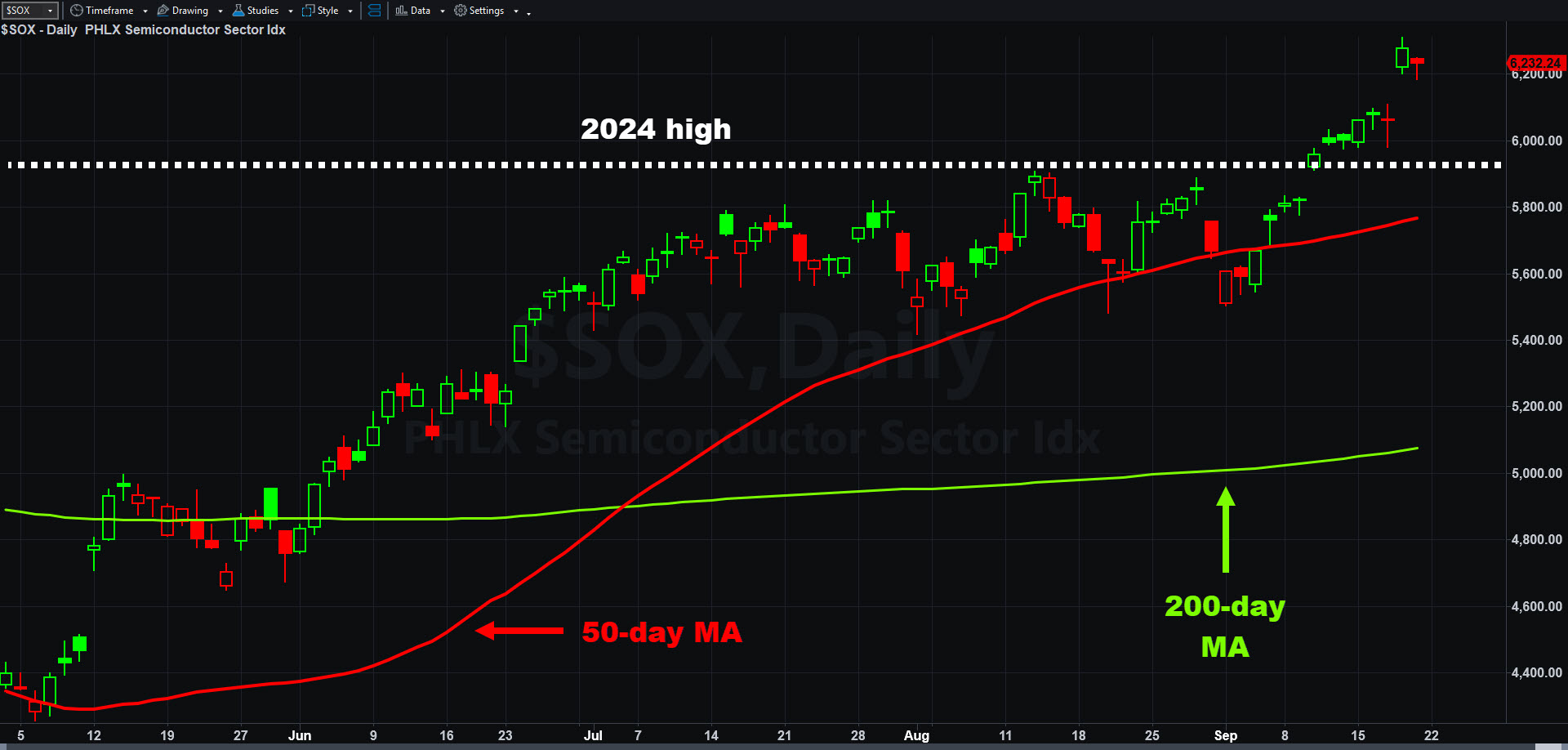
Philadelphia Semiconductor Index ($SOX), daily chart, with select patterns and indicators.
Quantum stocks like Rigetti Computing (RGTI) also surged on reports that the U.S. Air Force and Energy Department want to increase use of the advanced technology. Like the trend in chips, the news seems to reflect growing sovereign demand in certain corners of tech.
Third, Tesla (TSLA) rose to an eight-month high after CEO Elon Musk purchased another $1 billion of stock.
Fourth, CrowdStrike (CRWD) issued strong guidance and predicted more need for cybersecurity as AI spreads. CRWD’s rally lifted the software group, which had lagged in recent months.
| Intel (INTC) | +23% |
| Synopsys (SNPS) | +16% |
| CrowdStrike (CRWD) | +15% |
| Applied Materials (AMAT) | +13% |
| Seagate Technology (STX) | +13% |
| Source: TradeStation data |
INTC, TSLA and CRWD seemed to follow a pattern of bullish surprises in large growth companies. Other recent examples include:
The Federal Reserve cut interest rates by 25 basis points — the first reduction in a year. Policymakers signaled more easing is likely in October and December.
Retail sales increased 0.6 percent, triple the anticipated amount. Initial jobless claims also fell more than expected following a spike the previous week. Those reports suggested the economy remains relatively strong.
Housing starts and building permits, on the other hand, missed forecasts by wide margins. NAHB’s homebuilder sentiment failed to improve as prices fell and buyer traffic slowed. Wedbush also downgraded key supplier Builders FirstSource (BLDR), saying “the macro outlook … does not appear promising.”
Other negative headlines include:
There was also an unusual split in the American Association of Individual Investors’ weekly survey. Forty-two percent of respondents were bullish and 42 percent were bearish. It was the first time since 2009 that both camps exceeded 40 percent.
Metal producers rallied after the Fed meeting, especially gold and silver miners. (Physical gold hit a new record high and silver reached levels last seen in 2011.)
Chipmakers and solar-energy stocks also outperformed the S&P 500, along with Chinese and Brazilian companies.
| FactSet Research Services (FDS) | -20% |
| Darden Restaurants (DRI) | -13% |
| Builders FirstSource (BLDR) | -13% |
| DexCom (DXCM) | -12% |
| Humana (HUM) | -8.6% |
| Source: TradeStation data |
Lyft (LYFT) rallied 21 percent after announcing a partnership with GOOGL’s Waymo to provide ride-sharing services in Nashville.
Homebuilders, real-estate investment trusts and consumer staples were the worst performers, according to TradeStation data.
Last week also saw the U.S. dollar fall to its lowest level in 3-1/2 years after the Fed meeting. (It then rebounded to end the week slightly higher.)
FactSet Research Services (FDS), which provides earnings data to investors, had its biggest weekly drop since 2000 after earnings and revenue guidance missed estimates. The news also hurt rival S&P Global (SPGI), plus related companies like Morningstar (MORN) and Thomson Reuters (TRI).
The declines resembled the historic collapse in Gartner (IT) last month. Verisk Analytics (VRSK), which provides risk metrics to insurers, has also been sliding. Together, the declines seem to show broad weakness in data and analytics firms. The weakness corresponds with the rise of AI and slowing white-collar employment.
Darden Restaurants (DRI) had its worst week since the pandemic after earnings missed estimates. The parent of Olive Garden faces margin pressure as management forecasts higher cost inflation.
DexCom (DXCM) fell after its CEO went on medical leave and Hunterbrook Capital issued a bearish note. The diabetes company has trended lower since announcing results on July 30.
The S&P 500 ended last week above 6,600 for the first time ever. The index pulled back during Wednesday’s Fed meeting, only to bounce at its 8-day exponential moving average and September 10 peak around 6,550. Some chart watchers may consider those patterns consistent with a strong uptrend.
The rising moving average convergence/divergence (MACD) oscillator may confirm the short-term bullishness.
Next, the weak U.S. dollar and low volatility may be viewed as evidence of buyers outnumbering sellers.
Leadership has also shifted back to technology and communications. Those large-cap growth sectors often outperform at times of market strength.
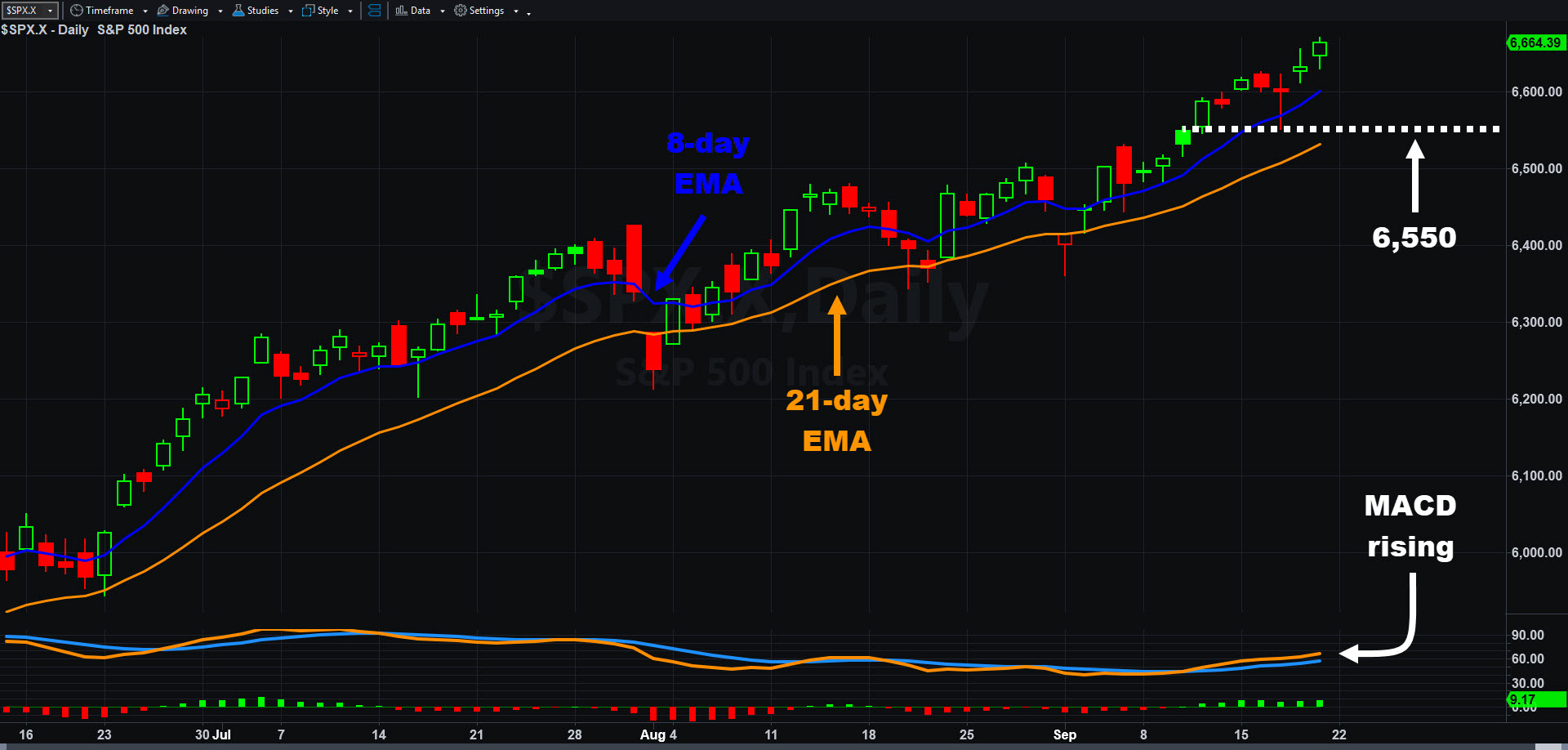
S&P 500, daily chart, with select patterns and indicators.
This week is light on economic news, but several Fed officials are scheduled to speak.
Stephen Miran, just appointed by President Trump, gives an address today along with Richmond’s Thomas Barkin and Cleveland’s Beth Hammack.
Chairman Powell speaks tomorrow and Micron Technology (MU) reports earnings in the post market.
Wednesday morning features crude-oil inventories.
Initial jobless claims, existing home sales, durable-goods orders and the final estimate of second-quarter economic growth are due. Costco (COST) issues quarterly results.
The personal consumption expenditures (PCE) inflation reading is on Friday. Personal spending and income are included in the report.

After a long bidding war for Warner Bros. Discovery, one big options trader is looking for the current deal to go through.

Apple has done little for a long time, and some traders may think the tech giant is rolling over.

Stocks could face a huge test as energy prices surge and violence sweeps the Middle East.