AI Stock ‘Stays Cool’ as Iran War Rages

Massive Volatility as Trump Signals De-Escalation
Stocks are whipsawing after the White House suggested it may de-escalate the Iran war.

Call toll-free 800.328.1267
Vertiv has been a quiet beneficiary of the AI boom and now it’s getting noticed.
The maker of datacenter cooling systems was added to the S&P 500 this month after a 232 percent gain in the two previous years. Its rally outpaces bigger companies like Nvidia (NVDA), Broadcom (AVGO) and Advanced Micro Devices (AMD) over that time.
VRT’s latest surge came on February 11, when earnings, revenue and guidance shot past expectations. The boom in AI datacenters pushed orders up 252 percent and doubled its backlog of business. It was the latest in a string of positive reports as AI spurs historic investment in datacenter hardware from GPUs to server racks.
All that electrical equipment in one place generates enough heat to bake pottery. That’s where VRT comes in because it was founded to solve this very problem in 1965 in the first wave of widespread IT adoption. International Business Machines (IBM), whose room-sized mainframes were transforming corporate America, was one of its first big customers. The company, then known as Liebert, went public on the Nasdaq in 1981 and was acquired by Emerson Electric (EMR) six years later.
Platinum Equity took over the business in 2016, renamed it Vertiv and took it public in February 2020.
VRT rallied along with other tech stocks after the pandemic and rolled over as the Federal Reserve hiked interest rates in 2022. Sentiment changed early the next year as the AI boom accelerated. The stock climbed along with other early movers like Super Micro Computer (SMCI) and Nvidia (NVDA). Those companies have mostly paused since, but VRT hasn’t broken its stride.
One big move occurred in October 2025, establishing VRT in new record territory. It consolidated those gains through last month, when quarterly results triggered another surge. VRT has barely flinched since, moving sideways with no significant pullbacks. It has barely reacted to the Iran war and stayed above its 21-day exponential moving average. Those patterns may suggest buyers still outnumber sellers.
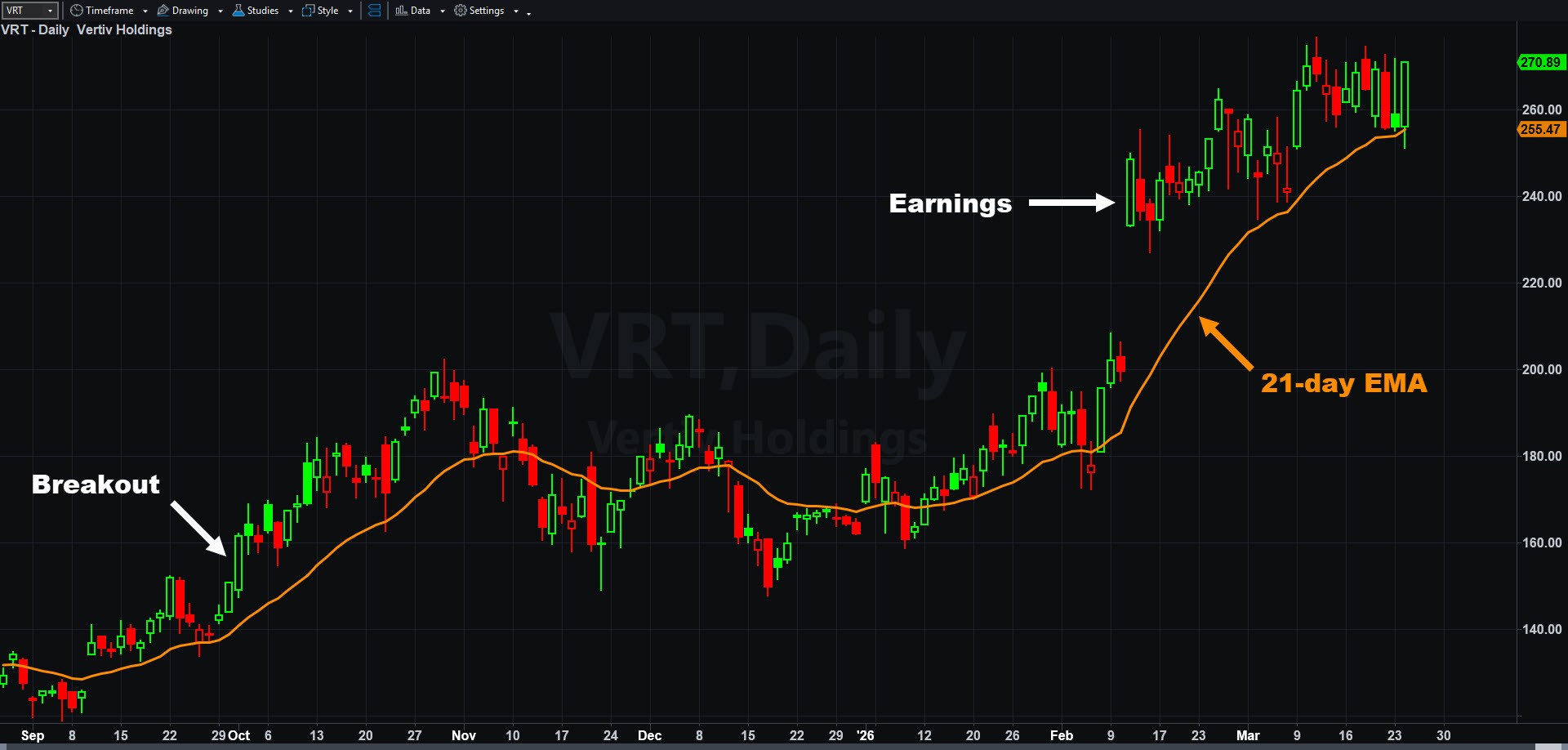
Vertiv (VRT), daily chart, with select patterns and indicators.
The shares rose 5.8 percent to $270.89 yesterday. While they’re slightly below the intraday peak two weeks ago, it was still a record closing high.
Given the strong momentum, some traders may look for VRT’s uptrend to continue in the near term. They might also consider using options to manage risk.
One potential strategy is a vertical call spread, which involves buying a call near the money and selling another at a higher price. It can profit from the shares climbing to the higher strike, potentially generating significant leverage from modest appreciation. (The key mechanism is selling upside calls to collect premium. That lowers the overall cost and increases the potential appreciation percentage terms.)
For example, a trader might purchase the April 285 calls and sell the April 305 calls for a net cost of about $6. That spread could be worth $20 if VRT closes at $305 or higher on April 17, which would translate into a 228 percent gain from the stock rising 13 percent.
Alternately, investors could purchase 100 shares and sell the April 285 calls for about $9.35. That would lower their cost basis to $261.54, letting them earn 9 percent from a 5.2 percent move to $285 by April 17. Gains would be capped at the level. The strategy, known as a covered call, would also cushion against a 3.5 percent drop. (Covered calls provide modest downside protection while also limiting gains.)
In conclusion, VRT has emerged as a key player in the AI datacenter industry. Buyers have looked past weakness in the broader market and focused on its steady growth metrics. Hopefully this article explains the trend and some ways traders may consider taking positions with options.
Options trading is not suitable for all investors. Your TradeStation Securities’ account application to trade options will be considered and approved or disapproved based on all relevant factors, including your trading experience. See www.TradeStation.com/DisclosureOptions. Visit www.TradeStation.com/Pricing for full details on the costs and fees associated with options.
Margin trading involves risks, and it is important that you fully understand those risks before trading on margin. The Margin Disclosure Statement outlines many of those risks, including that you can lose more funds than you deposit in your margin account; your brokerage firm can force the sale of securities in your account; your brokerage firm can sell your securities without contacting you; and you are not entitled to an extension of time on a margin call. Review the Margin Disclosure Statement at www.TradeStation.com/DisclosureMargin.

Stocks are whipsawing after the White House suggested it may de-escalate the Iran war.

Volatility is rising as geopolitical and economic risks increase. How will natural born traders react?

Stocks have been crumbling as stagflation and war dominate sentiment.