‘Sell America?’ Stocks Struggle as Dollar Sinks

Stocks Head for Record Drop as War Escalates
The pain is growing on Wall Street as fighting escalates in the Middle East.

Call toll-free 800.328.1267
Stocks are struggling as money streams away from U.S. assets.
The S&P 500 slid 0.4 percent in the holiday-shortened period between Friday, January 16, and Friday, January 23. The index has now fallen in back-to-back weeks for the first time since June.
A bigger and more dramatic move occurred in the U.S. dollar, which lost 1.9 percent of its value. It was the biggest drop since April’s Liberation Day selloff, boosting global assets like precious metals and foreign currencies. Silver crossed $100 for the first time ever and gold closed at a new record near $5,000. Stock markets in countries like Brazil, South Korea and Mexico also shot higher.
The moves followed threats to impose tariffs on European countries that refused to support annexing Greenland. That reminded investors of last year’s trade wars, making them question the dollar as a reserve currency and reducing demand for American assets.
“The U.S. Treasury is not performing the normal safe-haven role at this moment,” Evercore ISI Chairman Krishna Guha told CNBC on Tuesday. “There’s no turning back here. There are some fundamental tectonic shifts underway.”
| Abbott Laboratories (ABT) | -12% |
| Coinbase (COIN) | -10% |
| GE Aerospace (GE) | -9.6% |
| McCormick (MKC) | -9.3% |
| Capital One Financial (COF) | -9.1% |
| Source: TradeStation data |
Last week’s price action may signal a new kind of market is emerging in 2026. Sectors that have lagged for years, like energy and materials, are now leading. It’s a break from technology’s long-term outperformance, suggesting a bigger shift is underway.
Financials, which rallied sharply in previous weeks, fell after the White House called for limiting interest rates on credit cards. FactSet also noted the group’s revenue misses and slower earnings growth.
Industrials, homebuilders, retailers and small caps also struggled. That may argue against a recent shift to non-tech cyclicals.
Coinbase (COIN) led the S&P 500 lower as Bitcoin stalled under $100,000 and Ethereum stalled under $3,000. Abbott Laboratories (ABT) had its biggest weekly drop since the pandemic on weak sales of nutrition products.
GE Aerospace (GE) fell despite strong results and guidance. Global trade pressures hurt spice company McCormick (MKC). Capital One Financial (COF) slid after credit costs squeezed profits.
Equity Outflows
Some reports painted a less-than-stellar view of U.S. stocks.
Bank of America said institutional investors sold equities for the seventh straight week, led by large-cap companies.
Ray Dalio, founder of the hedge fund Bridgewater, said foreign investors may buy less U.S. assets.
| Moderna (MRNA) | +16% |
| Albemarle (ALB) | +16% |
| SanDisk (SNDK) | +15% |
| Advanced Micro Devices (AMD) | +12% |
| Micron Technology (MU) | +10% |
| Source: TradeStation data |
Longview Economics wrote that odds of a secular bear market are increasing because of high valuations and heavy ownership of domestic stocks.
Analysts also lowered price targets on companies like Meta Platforms (META), Trade Desk (TTD) and HubSpot (HUBS). Those are also examples of the traditional growth stocks that have lagged recently.
Moderna (MRNA) led the S&P 500 for a second straight week. Albemarle (ALB), a lithium provider, benefited from strength in metals. SanDisk (SNDK) and Micron Technology (MU) kept climbing on memory-chip demand. Advanced Micro Devices (AMD) jumped on optimism about its AI products.
Charting the Market
The S&P 500 has shown signs of potentially topping, but chart watchers may not see confirmation yet.
The first potentially bearish pattern is last week’s breakdown from an ascending wedge. The index bounced but stalled below the previous week’s close, which may suggest that sellers outnumber buyers.
Prices also stalled at the 10-day moving average, a potentially negative directional signal.
Second, the nine-day rate of change (ROC) turned negative last week after making lower highs. Such divergence may reflect weakening momentum.
Third, Cboe’s volatility index (VIX) has trended higher since Christmas Eve. That may suggest anxiety is growing.
Next, traders may watch January 14’s low of 6,886. Closing below it could potentially confirm that week’s bearish outside candle.
Below that, they may eye the January 21 low of 6789 as potential support. Closing below that level would represent a lower low following last week’s lower high.
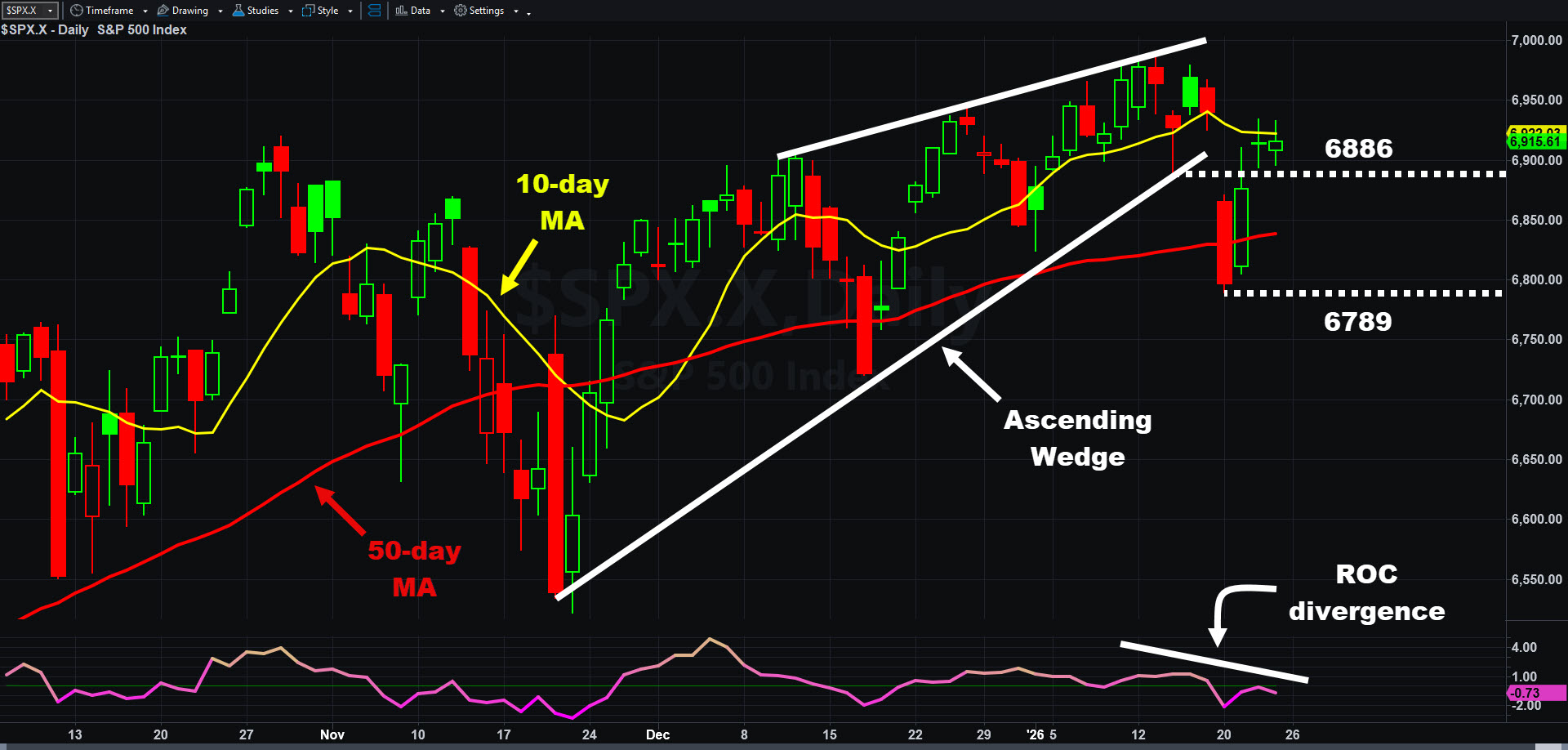
S&P 500, daily chart, with select patterns and indicators.
The Week Ahead
This week is full of important events that could serve as potential catalysts for coming moves.
Today is relatively quiet, with only durable-goods orders on the agenda.
Tomorrow brings quarterly results from companies like Boeing (BA), General Motors (GM) and Seagate Technologies (STX). Consumer confidence is also due.
Wednesday is a big day, with major earnings and a Federal Reserve meeting.
GE Vernova (GEV) and Starbucks (SBUX) announce in the premarket. Microsoft (MSFT), META and Tesla (TSLA) report after the closing bell.
The Fed’s policy statement comes at 2 p.m. ET, followed by a press conference 30 minutes later. It could be less important than other meetings because Chairman Jerome Powell is nearing the end of his term and interest rates aren’t expected to change. Crude oil inventories are also due.
Thursday features initial jobless claims, plus earnings from Apple (AAPL) and SNDK.
Friday is the final session of January. Exxon Mobil (XOM) and Chevron (CVX) report earnings. December’s producer price index (PPI) is also due.

The pain is growing on Wall Street as fighting escalates in the Middle East.

Vertiv has been a quiet beneficiary of the AI boom and now it’s getting noticed.

Stocks are whipsawing after the White House suggested it may de-escalate the Iran war.