Options Alert: Is This AI Pioneer Broken?

AI Stock ‘Stays Cool’ as Iran War Rages
Vertiv has been a quiet beneficiary of the AI boom and now it’s getting noticed.

Call toll-free 800.328.1267

Super Micro Computer was an early leader in the AI boom, but one options trader could be taking a grim view.
This large transaction occurred Friday afternoon in the maker of AI servers:
Volume was below open interest at both strikes, which suggests existing positions were closed before expiration.
At the same second, these blocks hit:
Volume exceeded open interest in both strikes, which indicates new positions were opened.
That combination of activity suggests the trader previously sold a credit spread expiring last Friday. He or she apparently made money on it and rolled it forward to this week. A similar transaction occurred in May, which could reflect ongoing activity by a single large investor.
Calls fix the price where a security can be purchased. They can appreciate when shares rise, so they are associated with bullish trends. However, they can be sold in credit spreads, letting traders profit from shares not climbing to a certain level.
In the case of Friday’s activity, the investor may have previously sold the 29-August 44.50 calls and bought the 29-August 47.50s as a hedge against a rally. Such a transaction would have generated a credit at the time.
It apparently worked because SMCI closed Friday at $41.54, down 5.5 percent. Rolling to this week’s expiration would have generated an additional credit of $0.38. The adjustment lowered the upside threshold for maximum profit by $1.50 (from $44.50 to $43), potentially reflecting a negative view of the stock.
It’s also noteworthy that the strategy is using short-dated contracts. That can capture the quicker pace of time decay in the final 1-2 weeks of an option’s life.
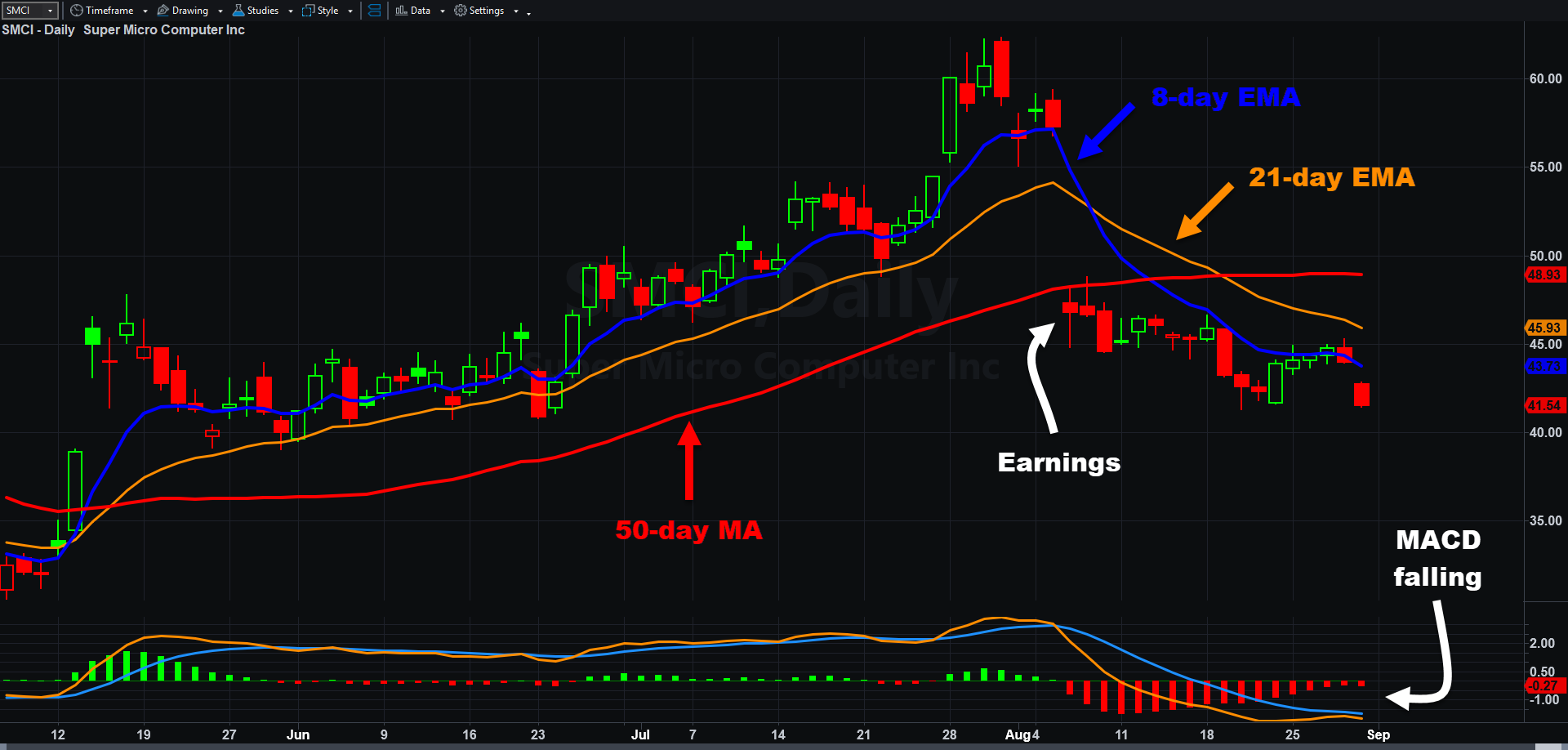
Super Micro Computer (SMCI), daily chart, with select patterns and indicators.
SMCI was the second-worst performer in the S&P 500 last month, according to TradeStation data. Its drop began on August 6 after earnings, revenue and guidance missed estimates. Moving average convergence/divergence (MACD) is falling and the 8-day exponential moving average is below the 21-day EMA. Those patterns may signal short-term bearishness. Prices additionally broke the 50-day moving average, which may reflect a weakening intermediate-term trend.
Dell Technologies (DELL), a rival in the AI server market, also fell sharply on Friday after guiding the current quarter below consensus. Combined with potential topping patterns in big companies like Microsoft (MSFT) and Palantir Technologies (PLTR), could traders think the AI trend is losing momentum?
Options trading is not suitable for all investors. Your TradeStation Securities’ account application to trade options will be considered and approved or disapproved based on all relevant factors, including your trading experience. See www.TradeStation.com/DisclosureOptions. Visit www.TradeStation.com/Pricing for full details on the costs and fees associated with options,
Margin trading involves risks, and it is important that you fully understand those risks before trading on margin. The Margin Disclosure Statement outlines many of those risks, including that you can lose more funds than you deposit in your margin account; your brokerage firm can force the sale of securities in your account; your brokerage firm can sell your securities without contacting you; and you are not entitled to an extension of time on a margin call. Review the Margin Disclosure Statement at www.TradeStation.com/DisclosureMargin.

Vertiv has been a quiet beneficiary of the AI boom and now it’s getting noticed.

Stocks are whipsawing after the White House suggested it may de-escalate the Iran war.

Volatility is rising as geopolitical and economic risks increase. How will natural born traders react?