Apple’s Big Week Drove the Nasdaq to Records

AI Stock ‘Stays Cool’ as Iran War Rages
Vertiv has been a quiet beneficiary of the AI boom and now it’s getting noticed.

Call toll-free 800.328.1267

Apple just had one of its best weeks ever, driving the Nasdaq to new record highs.
AAPL surged 13 percent between Friday, August 1, and Friday, August 8. It was the third-biggest weekly gain since the first iPhone was launched in January 2007.
The rally lifted the Nasdaq-100 by 3.7 percent, establishing a new all-time high for the tech-heavy index. Other benchmarks like the S&P 500 and Dow Jones Industrial Average rose but stayed below their record highs.
AAPL increased a planned investment in the U.S. by $100 billion, onshoring production of some components from China. The move let CEO Tim Cook sidestep threatened tariffs of 25 percent on imported handsets and 100 percent on chips. It relieved investors worried about the company’s supply chain and satisfied White House demands for domestic production of smart phones.
Other technology companies jumped as well:
Other megacap growth stocks outside of the technology sector helped lift the Nasdaq.
| Idexx Laboratories (IDXX) | +23% |
| Palantir Technologies (PLTR) | +21% |
| Arista Networks (ANET) | +18% |
| Axon Enterprise (AXON) | +13% |
| Micron Technology (MU) | +13% |
| Source: TradeStation data. |
Tesla (TSLA), a member of the consumer discretionary group, climbed as investors focused on its shift to robotaxis and robotics. The company also approved a new pay package for CEO Elon Musk and received an important regulatory approval in Texas.
Alphabet (GOOGL), a member of the communications sector, was approved to provide AI services to the federal government. The news refocused attention on a stock that had consolidated since reporting strong results on July 23.
Of the market’s eight companies with market caps of at least $1 trillion, Microsoft (MSFT) was the only stock to fall last week. (It slipped 0.4 percent.)
SoundHound (SOUN), a provider of AI-generated voices, also rallied 35 percent. Idexx Laboratories (IDXX) and Axon Enterprise (AXON) were other big gainers in the S&P 500. Strong quarterly results lifted all three.
Metals were one of the strongest industries overall last week. Better-than-expected results at rare-earths company MP Materials (MP) and a weak dollar helped drive the move. Gold and silver miners also surged as the U.S. dollar fell.
| Trade Desk (TTD) | -37% |
| Gartner (IT) | -30% |
| Fortinet (FTNT) | -24% |
| Super Micro Computer (SMCI) | -21% |
| Vertex Pharmaceuticals (VRTX) | -21% |
| Source: TradeStation data. |
Consumer discretionaires and technology were the top-performing major sectors. Consumer staples also jumped as bullish earnings sent Monster Beverage (MNST) to a new record high.
Energy fared the worst last week after OPEC+ boosted oil production again. Healthcare, the weakest sector in the last year, also fell.
Vertex Pharmaceuticals (VRTX) and Eli Lilly (LLY) had their biggest weekly drops in over a decade on disappointing drug-trial data. Super Micro Computer (SMCI) fell after earnings, revenue and guidance missed consensus.
The Trade Desk (TTD) had its biggest weekly drop ever after missing guidance and announcing the exit of its CEO. TTD was also the biggest decliner in the S&P 500 — just one month after joining the index.
Fortinet (FTNT) fell on weak guidance as customers slowed firewall renewals.
Gartner (IT) had its biggest weekly drop ever after issuing weak guidance.
The declines may showcase a widening bearish trend in providers of business software and services. Other companies under pressure include Salesforce (CRM), ServiceNow (NOW), Adobe (ADBE), GoDaddy (GDDY) and Twilio (TWLO).
At least two catalysts seem to be at play. First is weakening of business models because of competition from AI. Second is a weakening economy.
Speaking of the economy, initial jobless claims were higher than expected for the first time in almost two months. Continuing claims rose to the highest level since November 2021. The Institute for Supply Management’s service-sector index also missed estimates.
Separately, productivity rose less than forecast in the second quarter. Unit labor costs rose more than expected.
Reports from U.S. Treasury auctions showed weak demand for 10- and 30-year sovereign debt.
That combination of data is potentially stagflationary and consistent with higher borrowing costs. It could gain importance this week because of the Consumer Price Index (CPI) tomorrow morning and producer prices (PPI) on Thursday.
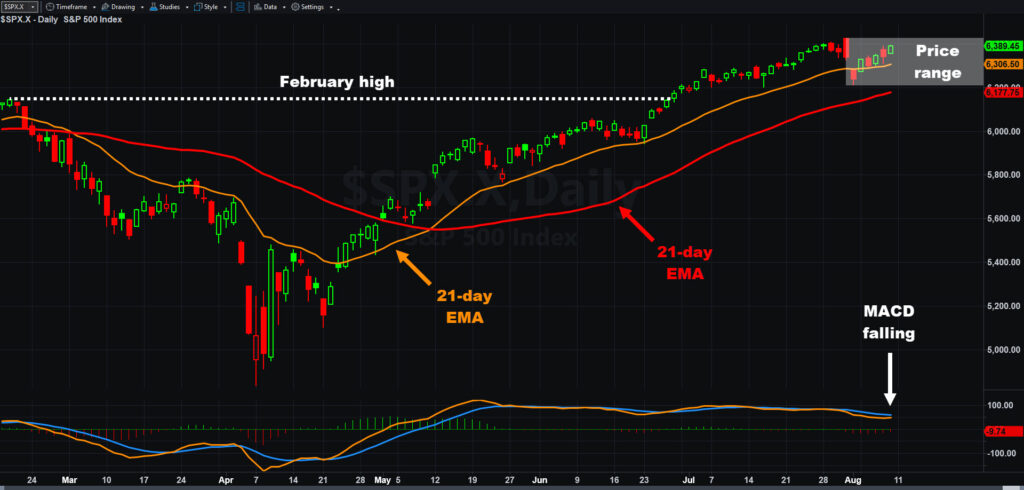
S&P 500, daily chart, with select patterns and indicators.
The S&P 500 ended last week at its second highest closing price ever. However some chart watchers may see risk of it stalling.
The main pattern is the large swing between July 31’s high of 6427 and August 1’s low of 6213. Prices have remained within that 214-point range since.
The moving average convergence/divergence (MACD) oscillator is also falling — a potential sign of weaker momentum.
The 10-year Treasury yield also stayed above 4.2 percent. That could also potentially influence the market because it impacts borrowing costs. It could be especially important before tomorrow’s CPI.
Attention may shift this week from earnings to interest rates.
Some smaller companies report this afternoon, including some associated with AI and data centers: BigBear.ai (BBAI), Oklo (OKLO) and Archer Aviation (ACHR).
Tomorrow’s CPI report at 8:30 a.m. ET is a potentially big event. Circle Internet (CRCL) will also report earnings for the first time since its IPO. CRCL is a cryptocurrency company known for the stablecoin USDC. CoreWeave (CRWV), Rigetti Computing (RGTI) and Cava (CAVA) follow in the afternoon.
Wednesday brings crude-oil inventories and results from Cisco Systems (CSCO) in the afternoon.
The PPI inflation report and initial jobless claims are on Thursday. Deere (DE) and Applied Materials (AMAT) report earnings.
Attention turns to the consumer on Friday morning, with retail sales and consumer sentiment due.

Vertiv has been a quiet beneficiary of the AI boom and now it’s getting noticed.

Stocks are whipsawing after the White House suggested it may de-escalate the Iran war.

Volatility is rising as geopolitical and economic risks increase. How will natural born traders react?