You’ve mapped the ratio diagonal in your head. Buy one back-month call, sell two front-month calls at a higher strike. The math makes sense. Theta tends to work in your favor.
But when you try to model the actual risk, the picture fractures.
You’re toggling between an options chain, a separate P&L calculator, and a Greeks spreadsheet. By the time you’ve estimated your exposure, implied volatility has shifted. The numbers you trusted are already stale.
This is the analysis friction of complex spreads: the cost of analyzing a multi-dimensional strategy through disconnected tools.
The pivot: your ratio diagonal math is right, your tools aren’t
A ratio diagonal spread isn’t complicated. It’s a diagonal with an extra short option, typically a 1:2 ratio that amplifies theta while introducing asymmetric risk.
The complexity isn’t in the structure. It’s in the analysis.
You’re managing two legs and three contracts across two expirations. Delta drifts as the underlying moves. Gamma accelerates as the front-month expiration approaches. Vega exposure means an IV spike can erase your theta gains overnight.
Modeling all of this on disconnected tools is where the “retail tax” adds up. You miss entries while manually calculating risk. You size incorrectly because your P&L tool lags the chain.
The solution: how to analyze ratio diagonal spread options
TITAN X treats multi-leg options as single structures from the start. You build, analyze, and verify risk before you commit capital. Here’s the workflow for ratio diagonals specifically.
1. Screening IV Rank for ratio diagonal setups
Ratio diagonals tend to thrive in elevated implied volatility environments. When IV Rank sits at 50 or higher (a common threshold many traders use to define “elevated”), the extrinsic value on your short options inflates, which can improve net premium economics whether you’re paying a small debit or collecting a credit.
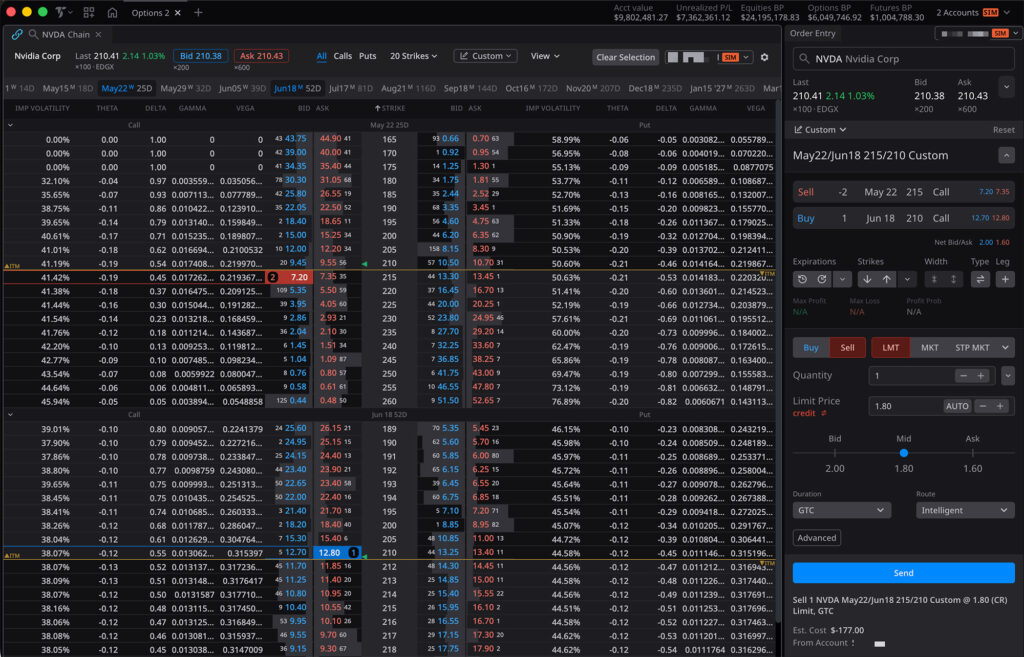
Load your watchlist into TITAN X. The options chain displays inline Greeks, implied volatility, and probability metrics for every strike. Click a symbol and linked charts, Matrix, and options chain update simultaneously.
For systematic IV Rank and IV Percentile scanning across symbols, TradeStation Desktop is the specialist tool. For deep volatility surface analysis, TradeStation’s third-party integrations include TradingView, Option Alpha, MultiCharts, QuantConnect, TradersPost, and ORATS.
Before you commit, check the volatility term structure. Front-month IV should exceed back-month IV for optimal economics, because your short options carry the inflated premium you’re selling and your long back-month typically holds vega better through the front-month decay cycle.
You’re looking for: elevated IV Rank, liquid options, tight bid-ask spreads, and a clean calendar. No earnings inside your short expiration unless that’s the play.
2. Visualizing ratio diagonal spread risk before entry
Here’s what separates ratio diagonals from standard diagonals: unlimited risk on one side.
In a 1:2 call ratio diagonal, you’re long one call and short two. One short is covered by your long. The other is naked. If the underlying rips through your short strike, losses compound with every tick higher.
For more depth, OptionStation® Pro on desktop renders 3D risk graphs across price and time in a single view. The asymmetric profile renders in real time: max profit typically at the short strike at front-month expiration, limited downside risk (capped at the net debit paid; or a small profit retained if entered for credit), and unlimited exposure to the upside through the naked short. You see exactly where losses accelerate.
Strike selection matters more than most traders acknowledge. The 1:2 ratio is standard, but 1:3 ratios exist for more aggressive theta capture, at the cost of amplified gamma risk and doubled naked exposure (from one naked contract to two). Wider strike spacing (longs further from shorts) can stretch the profit zone but generally increases the net debit paid and requires elevated IV to make the economics work.
3. Monitoring Greeks on a ratio diagonal position
At entry, your ratio diagonal Greeks profile will look approximately like this. Verify against your specific strikes.
Delta: Strike-dependent. Net delta varies widely based on where your short strikes sit relative to your long. A call ratio diagonal can run anywhere from slightly negative (neutral-to-bearish setup) to modestly positive (bullish setup). Model your specific strikes in OptionStation Pro before assuming directional bias.
Theta: Typically positive. Two short options usually decay faster than one long, especially when the shorts are closer to expiration. The position can earn time value as long as the underlying stays range-bound, though gamma losses on larger moves can offset theta gains on any given day.
Vega: Typically slightly negative to roughly neutral, depending on strikes. Two short front-month contracts usually carry more combined vega than one long back-month contract, but the back-month’s longer DTE partially offsets the math. IV contraction generally helps the position; an IV spike can pressure it.
Gamma: Negative and concentrated around your short strikes. Gamma accelerates in the final 7 days before front-month expiration, creating violent delta swings on small price moves.
TITAN X displays all of this in the options chain: delta, gamma, theta, and vega visible at a glance. You’re monitoring net delta drift versus your entry value and watching for gamma acceleration as front-month expiration approaches.
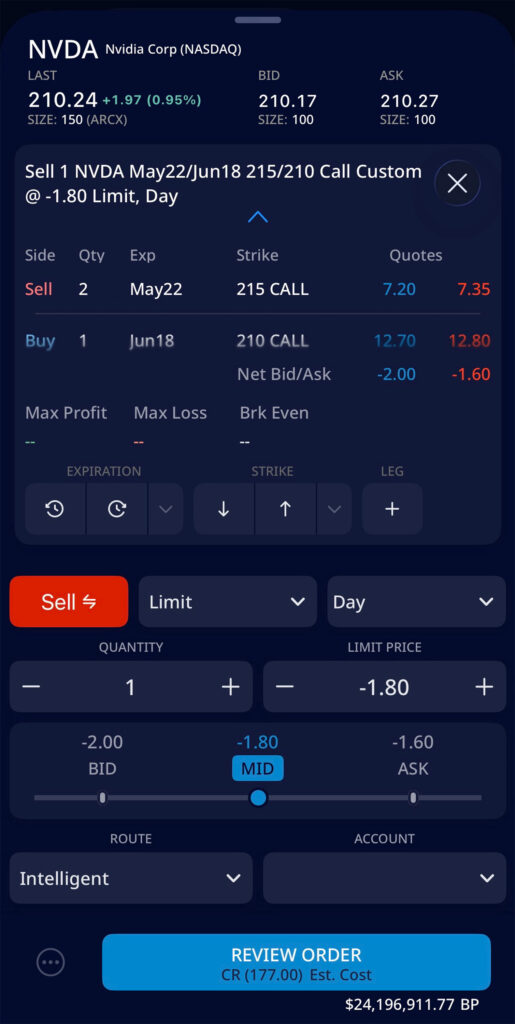
TradeStation Mobile lets you monitor Greeks throughout the session and roll standard spread structures from your phone. For ratio adjustments specifically, route back to TITAN X or OptionStation Pro on desktop where uneven leg counts are handled cleanly.
4. Ratio diagonal entry criteria: the pre-trade checklist
Before you commit capital, check the setup:
- IV Rank at 50 or higher?
- Volatility term structure in backwardation (front-month IV above back-month)?
- Short strikes at technical resistance (calls) or support (puts)?
- Front-month expiration 21–30 days to expiration (DTE)?
- Back-month expiration 45–60 DTE?
- Risk graph visualized in OptionStation Pro with the unlimited upside loss zone confirmed beyond your planned adjustment level?
If multiple answers are no, the setup probably isn’t ready.
Expert strategies: optimizing your ratio diagonal spread
Ratio diagonal strike selection: width and ratio
While 1:2 is the standard structure, some traders expand to 1:3 for greater theta, accepting higher gamma sensitivity and additional naked exposure. Wider strike spacing can improve the profit zone but typically requires elevated IV and more capital at risk.
When to roll, close, or take profits on a ratio diagonal
Many traders take profits and roll when short option delta option has moved meaningfully OTM and the residual premium isn’t worth the remaining risk) or when 7–10 DTE remains, whichever comes first. For defensive rolls, when the underlying rallies and short delta climbs past 40, consider moving the shorts up and out. If the underlying breaches your short strike by more than one ATR, you may decide to close the position rather than roll.
Many traders close at 50–75% of max profit potential. Holding for full max profit means riding gamma risk into expiration week. The theta that pays you daily doesn’t protect you from gamma acceleration if you overstay.
Ratio diagonal spread risks: unlimited exposure on one side
Ratio diagonals carry unlimited risk on one side. In a 1:2 call ratio diagonal, your upside exposure is uncapped if the underlying rips through your short strikes. The extra short option requires naked call margin, and this strategy typically requires elevated options approval given the naked short component. This isn’t a defined-risk strategy. Gamma accelerates violently in the final week before front-month expiration. The theta that can pay you daily doesn’t protect you from gamma acceleration if you overstay. Every ratio diagonal position should be actively monitored and supported by a pre-defined adjustment plan.
Analyze ratio diagonal spreads with the right tools
Ratio diagonals can reward traders who analyze before they execute. The strategy isn’t exotic. The risk profile is.
You’ve seen how to screen for elevated IV, visualize asymmetric payoffs, monitor the Greeks that matter, and establish entry criteria that filter marginal setups.
Want to learn more? Explore the Options Education Center
Ready to trade? Open a TradeStation account
Trade like you were born to do this.
Disclosure:
Options trading is not suitable for all investors. Your TradeStation Securities’ account application to trade options will be considered and approved or disapproved based on all relevant factors, including your trading experience. See www.TradeStation.com/DisclosureOptions. Visit www.TradeStation.com/Pricing for full details on the costs and fees associated with options.
Margin trading involves risks, and it is important that you fully understand those risks before trading on margin. The Margin Disclosure Statement outlines many of those risks, including that you can lose more funds than you deposit in your margin account; your brokerage firm can force the sale of securities in your account; your brokerage firm can sell your securities without contacting you; and you are not entitled to an extension of time on a margin call. Review the Margin Disclosure Statement at www.TradeStation.com/DisclosureMargin.
Equities, equity options, and commodity futures products and services are offered by TradeStation Securities, Inc. (Member NYSE, FINRA, CME and SIPC).
The examples in this article are hypothetical and for educational purposes only. They do not represent actual trades or guarantee future results. Past performance is not indicative of future results.
ID5455879 P10616076717 D0526