Is a Santa Rally Coming After Bears Retreat?

Call Volume Spikes: Has Oracle Bottomed?
Is Oracle finally bottoming? Some traders may think it has.

Call toll-free 800.328.1267

Some investors may see potential for a “Santa rally” after stocks recovered from a sharp pullback last month.
The S&P 500 spent most of November in the red, dropping almost 5 percent at its low. The index recovered in Thanksgiving week and turned green in the final hours of trading, ending with a 0.1 percent gain. It was the seventh straight positive month — the longest winning streak since mid-2021.
Rotation and doubts were the main themes of the month. Investors questioned the sustainability of AI investment after Michael Burry said hyperscalers may be understating datacenter costs. They also wondered about the leadership of Nvidia (NVDA) after Alphabet (GOOGL) started winning users to its new Tensor AI chips.
Other stocks fell on worries about the long-term profitability of the current AI buildout. Those included Meta Platforms (META), Oracle (ORCL), Microsoft (MSFT), Super Micro Computer (SMCI) and Dell Technologies (DELL).
| Albemarle (ALB) | +32% |
| Eli Lilly (LLY) | +25% |
| Solventum (SOLV) | +23% |
| Merck (MRK) | +22% |
| Kenvue (KVUE) | +21% |
| Source: TradeStation data |
Healthcare, on the other hand, rose the most in three years. Eli Lilly (LLY) became the sector’s first trillion-dollar company thanks to strong results and optimism about its weight-loss drugs. Merck (MRK) had its biggest monthly gain of the century as Wall Street focused on expanded uses of its Keytruda cancer treatment.
Solventum (SOLV), a supplier of medical equipment spun off from 3M (MMM) in April 2024, advanced on strong quarterly results.
November also featured uncertainty about the economy and monetary policy. First, the government shutdown delayed economic data. That will continue to impact the release of key numbers in December, causing some unusual release dates this month:
Second, the Federal Reserve holds its key meeting on December 10. Expectations have swung considerably as policymakers struggled with the lack of economic data and issued mixed statements. CME’s FedWatch tool did almost a complete roundtrip: Odds of a 25-basis point cut began were around 90 percent in October. They fell to 34 percent on November 19 and then recovered to 86 percent.
Speaking of the Fed, Treasury Secretary Scott Bessent told CNBC “there’s a very good chance” President Trump will announce his nominee for the next chairman before Christmas. That could also focus attention on rate cuts.
Those hopes of easier monetary policy brought investors back to precious metals. Silver ended the month at a new all-time high above $55 and gold held support at $4,000. Producers like Iamgold (IAG), Hecla Mining (HL) and Pan American Silver (PAAS) had some of the biggest gains.
| Super Micro Computer (SMCI) | -35% |
| Axon Enterprise (AXON) | -26% |
| Oracle (ORCL) | -23% |
| DoorDash (DASH) | -22% |
| Trade Desk (TTD) | -21% |
| Source: TradeStation data |
Industrial metals like Steel Dynamics (STLD) and lithium producers like Albemarle (ALB) also climbed to new 52-week highs. Steelmakers have reported strong earnings and lithium companies have benefited from a rally in the battery metal as China limits output.
Several traditional retailers jumped after quarterly results beat estimates. The list included Kohl’s (KSS), Abercrombie & Fitch (ANF) and Urban Outfitters (URBN). Macy’s (M) climbed ahead of its numbers this coming Wednesday.
Interestingly, all those store operators were formerly in the S&P 500 but were removed during the past decade’s “retail apocalypse.” (That’s when the spread of e-commerce shuttered thousands of traditional brick-and-mortar locations.) With smaller footprints and years of weakness in the rearview mirror, are these traditional merchants staging a comeback?
The S&P 500 has been consolidating for more than a month, but some chart watchers may expect further upside given some recent patterns.
First, the index bounced at the same 6,551 level where it bottomed on October 10. Second, the S&P just had its highest weekly close ever. Those signals may suggest support is in place and new price discovery is starting.
Next, technology and consumer discretionaries are two key sectors based on size and their holdings of large growth stocks. They led the market lower in early November but were the strongest groups during the Thanksgiving bounce. That may suggest dip buyers have appeared. (The Nasdaq-100 rose 4.9 percent, its biggest weekly gain since mid-May, according to TradeStation data.)
Short-term directional indicators like 8-day exponential moving average and moving average convergence/divergence (MACD) have also turned positive. Prices additionally returned above their 50-day moving average — a potential sign of intermediate-term bullishness.
Friday’s new high on the advance/decline line could reflect improved breadth.
Traders may also see downside potential in Cboe’s volatility index (VIX), the U.S. dollar and Treasury yields. That may be consistent with increased confidence after a period of fear.
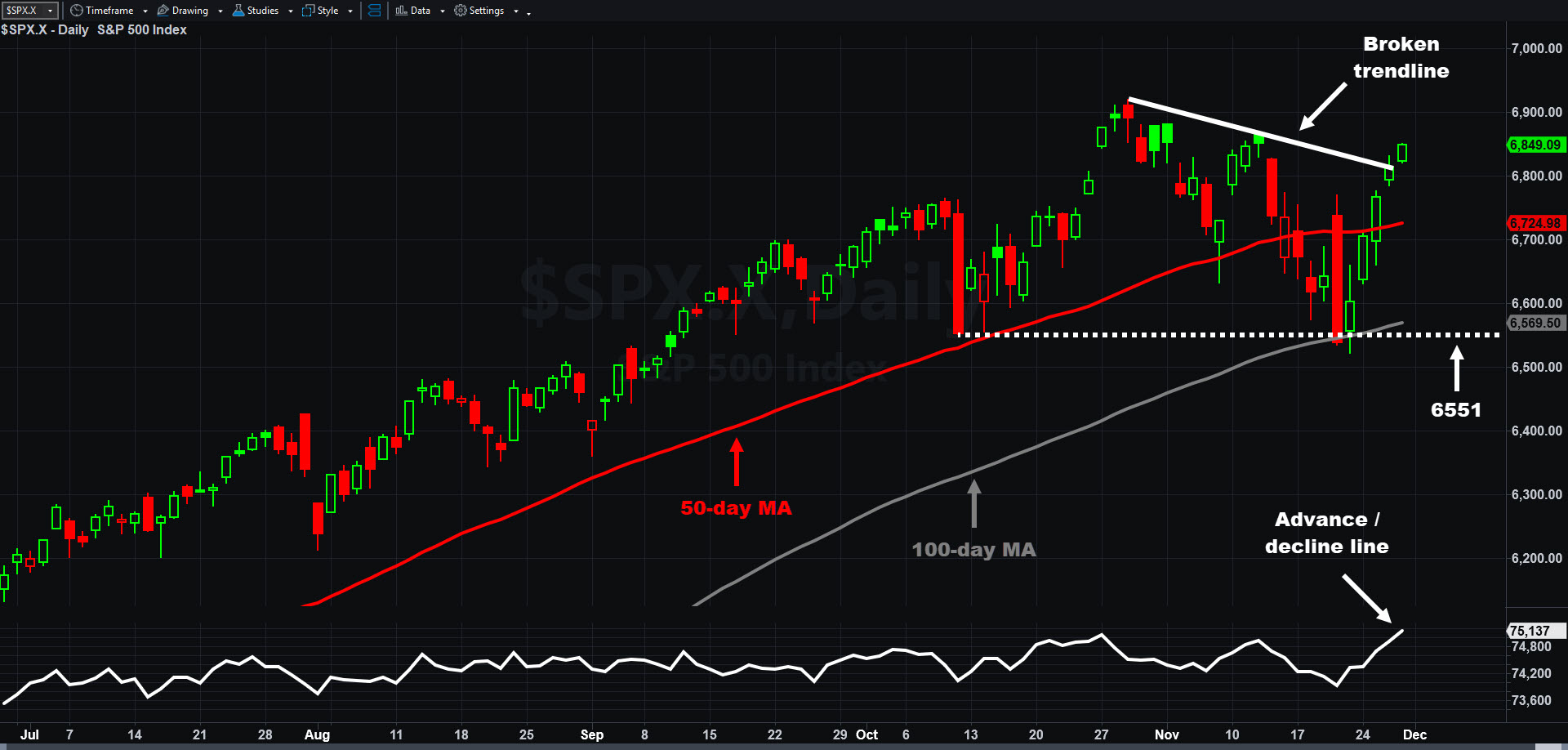
S&P 500, daily chart, with select patterns and indicators.
This week’s schedule is relatively quiet, with few big earnings or economic releases.
The Institute for Supply Management’s manufacturing index is the main item today.
Tomorrow afternoon features results from CrowdStrike (CRWD) and Marvell Technology (MRVL).
ADP’s private-sector payrolls report is due on Wednesday morning, followed by ISM’s service-sector index and crude-oil inventories. Salesforce (CRM) and Snowflake (SNOW) report earnings.
Initial jobless claims are in Thursday’s premarket.
Friday brings December’s initial reading of consumer sentiment. The government will also issue September’s personal income and spending data (delayed by the shutdown).

Is Oracle finally bottoming? Some traders may think it has.

Nebius consolidated for months, but some traders may think the datacenter stock is breaking out. The first pattern on today’s chart is the long basing pattern between November and late March. (It could also be viewed as a cup and handle following the rally between...

Chipmakers are trying to break out as investors brace for a potential oil shock.