Stocks Set a New Record as Pharma Comes to Life

Nasdaq Keeps Running as Bulls Move to Software
The Nasdaq-100 keeps running as the AI boom widens across the technology sector.

Call toll-free 800.328.1267

Stocks keep setting records as new sectors come to life. Last week, healthcare and pharmaceuticals led the charge.
The S&P 500 rose 1.1 percent between Friday, September 26, and Friday, October 3. The index crossed 6,700 for the first time and has made fresh all-time highs for six consecutive weeks.
The big news came on Tuesday, when President Trump announced Pfizer (PFE) agreed to lower drug prices. Investors viewed the deal as evidence the White House will reduce pressure on drugmakers. He’s also willing to cancel high tariffs on companies that manufacture domestically.
Pharmaceutical stocks had their biggest weekly gain since the pandemic, and the broader healthcare sector turned positive on the year.
The Administration also considered taking stakes in Lithium Americas (LAC) and USA Rare Earth (USAR). LAC jumped 43 percent and USAR rallied 50 percent. The potential investments followed similar moves with Intel (INTC) and MP Materials (MP).
| Western Digital (WDC) | +23% |
| Robinhood Markets (HOOD) | +22% |
| Fair Isaac (FICO) | +22% |
| Coinbase Global (COIN) | +22% |
| Bio-Techne (TECH) | +21% |
| Source: TradeStation data |
Western Digital (WDC) led the S&P 500 last week after Morgan Stanley raised its price target on strong hard-drive demand. It was also the index’s third-best performer in September as AI investors focused on data-storage companies. Peers like Micron Technology (MU), Seagate Technology (STX) and Sandisk (SNDK) also made large moves last month. Will the move continue in the new quarter, or will traders take profits?
Robinhood Markets (HOOD) jumped to a new record high on excitement about its widening customer base and growth in its event-prediction market.
Fair Isaac (FICO), which had been falling since late 2024, jumped after adjusting its pricing model. The change also came in a response to pressure from the White House.
Coinbase Global (COIN) advanced as Bitcoin pushed above $120,000. Other cryptocurrency-related companies like Bakkt (BKKT), CleanSpark (CLSK) and Hut 8 (HUT) also rallied.
AES (AES) was another big gainer last week after the Financial Times reported it may be acquired in a private-equity deal. (AES didn’t make the top five in the index, but it still rose 10 percent.) The news helped lift the broader utility sector to a new record high.
Metals and global stocks also outperformed last week. Energy, banks and consumer discretionaries struggled.
The federal government shut down last week after lawmakers failed to agree on a funding resolution. The stoppage prevented the release of data like initial jobless claims and September’s non-farm payrolls.
The available economic reports were mixed. ADP’s private-sector payrolls report for September unexpectedly shrank by 32,000, its lowest reading since June 2021. However, the Labor Department’s job-opening report (JOLTs) for August surprised to the upside.
| Valero Energy (VLO) | -8.7% |
| Apollo Global (APO) | -8.5% |
| Paycom Software (PAYC) | -7.2% |
| Philip Morris (PM) | -7% |
| Corteva (CTVA) | -6.9% |
| Source: TradeStation data |
Many economists think the government shutdown will reduce employment, prompting the Federal Reserve to keep interest rates low. The shutdown could also delay the release of inflation data on October 15. Both of those conditions — rate cuts and no inflation data — could be viewed as positive for stocks.
“There is a strong seasonal tailwind underway and the upside is higher given the Fed is dovish,” Tom Lee of Fundstrat wrote on Thursday, according to CNBC. He added the S&P 500 may reach 7,000 by yearend, saying investors shouldn’t heed “dire warnings of calamity because of the shutdown.”
FactSet also noted that third-quarter earnings forecasts rose during the third quarter. It was the first time since the end of 2021 that estimates increased during the quarter, according to the research firm. (Analysts are usually more optimistic about long-term profits and revise numbers down as the reports approach.) Energy and technology had the most favorable changes, according to FactSet.
The S&P 500 has risen for six consecutive days, matching positive streaks from late July and mid-May.
The index has consistently made higher highs and higher lows while staying above its 8- and 21-day exponential moving averages. That could suggest an uptrend remains in effect.
Next, the advance/decline line hit a new high on Friday. TradeStation data also showed 27 members of the S&P 500 rose at least 10 percent last week, while not a single company fell that much. Those points may reveal strong breadth.
Last week’s low of 6,441 was 0.3 percent below the close from two weeks before on September 19. Prices quickly recovered before continuing upward, a sign that old resistance became new support.
Chart watchers using intermarket analysis may see few risks on other charts. For example, Cboe’s volatility index (VIX) remains below 20 and the U.S. dollar has been weak. Treasury yields are also staying low.
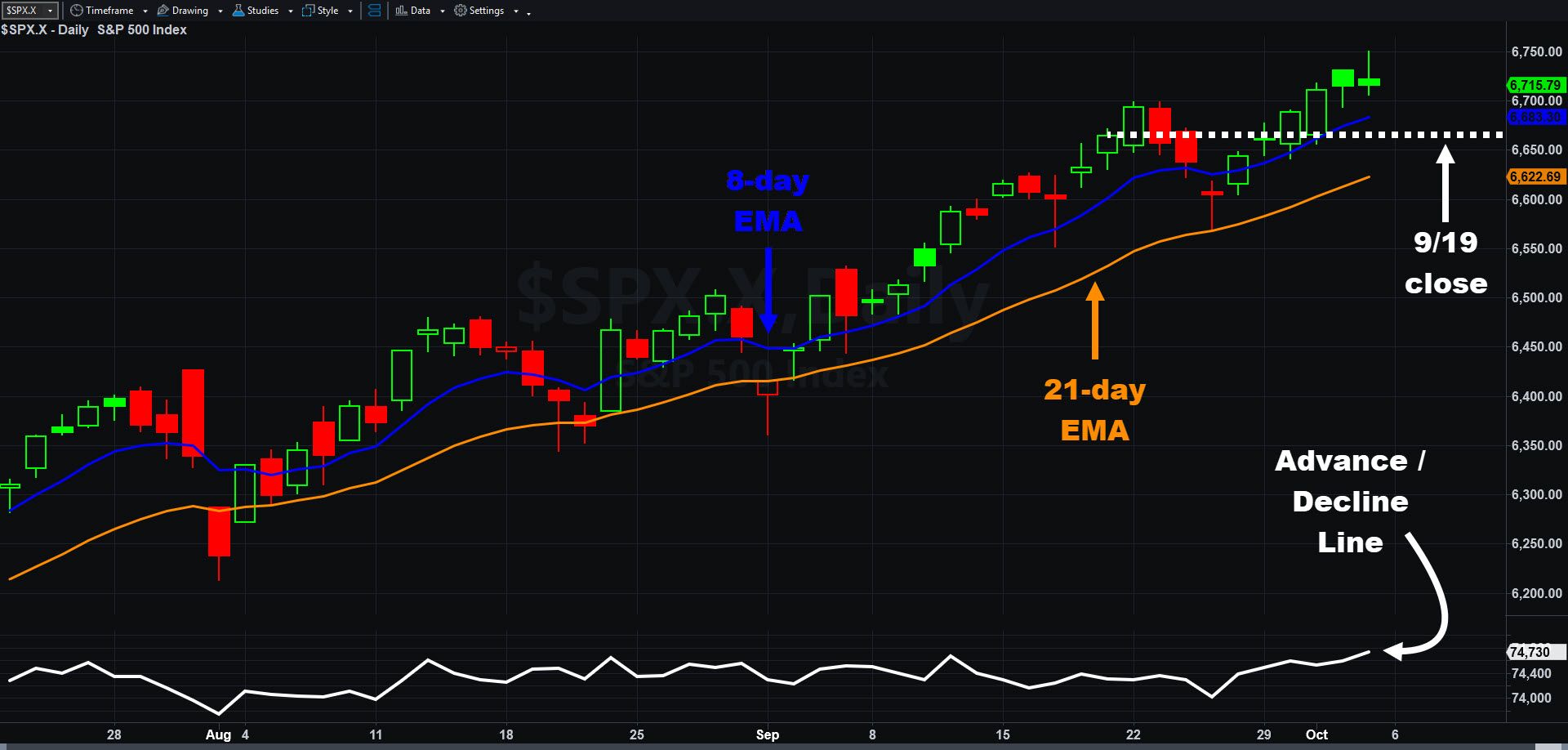
S&P 500, daily chart, with select patterns and indicators.
Few important events are scheduled for this week, although there may be news from Congress about the shutdown.
OpenAI, the parent of ChatGPT, holds its DevDay conference today. The event may have some impact on tech stocks.
Fed governors Michelle Bowman and Stephen Miran speak tomorrow. Both have recently favored rate cuts.
Crude-oil inventories are due Wednesday, although the release may be impacted by the government shutdown. The Fed is scheduled to release minutes from its last meeting in the afternoon.
Delta Airlines (DAL) and PepsiCo (PEP) report earnings on Thursday morning. Jobless claims will likely be delayed if the shutdown is still in effect.
Consumer sentiment is on Friday morning.

The Nasdaq-100 keeps running as the AI boom widens across the technology sector.

Apple has been snoozing for months, but there could be signs of a breakout

Growth stocks could be staging a comeback as May begins. Learn more about AI’s broadening effect and the growth in Apple.