Stocks Head for Record Drop as War Escalates

AI Stock ‘Stays Cool’ as Iran War Rages
Vertiv has been a quiet beneficiary of the AI boom and now it’s getting noticed.

Call toll-free 800.328.1267

The pain is growing on Wall Street as fighting escalates in the Middle East.
The S&P 500 has fallen 7.4 percent so far in March, and is on pace for its biggest percentage drop since September 2022. It’s also down 510 points, which would be the largest monthly decline ever (in points).
The Nasdaq-100 led to the downside last week, shedding 3.2 percent of its value between Friday, March 20, and Friday, March 27. It was the index’s biggest drop since the week of “Liberation day” almost a year ago.
Interestingly, some of the most noteworthy declines had nothing to do with the war. Meta Platforms (META) fell 11 percent and Alphabet (GOOGL) slid 8.9 percent after a pair of unfavorable lawsuits. The communications sector, home to META and GOOGL, led to the downside and had its biggest weekly drop in almost a year.
Software companies returned to the red as sellers hammered AppLovin (APP), Trade Desk (TTD) and ServiceNow (NOW). Software remains the worst-performing industry group this year, according to TradeStation data. Coinbase Global (COIN) followed cryptocurrencies lower.
| Estee Lauder (EL) | -22% |
| Coinbase Global (COIN) | -18% |
| Micron Technology (MU) | -16% |
| AppLovin (APP) | -14% |
| Axon Enterprise (AXON) | -13% |
| Source: TradeStation Data |
Steady gains in oil prices remained the big headwind for stocks. President Trump suggested multiple times that the conflict could ease, but escalation continued. On Friday, for example Israel attacked two Iranian steel plants. Tehran responded by threatening Israeli and Gulf industrial sites. Yemen’s pro-Iran Houthis also entered the conflict, potentially endangering Red Sea traffic and Arabia’s alternate Petroline pipeline.
Energy rose for the 14th straight week and was the leading sector last week. Materials also climbed, supported by chemical producers like Albemarle (ALB), Dow (DOW) and LyondellBasel (LYB). Related groups like metals and coals miners moved higher.
The increase in oil prices is feeding inflation, which was already showing signs of accelerating:
The University of Michigan revised its consumer sentiment index lower than expected as Americans react to falling stock prices and rising energy costs. Netflix (NFLX) also raised prices on all its subscription services.
The U.S. Labor Department revised fourth-quarter productivity lower and unit labor costs sharply higher. In other words, stagflation was taking root before the Iran war started. That may create a difficult environment for Fed policymakers. Speaking of the Fed, The New York Post reported that Kevin Warsh’s nomination to replace Jerome Powell as chairman remains stuck in the U.S. Senate.
| Brown-Forman (BF.B) | +19% |
| SLB (SLB) | +15% |
| Albemarle (ALB) | +15% |
| APA (APA) | +14% |
| Dow (DOW) | +11% |
| Source: TradeStation Data |
The U.S. Treasury additionally met weak demand in auctions for two- and seven-year notes last week.
All those points suggest the U.S. may face rising interest rates and sticky inflation — not typically an ideal mix for stocks.
At least two strategists added that the supply/demand dynamics may be unfavorable for equities.
JPMorgan’s Nikolaos Panigirtzoglou calculated that investors don’t have large stock piles of unused cash. Mark Hulbert also noticed that retail investors have record stock holdings.
Semiconductor stocks have outperformed for years because of AI, but they may now face headwinds.
First, Micron Technology (MU) fell after GOOGL’s TurboQuant compression algorithm potentially reduced the need for computer memory. Data-storage companies like MU and SanDisk (SNDK) are some of the biggest gainers in the last six months, offsetting losses in software companies.
Second, Reuters reported that helium shortages are starting to affect some chip production. (The Iran war has disrupted Qatar, a major supplier.)
Third, major chip companies Nvidia (NVDA) and Broadcom (AVGO) closed at their lowest levels since September. Both have slipped below their 200-day moving averages after long periods of sideways movement. Have they topped?
Last week also featured some takeover activity. Liquor maker Brown-Forman (BF.B) jumped on a Bloomberg report is may be acquired by Pernod Ricard. Estee Lauder (EL) fell after seeking to combine with Puig. Henkel gobbled up Olaplex (OLPX) and Merck (MRK) grabbed Terns Pharmaceuticals (TERN).
JetBlue Airways (JBLU) also climbed on a Semafor report it may seek a buyer.
The S&P 500 has declined for five consecutive weeks, its longest losing streak in almost four years. The index has made lower lows and lower highs for four streak weeks. The 5- and 21-day moving averages are falling sharply, along with the moving average convergence/divergence (MACD) indicators. Those patterns may confirm its bearish trend.
Prices consolidated for several sessions below their 200-day moving average and tried to hold a support zone around 6,551. However Friday’s drop decisively violated those levels.
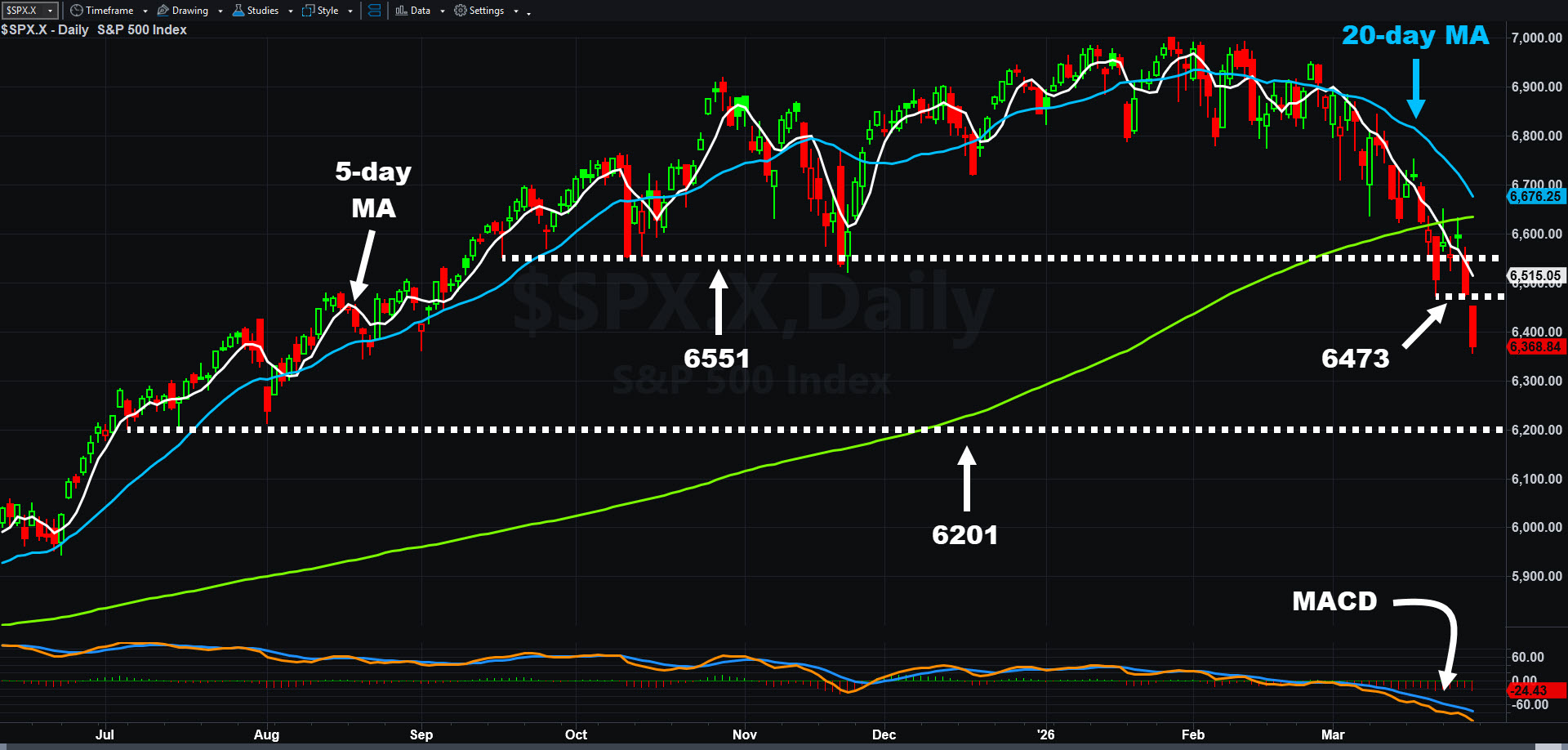
S&P 500, daily chart, with select patterns and indicators.
The index ended last week near the September low around 6,361. Given the apparent strength of the downtrend, chart watchers may look for support closer to 6,200 (near lows from July and August). They may also look for bounces toward 6,473, near the lows of April 20 and April 26.
Intermarket conditions could make traders expect further weakness. Cboe’s volatility index (VIX) had its first weekly close above 30 since last spring’s Liberation Day selloff. VIX often peaks at higher levels, which would imply lower prices.
The 10-year U.S. Treasury yield and U.S. dollar index have also climbed from lows earlier this year. (Both moves are consistent with expectations that high inflation will result in higher interest rates.) Higher Treasury yields could hurt economic activity and stock-market multiples. A stronger greenback could also hurt risk appetite overall.
This week only has four trading sessions because of Good Friday. While there are some important economic events, military developments could remain the big movers.
Federal Reserve Chairman Jerome Powell will participate in a Harvard University economics panel at 10:30 a.m. ET today. It’s unclear whether he will discuss monetary policy.
Tomorrow brings the JOLTs job openings report for February and consumer confidence for March. Nike (NKE) reports earnings in the afternoon. Tuesday also marks the end of the first quarter.
February’s retail sales report is on Wednesday morning. The Institute for Supply Management’s manufacturing report and crude-oil inventories are also due.
Thursday brings Challenger Gray’s job cut report and initial jobless claims.
The Labor Department’s key non-farm payrolls report is due on Friday morning despite the market being closed.

Vertiv has been a quiet beneficiary of the AI boom and now it’s getting noticed.

Stocks are whipsawing after the White House suggested it may de-escalate the Iran war.

Volatility is rising as geopolitical and economic risks increase. How will natural born traders react?