Stocks Face Major Uncertainty as War Erupts

AI Stock ‘Stays Cool’ as Iran War Rages
Vertiv has been a quiet beneficiary of the AI boom and now it’s getting noticed.

Call toll-free 800.328.1267
Stocks face massive uncertainty as war erupts in the Middle East, threatening global oil supplies.
S&P 500 futures dropped about 1 percent on Sunday evening after the attack on Iran. Crude-oil futures jumped about 8 percent after Tehran pledged to block traffic from the Persian Gulf and attacked tankers. That creates the risk of inflation and an economy-shaking loss of confidence.
The news comes after negativity had already begun swirling around AI datacenters. Moody’s Ratings said hyperscalers have $662 billion of off-balance sheet lease commitments. CoreWeave (CRWV), which runs AI infrastructure inside data centers, issued weak guidance and aggressive capital-spending plans. Bain also highlighted weakness in the private-equity industry as sponsors holding trillions of dollars in assets struggle to exit positions profitably.
Are cracks emerging in the AI investment boom, a key driver of economic growth? Investors might think so. They dumped banks, which had their biggest weekly drop since last year’s Liberation Day tariffs. Financials also fell and are now the worst-performing sector on a year-to-date basis. At the same time, safe havens like utilities, consumer staples and health care climbed. Such price action may reflect worries about a potential recession.
| KeySight Technologies (KEYS) | +26% |
| Paramount Skydance (PSKY) | +26% |
| Axon Enterprise (AXON) | +25% |
| Netflix (NFLX) | +22% |
| Dell Technologies (DELL) | +21% |
| Source: TradeStation data |
Another shock came on Friday morning when the Labor Department reported that the producer price index (PPI) rose 0.5 percent in January, higher than the 0.3 percent gain expected by economists. The core rate jumped 0.8 percent, almost triple the estimates, on higher services. Initial jobless claims were also lower than expected.
Combined with rising energy costs, those numbers may revive worries about inflation and undermine hopes of the Federal Reserve cutting interest rates in June.
Separately, FactSet reported that analysts are lowering earnings estimates for the first time in three quarters. UBS downgraded U.S. equities, citing risks to the dollar, high multiples and uncertain policies. Bank of America strategist Michael Hartnett also said international stocks may outperform domestic markets, in part because of AI disruption.
Speaking of AI disruption, Block (XYZ) said it will cut about 40 percent of its workforce as machines automate work. The stock jumped 17 percent on Friday, its biggest rally in over three years. (XYZ was formerly known as Square and is run by Jack Dorsey.)
Keysight Technologies (KEYS) rose the most in the S&P 500 and had its biggest weekly gain ever. The provider of network-testing equipment beat earnings and revenue estimates thanks to strong AI and military demand.
Paramount Skydance (PSKY) and Netflix (NFLX) rallied as their bidding war for Warner Bros. Discovery (WBD) ended. Both stocks fell during the contest, which concluded with NFLX walking away.
Quarterly results lifted Axon Enterprise (AXON) and Dell Technologies (DELL).
| First Solar (FSLR) | -18% |
| KKR (KKR) | -13% |
| Apollo (APO) | -13% |
| Zebra Technologies (ZBRA) | -12% |
| Emcor (EME) | -11% |
| Source: TradeStation data |
Precious metals were the strongest group overall last week. Biotechnology and energy also climbed.
Aside from banks, solar-energy stocks, airlines and homebuilders fell.
Utilities were the leading sector on the week and ended February with their biggest monthly gain since 2000.
Two of the biggest decliners were KKR (KKR) and Apollo (APO) amid the weakness in private equity.
The S&P 500 fell 0.4 percent last week and 0.9 percent last month. The index has stayed between roughly 6,800 and 7,000 all year. Even with last night’s drop, it appeared to hold the lower end of the range.
Some chart watchers may consider the price action to be neutral and indecisive. Bulls might take confidence in 6,800 holding and the index staying above its 100-day moving average. They could also think that falling bond yields and weakness in the U.S. dollar will support risk appetite.
The advance/decline (A/D) line hit a new record high last week, a potentially positive sign of breadth.
Bears, on the other hand, may think the S&P 500 is at risk of stalling below 7,000. They may think the narrow movement shows a loss of momentum.
Sentiment surveys have grown more negative. The American Association of Individual Investors has the least bullish and most bearish mix since November. The National Association of Active Investment Managers shows the least exposure to stocks since last May. Contrarians may view that as potentially positive, with money on the sidelines.
Overall, investors may take signals from the current range. They could view a move above 7,000 as a bullish breakout, but see downside risk if the index breaks 6,800.
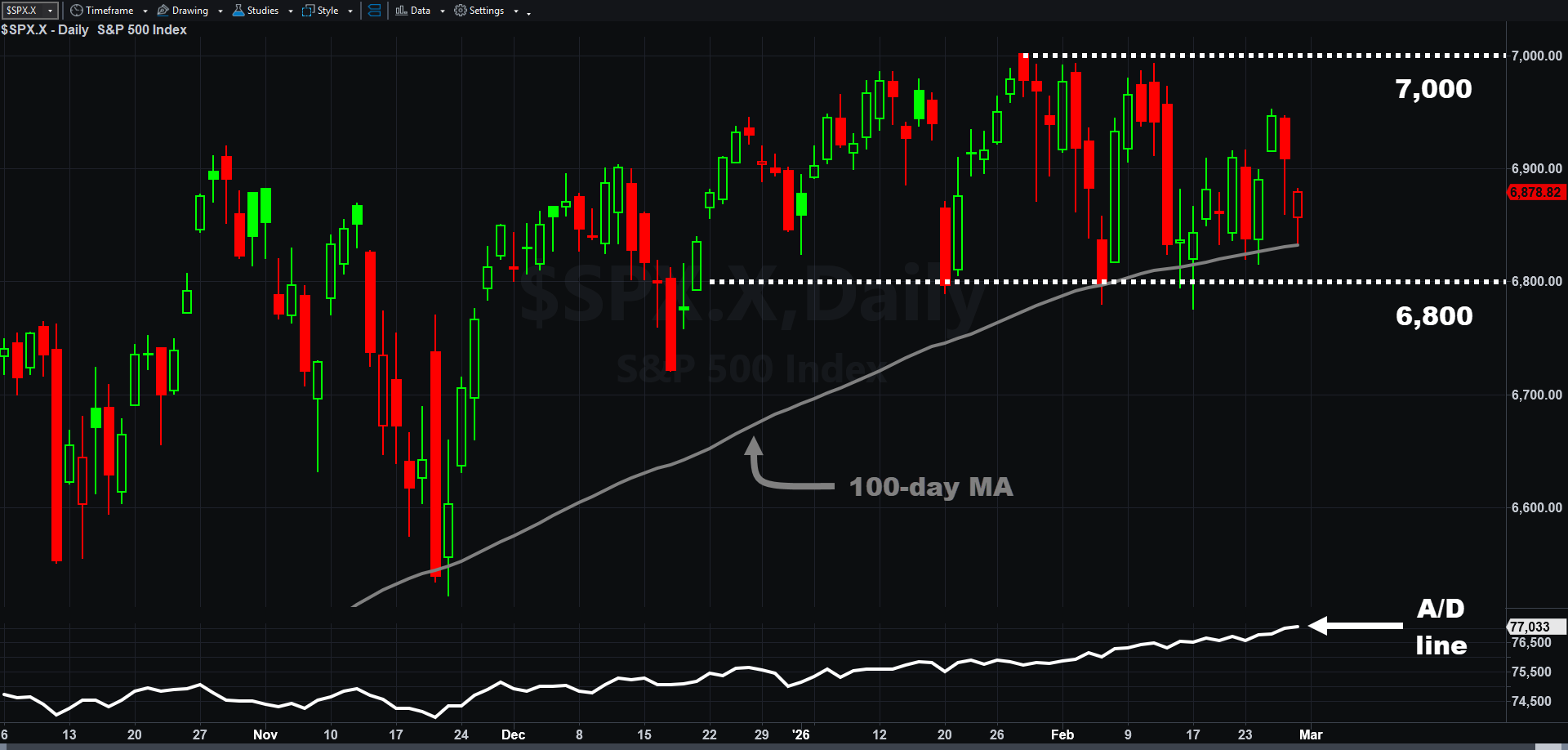
S&P 500, daily chart, with select patterns and indicators.
A few important events are scheduled this week. However, given the uncertain situation in the Middle East, geopolitical developments could exert a greater influence on the market.
The Institute for Supply Management’s manufacturing index is due this morning.
Tomorrow brings results from Best Buy (BBY) and CrowdStrike (CRWD).
ADP’s private-sector payrolls report is on Wednesday morning, along with ISM’s services index and crude-oil inventories. Broadcom (AVGO) reports in the postmarket.
Initial jobless claims are on Thursday morning. Ciena (CIEN), Costco (COST), Gap (GAP) and Marvell Technology (MRVL) are some of the noteworthy companies issuing results.
The week concludes with February’s non-farm payrolls and January’s retail sales on Friday morning.

Vertiv has been a quiet beneficiary of the AI boom and now it’s getting noticed.

Stocks are whipsawing after the White House suggested it may de-escalate the Iran war.

Volatility is rising as geopolitical and economic risks increase. How will natural born traders react?