Your opportunity is five cents wide: the put credit spread strategy

Volatility Is Rising. How Do Born Traders React?
Volatility is rising as geopolitical and economic risks increase. How will natural born traders react?

Call toll-free 800.328.1267

The market’s been grinding higher for a week. Your technical thesis is strong: support is holding, volume is confirming, and the stock looks like it wants to base here before the next leg up.
You’re not looking for a home run. You want a put credit spread that collects premium below the action while the stock does what you think it’s going to do: a relaxed move to the upside.
Implied volatility is low. The premiums aren’t rich. But that’s the point. You’re not selling premium because it’s expensive; you’re selling it because your directional thesis is now and the market’s own volatility pricing supports the range-bound outcome you’re betting on.
Low IV means the market is pricing in a tight range. You want to sell a put spread below support, collect a credit, and let your thesis, backed by accelerating theta decay, do the work over the next several sessions. Just remember, as expiration approaches, theta accelerates but so does gamma, meaning P&L swings can get sharper in both directions.
In low IV, you’re paid less for the same defined risk, so your edge depends more on strike placement, liquidity, and execution. Simple thesis. Defined risk. Textbook setup. But when you try to execute it on your current platform, it gets complicated.
You open the options chain and start hunting. You’re scrolling through expirations, mentally estimating delta, trying to remember the IV percentile from a different screen. You find a strike pair that looks right, but you can’t see the probability of the option expiring out of the money without switching to another tab. You estimate the credit. You calculate the max loss in your head. Close enough.
You enter the short leg. Filled, but the bid was already a penny thinner than your model priced. Now you enter the long leg. The ask has run three cents against you while you were navigating between tickets. You chase it. Filled.
By the time both legs are on, you’re four cents worse than your original model. Your target credit was $0.50. You got $0.46.
Four cents. That’s 8% of your planned max profit surrendered to execution friction before the position even starts working.
You were right on the thesis. You were right on the timing. But imprecise execution charged you an invisible tax for the privilege of being slow.
When you’re selling premium in a high-IV environment, slippage is a nuisance. Your target credit was $2.50. You slipped a nickel. That’s 2% of your planned max profit. It’s annoying, but survivable.
When you’re selling premium in a low-IV environment, slippage can be a crippling cost. Your target credit was $0.50. You slipped the same nickel. That’s 10%. Your risk-to-reward just shifted from manageable to marginal.
This is the regressive nature of the “retail tax” you often have to pay to use subpar platforms. It tends to hit hardest when your edge is thinnest. And in a low-IV put credit spread strategy, your edge is thin by design. You’re not betting on an explosion. You’re betting on stability. The math works when every variable is precise: the right strikes, the right credit, the right fill.
But precision requires infrastructure. You can’t achieve it by tabbing between windows, mental-math-ing your breakeven, and legging into a two-contract spread like it’s 2009.
Your strategic mind deserves a platform that shows you the full risk picture before you commit a dollar. One that lets you build the spread as a single instrument and route it as a single package.
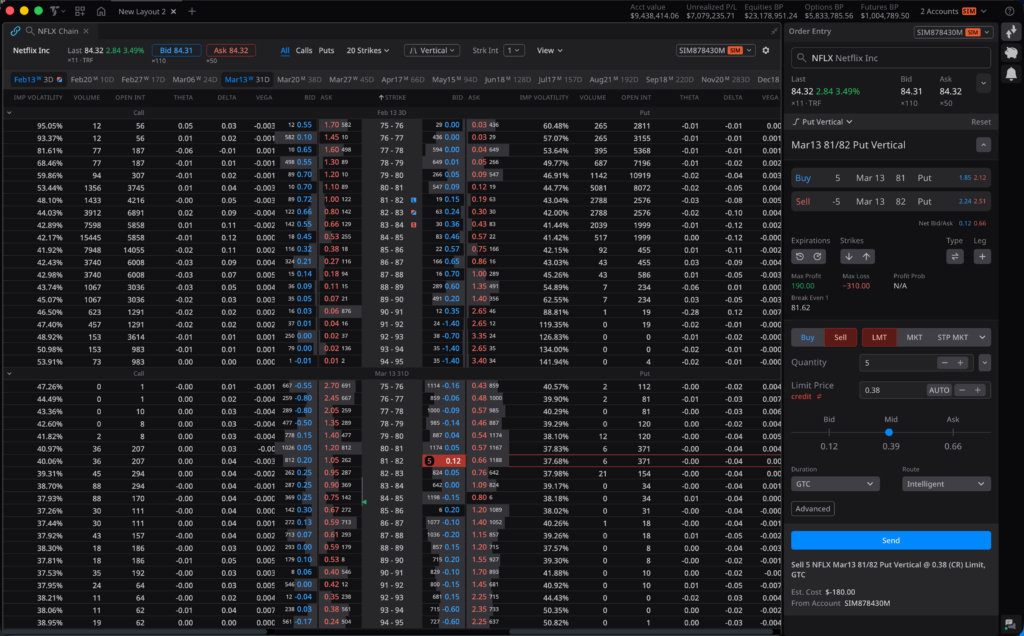
This is where you stop wrestling with your interface and start operating with the efficiency your thesis warrants. TITAN X compresses the entire analysis-to-execution cycle into a single environment: no toggling, no estimating, no manual calculations.
Forget switching between screens to piece together the data you need. In TITAN X, you load the options chain with customizable columns that display exactly what matters for this trade.
You add delta, implied volatility, open interest, and volume – all inline and streaming in real time. You’re not estimating anything. You’re reading the numbers directly from the chain.
The current stock price is highlighted in the strike column. The yellow separator marks the at-the-money boundary. Below it, you see the out-of-the-money puts you’re targeting. You filter the chain to puts only and select the weekly expiration eight days out, enough time for the thesis to play out without overpaying for time value you don’t need.
Your thesis says the stock holds above $142. You scan the strike column. The $140 put shows a delta of -0.20 and roughly an 80% probability of expiring out of the money. The $135 put (your long protection) sits at a delta of -0.08. You can see the bid-ask spread on both contracts. You can see where the open interest is concentrated, telling you exactly where the liquidity lives.
You haven’t opened a separate analytics window. You haven’t punched a single number into a calculator. The chain delivered the full picture in seconds.
You’ve identified your strikes. Now you build the trade.
You click into TITAN X’s spread selector, which pre-fills both legs of your put credit spread with a single action. No manual entry of each contract. No risk of fat-fingering a strike or selecting the wrong expiration. The trade ticket slides in from the right, already populated with your short and long legs.
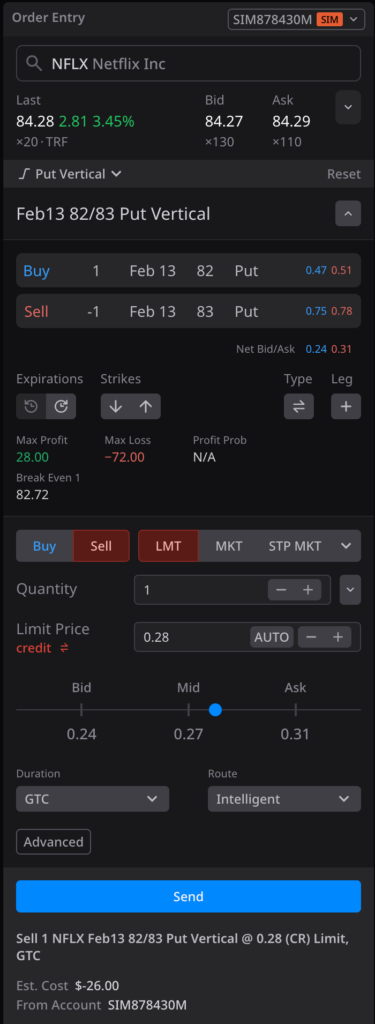
This is where TITAN X separates itself from a basic order ticket. Before you route anything, the trade ticket displays your max profit, max loss, and breakeven, calculated automatically, updating in real time as you adjust.
You see the net credit: $0.48. You see the max loss: $4.52. You see the breakeven: $139.52. And because you’ve added probabilities to your chain columns, you already know the short strike’s likelihood of expiring out of the money. The spread’s probability of profit runs slightly higher still, because your breakeven sits below the short strike by the amount of the credit received. You know the exact risk profile of this trade before you touch the Send button.
Want to test a tighter spread? Click a different long strike. The P&L calculations recalculate instantly. Want to push the short strike further out of the money? Click it. New credit, new max loss, new breakeven, all right there.
You’re not guessing. You’re iterating in real time. And you’re doing it in the same window where you’ll execute. There’s no translation layer between your analysis and your action.
For traders who want to stress-test the position across multiple scenarios simultaneously (what happens if IV spikes, if the stock drops 3%, if you hold through a specific date), OptionStation® Pro on the TradeStation desktop platform offers 3D risk graphs that project P&L across price, time, and volatility dimensions. But for the core put credit spread entry, the inline data in TITAN X’s chain and trade ticket gives you what you need without switching platforms.
When the numbers confirm the edge, you move to execution.
This is the moment that separates professional infrastructure from a retail workaround. You click Send, and your put credit spread is routed as a single, complex order.
You’re not legging in. You’re not entering the short put first, then scrambling to buy the long put while the market ticks against you. The spread is transmitted as one package. Both legs are handled together.
TradeStation utilizes intelligent order routing technology designed to seek the best available execution for complex options spreads. Your order routes to eligible venues based on TradeStation’s intelligent routing logic, seeking efficient fills for the package rather than the individual components.
For traders who want to work the order, TITAN X lets you set a limit on the net credit. You don’t just accept whatever the market offers. You name your price. If you want $0.50 credit instead of the $0.48 natural, you set the limit and let the order work.
The difference between $0.48 and $0.50 on a 10-lot is $20. Over the course of a year, tighter fills on every spread entry can help you retain more of your edge instead of surrendering it to execution friction.
This is how you fight the retail tax. Not by trading less, but by executing with better tools.
Put credit spreads are defined-risk strategies, but defined risk does not mean negligible risk. If the underlying stock drops sharply through your short strike, you can face the maximum loss on the position: the width of the spread minus the credit collected. In low-IV environments, the premium collected is smaller, which means the risk-to-reward ratio may be less favorable than in higher-volatility conditions. Additionally, low IV does not guarantee that the stock will remain range-bound. And if volatility spikes before expiration, the spread’s mark-to-market value can move against you temporarily, even if the stock hasn’t breached your strike. Unexpected catalysts (earnings surprises, macroeconomic data, sector rotation) can produce moves that exceed the market’s implied range. Professional execution tools help reduce operational friction, but they cannot eliminate directional market risk. Size your positions appropriately and never allocate more capital to any single trade than you can afford to lose.
In a low-IV environment, your put credit spread strategy lives or dies on the details. The thesis isn’t complicated. The math isn’t exotic. The detail in the execution matters: the exact strikes, the precise credit, the clean fill.
Stop building two-leg spreads with a one-leg interface. Stop giving away a dime on every entry because your platform can’t route a complex order as one package. Stop accepting a workflow that forces you to calculate breakeven in your head while the market moves.
Open TITAN X. Load the chain. See your edge in real time. Build the spread in one click. Route it as a single package. Fight for every cent.
Trade like you were born to do this.
Disclosure:
This content is for educational and informational purposes only. Any symbols, financial instruments, or trading strategies discussed are for demonstration purposes only and are not research or recommendations. TradeStation companies do not provide legal, tax, or investment advice. Past performance, whether actual or indicated by historical tests of strategies, is no guarantee of future performance or success. There is a possibility that you may sustain a loss equal to or greater than your entire investment regardless of which asset class you trade (equities, options or futures); therefore, you should not invest or risk money that you cannot afford to lose. Before trading any asset class, first read the relevant risk disclosure statements on www.TradeStation.com/Important-Information/.
Futures trading is not suitable for all investors. To obtain a copy of the futures risk disclosure statement visit www.TradeStation.com/DisclosureFutures.
Options trading is not suitable for all investors. Your TradeStation Securities’ account application to trade options will be considered and approved or disapproved based on all relevant factors, including your trading experience. See www.TradeStation.com/DisclosureOptions. Visit www.TradeStation.com/Pricing for full details on the costs and fees associated with options.
IMPORTANT: The projections or other information generated by OptionStation® Pro regarding the likelihood of various investment outcomes are hypothetical in nature, do not reflect actual investment results and are not guarantees of future results.
Margin trading involves risks, and it is important that you fully understand those risks before trading on margin. The Margin Disclosure Statement outlines many of those risks, including that you can lose more funds than you deposit in your margin account; your brokerage firm can force the sale of securities in your account; your brokerage firm can sell your securities without contacting you; and you are not entitled to an extension of time on a margin call. Review the Margin Disclosure Statement at www.TradeStation.com/DisclosureMargin.

Volatility is rising as geopolitical and economic risks increase. How will natural born traders react?

The U.S. Dollar index flirted with multiyear lows in January, but now momentum could be building in the other direction.

Stocks have been crumbling as stagflation and war dominate sentiment.