Stocks Keep Sailing as Volatility Eases

Can Semiconductor Stocks Withstand an Oil Shock?
Semiconductors have led stocks higher since the AI rally began, but they may face new risks as oil prices jump.

Call toll-free 800.328.1267

Stocks are sailing higher as the AI boom continues, with few signs of volatility on the horizon.
The S&P 500 rose 1.6 percent between Friday, July 18, and Friday, July 25. The index made a new all-time high for the fifth straight week, with every major sector advancing.
While there were plenty of headlines, the dominant narrative seemed to be spreading calm. Here are some examples.
First, President Trump continued to criticize Federal Reserve Chairman Jerome Powell. He even made an unusual visit to the central bank, but in the end didn’t attempt to fire the Fed chief.
Second, the White House concluded its trade war with Japan. Global equities rallied in response. The president has signaled more deals could be coming before a self-imposed deadline this week.
Third, Alphabet (GOOGL) reported strong quarterly results. The Internet giant also increased its capital-spending budget from $75 billion to $85 billion. That helped confirm that money is still flowing into datacenters and AI equipment, boosting sentiment toward the broader technology sector.
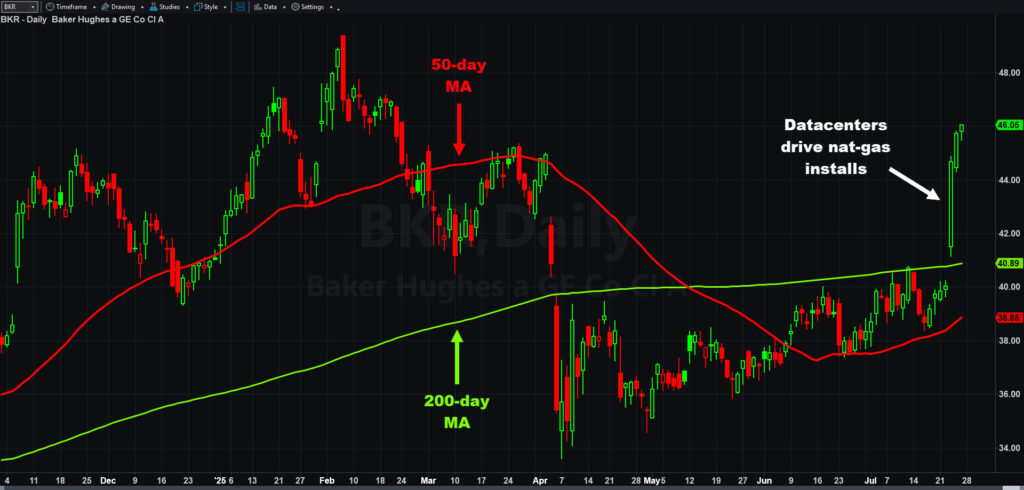
Baker Hughes (BKR), daily chart, with select indicators and events. The AI boom extends to an oilfield servicer.
Fourth, meme stocks made a comeback as traders targeted beaten-down companies like GoPro (GPRO), Kohl’s (KSS) and Beyond Meat (BYND). There’s also a renewed focus on mergers with railroad CSX (CSX) reportedly targeting Norfolk Southern (NSC). JPMorgan’s global head of advisory, mergers and acquisitions, Anu Aiyengar, also told Reuters that corporate boards increasingly want to “think bold and act as opposed to waiting for certainty.”
Fourth, beaten-down groups like health care and homebuilders leaped on strong earnings.
Fifth, Treasury yields retreated after rising the three previous weeks.
All those events helped push Cboe’s volatility index (VIX) to its lowest level since February. That’s consistent with confidence in market conditions and relative lack of selling pressure.
Economic news supported the positive backdrop. Initial jobless claims fell more than expected to a three-month low and durable goods orders surprised to the upside. The Treasury Department also reported strong demand in an auction for 20-year bonds, easing worries about longer-term borrowing costs.
Healthcare, the worst-performing sector in the past year, was the leading sector last week. It rose 3.5 percent, the most in almost three years, and accounted for some of the biggest gainers in the S&P 500. Drugmaker West Pharmaceutical Services (WST) and life-sciences company Iqvia (IQV) jumped on better-than-expected earnings and revenue.
| West Pharmaceutical Services (WST) | +25% |
| Lamb Weston (LW) | +24% |
| Iqvia (IQV) | +24% |
| TE Connectivity (TEL) | +16% |
| Baker Hughes (BKR) | +16% |
| Source: TradeStation data |
Potato processor Lamb Weston (LW), which has been sliding for two years, jumped on hopes of a potential turnaround. TE Connectivity (TEL) and Baker Hughes (BKR) also beat estimates. While their businesses are different (cables/connectors vs. oil & gas services), both benefited from AI demand.
Homebuilders rallied after DR Horton (DHI), PulteGroup (PHM) and Mohawk Industries (MHK) reported strong quarterly results. Gold miners, metals and solar energy also climbed.
Banks and airlines were the weakest performers, according to TradeStation Data.
Last week saw the AI boom spread to new companies profiting from the technology:
| Charter Communications (CHTR) | -19% |
| Texas Instruments (TXN) | -15% |
| Fiserv (FI) | -14% |
| LKQ (LKQ) | -13% |
| Chipotle Mexican Grill (CMG) | -13% |
| Source: TradeStation data |
Last week’s big decliners in the S&P 500 all fell in reaction to their quarterly results.
The S&P 500 has steadily moved higher since late June, with few potentially bearish signals.
Prices have remained above the 8-day exponential moving average. Index members making new 52-week highs last week reached levels last seen in March. The advance/decline line also set a new record. Those patterns potentially confirm positive market conditions.
Wilder’s Relative Strength Index (RSI) ended last week at its highest level in over a year. While that may suggest that prices are overextended, elevated RSI can also show the presence of a strong uptrend.
Traders looking for potential pullbacks or volatility may eye events on Wednesday, which features key economic and earnings news.
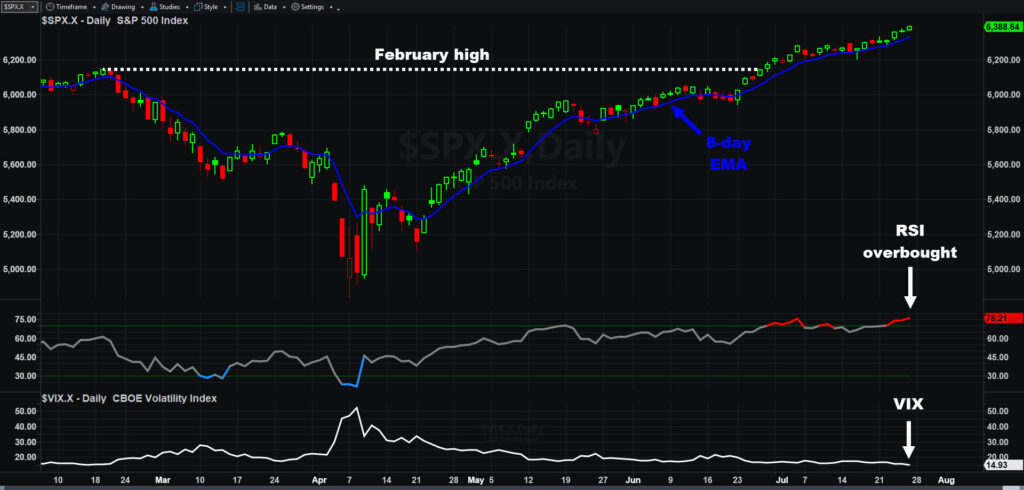
S&P 500, daily chart, with select patterns and indicators.
It’s the busiest week in earnings season, with more than one-third of the S&P 500 announcing results.
Few major events are scheduled for today.
Tuesday brings the JOLTs job openings report and consumer confidence. Boeing (BA), UnitedHealth (UNH), Visa (V) and Seagate Technology (STX) are some of the big companies releasing quarterly numbers.
Wednesday begins with gross domestic product in the premarket. The Fed makes its interest-rate announcement at 2 p.m. ET, followed by Powell’s press conference about 30 minutes later. The post-market session includes results from a pair of trillion-dollar companies: Microsoft (MSFT) and Meta (META). Robinhood (HOOD), Ford Motor (F), Qualcomm (QCOM), Western Digital (WDC), Arm (ARM) and are also on the agenda.
Thursday features the personal consumption expenditures (PCE) inflation report, plus initial jobless claims. Apple (AAPL), Amazon.com (AMZN) and Coinbase Global (COIN) report in the postmarket.
Friday morning brings the key monthly employment report for July. Exxon Mobil (XOM) and Chevron (CVX) announce results as well.

Semiconductors have led stocks higher since the AI rally began, but they may face new risks as oil prices jump.

After a long bidding war for Warner Bros. Discovery, one big options trader is looking for the current deal to go through.

Apple has done little for a long time, and some traders may think the tech giant is rolling over.